Table of Contents
Round Rock is not short on renters. It’s short on the right site, the right zoning fit, and the patience to get both of those things aligned before a shovel goes in the ground. With roughly 21,000 apartment units already in the submarket and thousands more under construction across the broader Austin region, the question facing developers isn’t whether Round Rock can support multifamily housing. It’s whether a given parcel, a given zoning path, and a given renter thesis can survive a market where oversupply, not undersupply, is the live risk.
The city’s growth pattern makes the opportunity obvious on paper. Dell Technologies and the North Austin technology corridor anchor one side of town. Baylor Scott & White, Ascension Seton Williamson, and St. David’s Round Rock Medical Center anchor another. Amazon, UPS, Emerson, Kalahari Resorts, and the Round Rock Premium Outlets round out a labor market that draws commuters from Georgetown, Pflugerville, and the wider Austin metro. IH-35, SH 45, SH 130, and US 79 stitch it all together. That’s the pitch every broker will give you.
What the pitch usually skips is the part where zoning, platting, traffic impact review, and roadway impact fees decide whether the project actually pencils, and whether it opens on schedule.
Where should multifamily developers target sites near Round Rock’s employers and highways?
The strongest apartment sites in Round Rock share a specific set of traits, and freeway frontage isn’t the most important one. A defensible site sits within a five to fifteen minute drive of a major employment center, connects to a collector or arterial road rather than a single congested driveway, and has confirmed water and wastewater capacity before the land contract is signed. It also sits outside meaningful floodplain exposure and near enough daily-needs retail, groceries, and childcare that residents aren’t driving twenty minutes for a gallon of milk.
A site tight against IH-35 with no pedestrian access, constant highway noise, and no nearby retail can underperform a less visible parcel with better neighborhood infrastructure. Visibility sells land. Access, utilities, and daily convenience sell leases.
Five submarkets currently offer the clearest paths to entitlement and absorption:
IH-35 and SH 45. This corridor has the strongest regional accessibility in the city and proximity to planned mixed-use activity at The District. It also carries the highest land costs, the most freeway noise, and the greatest risk of several competing phases delivering into the same leasing season. Mid-rise or podium product integrated with retail and public space tends to outperform an isolated garden complex ringed by surface parking here.
The Dell and North Austin employment corridor. Renter demand here skews toward technology and professional workers who want flexible, amenity-rich units, but office and tech employment runs cyclical, and the corridor already carries substantial suburban apartment competition. Underwriting that leans on one employer is underwriting a single point of failure.
The medical corridor. Nurses, residents, medical technicians, and traveling clinical staff create a renter base that’s arguably more resilient than tech-driven demand, since healthcare employment doesn’t move with the economic cycle the way office employment does. Shift-based traffic patterns don’t always match conventional peak-hour assumptions, though, and this renter pool tends to be price-sensitive, so the product needs sound insulation, secure access, and flexible lease terms more than it needs a rooftop pool.
US 79, Kalahari, and Dell Diamond. Large parcels and existing regional draws make this area suitable for master-planned residential paired with hospitality and entertainment uses, but hospitality wages don’t always support premium rents, and event traffic creates its own congestion pattern. Workforce and moderate-rent product tends to fit better here than luxury positioning.
Northeast Round Rock and Avery. This is greenfield territory with room for phased communities that blend apartments, townhomes, parks, and neighborhood retail. The tradeoff is that infrastructure often arrives ahead of demand, and commute times to established employment centers run longer until planned arterials are complete.
Downtown and the area south of downtown round things out as a smaller-scale opportunity, better suited to adaptive reuse, boutique multifamily, and apartments over retail than to a large garden-style project, given fragmented parcels and tighter construction staging.
What is the entitlement process for multifamily projects in Round Rock?
Round Rock’s Development Code now distinguishes MF-1, MF-2, and MF-3 districts for low-, medium-, and high-density multifamily housing, and which district applies to a given parcel largely determines how much friction the project will face on its way to a certificate of occupancy.
If the site already carries the right MF designation, the path runs through site plan review, platting, a site-development permit, and building permits, roughly in that order. If the zoning allows multifamily but not the density, height, or configuration a developer actually wants, or if the site sits under commercial, mixed-use, single-family, or agricultural zoning, the project needs a rezoning, a Planned Unit Development, or a PUD amendment before anything else moves forward.
For most large-scale garden, podium, or transit-oriented projects, a PUD is the more useful tool. It lets a development team negotiate unit counts, building heights, setbacks, parking ratios, amenity standards, access points, phasing, and buffering as a customized package rather than fitting the project into a standard district’s limits. Round Rock has approved multifamily through this mechanism before. PUD No. 139, near South Mays Street and East Logan Street, was amended to permit high-density apartments, townhomes, and attached single-family units following an earlier approval for a 410-unit high-density project with structured parking, and a separate PUD near Kenney Fort Boulevard advanced urban-style multifamily alongside single-family and townhouse components across from Kalahari.
The sequence from there generally runs through ten stages: site control and feasibility review, confirmation of the zoning pathway, a pre-application meeting with Planning and Development Services, rezoning or PUD approval, public hearings, platting and subdivision, traffic and roadway impact fee review, site-development approval, phased building permits, and finally inspections leading to certificates of occupancy. Each stage carries its own timeline risk. A site plan can be technically flawless and still stall for months if the traffic study doesn’t account for shift-change patterns at a nearby hospital, or if a plat hasn’t accounted for how a future phase will be financed and sold separately from the rest of the project.
Roadway impact fees add a real cost line to the pro forma. For property with a final plat recorded on or after January 1, 2024, the city’s ordinance sets a residential rate of $1,507 per service unit, subject to the applicable calculation, offsets, and any amendments in effect at the time of application. That number shouldn’t go straight into an underwriting model without confirming the current ordinance, service area, and plat date against the city’s current fee schedule, since these figures are revised.
This is where an entitlement-focused firm earns its fee before the first design drawing is finalized. JDJ Consulting’s Round Rock permit expediting and entitlement team works through zoning confirmation, PUD strategy, plat sequencing, and impact fee coordination with the city on behalf of developers, which is often the difference between a project that clears entitlements in a predictable window and one that discovers a fatal zoning mismatch after the land is already under contract.
Is Round Rock’s apartment market oversaturated?
Not uniformly, but the numbers deserve a hard look before anyone assumes this market absorbs everything. Cushman & Wakefield’s Q4 2025 Austin multifamily report put the Round Rock submarket at roughly 21,082 existing units, with 252 units under construction, another 217 in the pipeline, and average asking rent near $1,415. Regionally, the broader Austin market carried around 14,600 units under construction as of Q1 2026, with average asking rents near $1,500 and rent growth down 4.7% year over year.
Read together, those figures point to a market where the constraint isn’t renter demand in the abstract. It’s competing supply landing in the same submarket at the same time. Conventional garden apartments near IH-35, luxury product marketed mainly on finishes and amenities, and large projects without a distinct location or renter thesis are the formats most exposed to concessions and slower lease-up.
The less crowded lanes tend to be workforce housing near hospitals and logistics employers, smaller units built for single professionals and shift workers, furnished or flexible-term housing, townhome-style rentals, and mid-market product positioned below the luxury ceiling. Round Rock isn’t one apartment market. A project near Dell, a project near the medical corridor, and a project near Kalahari draw from different renter pools with different rent ceilings, and treating them as interchangeable is how a strong location ends up with a mediocre lease-up.
What risks does each stakeholder face on a Round Rock multifamily project?
Every participant in a multifamily deal is managing a different risk profile, and misreading another party’s priorities is a common source of delay.
| Stakeholder | Primary risks |
| Developer | Rezoning or PUD approval timelines, unit-count limits, neighborhood opposition, infrastructure sequencing, absorption against competing deliveries, roadway impact fees |
| Architect | Building height and massing limits, fire access, parking geometry, accessibility compliance, noise mitigation, compatibility with adjacent single-family areas |
| Civil engineer | Drainage and detention design, utility upsizing, floodplain constraints, driveway spacing, tree preservation requirements |
| General contractor | Site logistics across phases, subsurface conditions, material cost escalation, fire-access compliance, coordination across multiple buildings |
| Investor or lender | Rent growth assumptions, concessions, lease-up duration, operating expense creep, exit cap rate, employer concentration risk |
| Property manager | Lease-up pacing, parking allocation, resident security, amenity operations, turnover management |
| Nearby residents | Traffic, density, building height, privacy, drainage impact, school capacity, construction disruption |
| Public agencies | Traffic and fire response capacity, utility loads, drainage, and whether the project delivers the infrastructure and housing outcomes it promised |
The developers who move fastest through hearings are usually the ones who’ve already answered the neighborhood’s questions before the public meeting, not the ones relying on the meeting itself to make the case.
What incentives and financing tools apply to Round Rock multifamily projects?
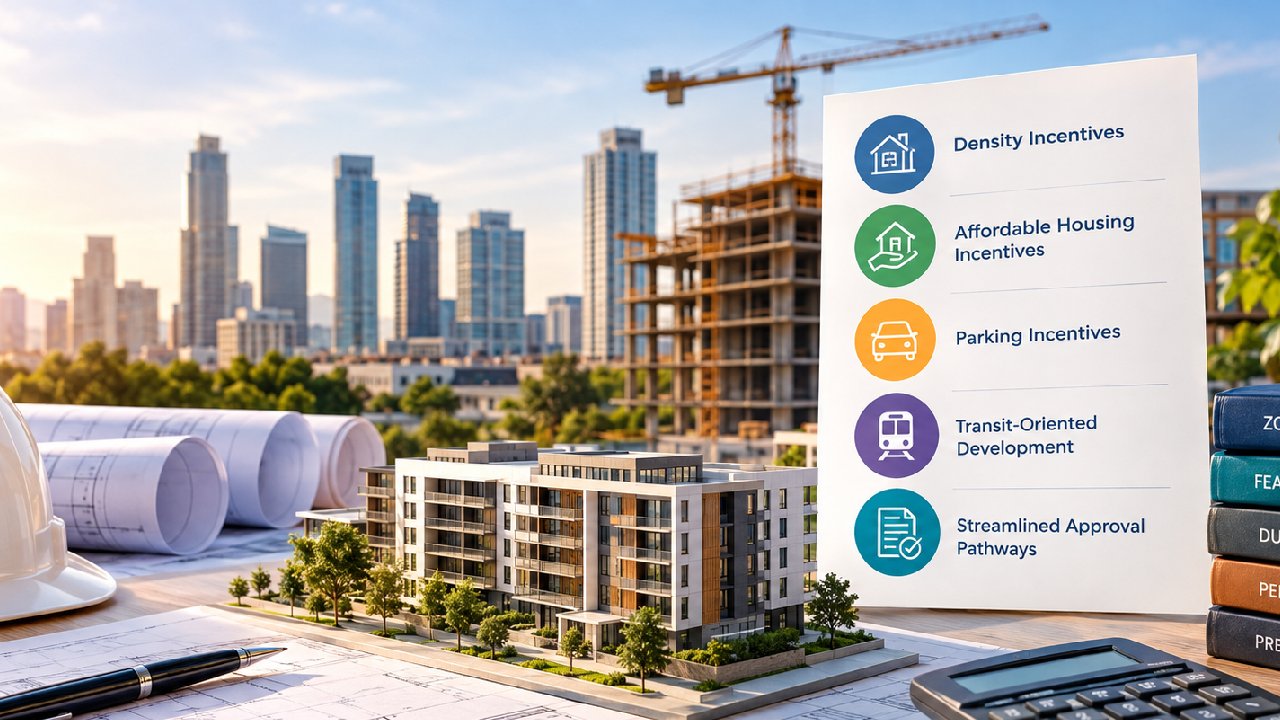
Round Rock negotiates Chapter 380 economic-development agreements on a case-by-case basis, and these can include property tax abatements, sales tax rebates, and fee reductions, generally capped at ten years with recapture provisions if the project doesn’t perform. A straightforward market-rate apartment deal has a weaker case for this kind of assistance than a project that pairs housing with job creation, workforce housing components, public infrastructure, or a redevelopment element the city has already prioritized.
Type B sales tax funds have supported infrastructure tied to large mixed-use projects in the city, and a Public Improvement District can help finance internal streets, enhanced landscaping, and district-level maintenance, though the assessment becomes a permanent operating cost that has to be reflected in rents and lender underwriting. A Tax Increment Reinvestment Zone may apply where the apartment project is part of a larger redevelopment or infrastructure district, and Municipal Utility District financing can help fund infrastructure in ETJ areas, though it comes with bond debt, annexation risk, and resident disclosure obligations that need underwriting before the land closes, not after.
Round Rock’s dedicated affordable housing programs are more limited than what larger Texas cities offer, so most workforce housing components rely on Low-Income Housing Tax Credits through TDHCA, tax-exempt private activity bonds, HOME or CDBG funds where eligible, or density and parking modifications negotiated directly through a PUD. None of these tools apply automatically, and each carries its own eligibility and compliance track that needs to run in parallel with the entitlement process rather than as an afterthought.
The most reliably useful form of public participation, in practice, tends to be infrastructure cost-sharing rather than tax abatement: off-site roadway improvements, utility extensions, drainage facilities, or structured parking negotiated as part of the PUD or development agreement.
Building a defensible strategy
The projects most likely to clear entitlements on schedule and lease up without heavy concessions tend to follow a consistent pattern. They pick the employment node first and define the renter profile before selecting a building type. They confirm zoning history, utility capacity, and floodplain status before the land contract is signed, and they underwrite nearby approved and under-construction projects, not just current occupancy. They use a PUD when the density or program doesn’t fit a standard MF district, and they build in noise, lighting, and pedestrian mitigation near highways from the start rather than adding it after community pushback. Most importantly, they avoid relying on a single employer or a single interchange to carry the leasing thesis.
A generic 300 to 400 unit luxury project next to an interchange is the format most exposed to oversupply and concessions right now. A mid-density project near employment and highway access, but paired with neighborhood retail, real pedestrian design, and a renter profile that isn’t identical to everyone else’s, is the format with room to differentiate.
Frequently Asked Questions
What zoning is required for multifamily development in Round Rock, Texas?
Multifamily projects need MF-1, MF-2, or MF-3 zoning, or a Planned Unit Development if the proposed density, height, or configuration doesn’t fit an existing district. Sites zoned single-family, agricultural, or commercial typically require a rezoning or PUD before multifamily development can proceed.
How long does multifamily entitlement take in Round Rock?
Timelines vary by zoning status and project scale, but a project requiring rezoning or a PUD should plan for a longer runway than one with confirmed MF zoning, since rezoning and PUD approvals require pre-application review, public hearings, and often community engagement before site-development permits can even be submitted.
What is the roadway impact fee for multifamily development in Round Rock?
For property with a final plat recorded on or after January 1, 2024, the city’s ordinance sets a residential rate of $1,507 per service unit, subject to the applicable calculation, offsets, and current amendments. Developers should confirm the current fee schedule with the city rather than relying on a fixed figure in underwriting.
Is the Round Rock apartment market oversupplied?
The submarket carried roughly 21,000 existing units as of late 2025, with several hundred more under construction and in the pipeline, and regional rent growth has recently trended negative. The risk is concentrated in conventional and luxury garden product competing for the same renter pool, not in the market as a whole.
What incentives are available for multifamily projects in Round Rock?
Available tools include Chapter 380 economic-development agreements, Type B sales tax fund participation, Public Improvement Districts, Tax Increment Reinvestment Zones, Municipal Utility District financing, and, for workforce housing components, Low-Income Housing Tax Credits and tax-exempt bonds. Eligibility depends heavily on the project’s public benefit and is negotiated case by case.
Navigating Round Rock’s zoning code, PUD process, and impact fee structure without a misstep takes more than a single pre-application meeting. JDJ Consulting works alongside developers, architects, and investors through the full entitlement path, from zoning confirmation and PUD strategy through permitting and certificate of occupancy, so projects move on schedule instead of stalling in review.