Table of Contents
On July 1, 2026, a parcel in Bay Park that had been zoned for a handful of townhomes for three decades became legally entitled to a mid-rise apartment building, without a single public hearing. Nobody rezoned it. No community plan amendment passed. No developer spent eighteen months in front of a planning commission. The state did it in one sentence of code.
That is the quiet violence of Senate Bill 79. It does not ask San Diego’s permission. It tells the city what a qualifying parcel near a trolley stop or a high-frequency bus line is now allowed to become, and it backs that instruction with a ministerial approval path that skips the discretionary review process entirely for projects that meet the standard.
For developers, architects, and investors who have spent years circling San Diego’s transit corridors waiting for the right moment, that moment technically already happened. But “technically eligible” and “actually buildable” are two very different things in this city right now, and the gap between them is where fortunes get made or quietly evaporate.
As of July 2026, qualifying SB 79 sites may allow up to 140 dwelling units per acre, 4.0 FAR, and 85 feet within 200 feet of a qualifying stop, with tiered reductions to 100 units per acre at a quarter mile and 80 units per acre at a half mile.
Those numbers are the headline. The story underneath them, the one that actually determines whether a project pencils, is far more interesting.
The Question Every San Diego Site Now Has to Answer
Ask most brokers whether a property qualifies for transit-oriented density and they will point to a map and a half-mile radius drawn in Google Maps. That instinct is understandable and it is also the single most expensive mistake being made in San Diego right now.
San Diego’s SB 79 eligibility is not a radius. It is a parcel-by-parcel determination that runs through the city’s official SB 79 Eligible Sites layer inside ZAPP, cross-referenced against zoning, affordability status, tenant protections, fire hazard severity, coastal jurisdiction, sea-level-rise exposure, and historic designation.
The distinction matters because San Diego did not implement SB 79 uniformly. The city phased it. Some station areas activated on the July 1, 2026 effective date. Others were pushed into a future Transit Village Plan process the city expects to bring before Council in early 2027. Still others, largely Low Resource Areas, will not activate until 2031.
The areas that took effect immediately on July 1, 2026 are concentrated around Bay Park and Clairemont along the Mid-Coast Trolley extension, the UC San Diego and University City area, and bus stops in North Park and Normal Heights, according to the City Planning Department.
SANDAG, the regional transit authority responsible for finalizing which stops qualify, has continued expanding the map even after the law’s effective date. What started as a narrow interpretation covering roughly four bus stops and San Diego’s forty-seven undisputed trolley stations grew through the spring and summer of 2026 into a much wider net, with dozens of additional bus stops added after SANDAG released its draft TOD map in June.
The practical implication for anyone underwriting a deal right now: the eligible-sites map you pulled in March may already be out of date. This is a live document, not a static one, and it will keep moving through at least 2027.
What SB 79 Actually Buys a Developer
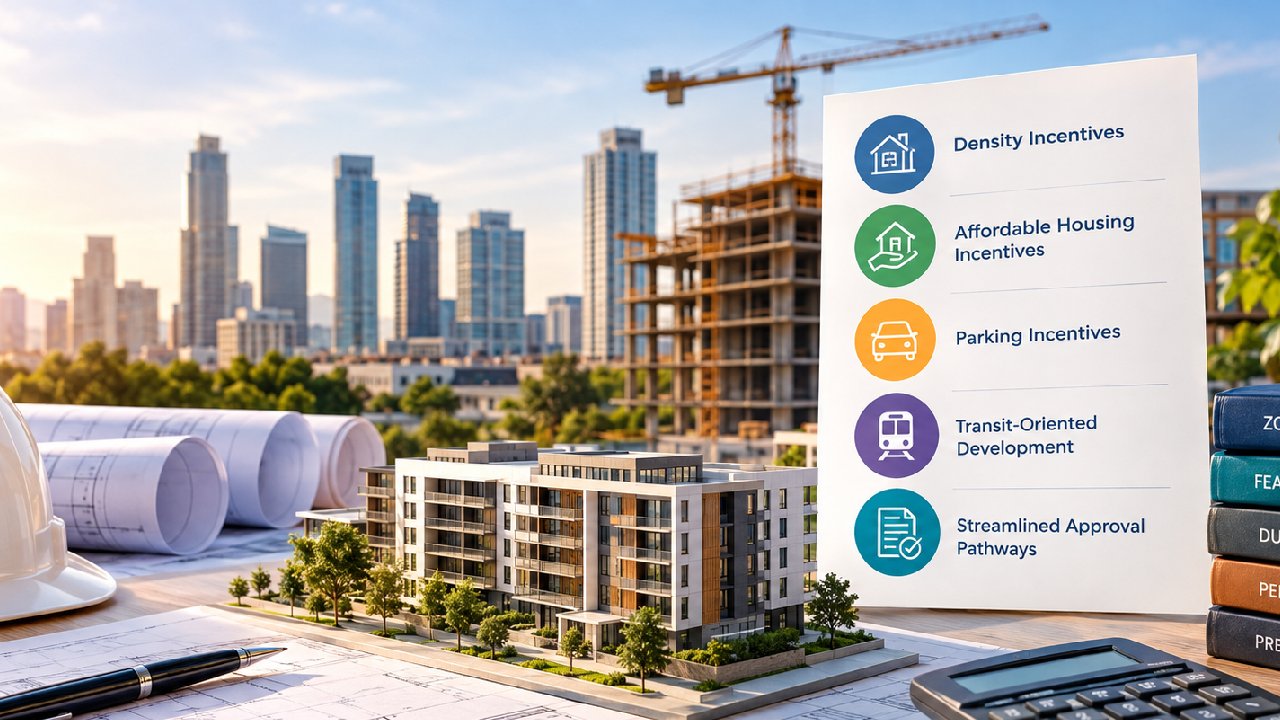
Strip away the legislative language and SB 79 does three things that matter to a pro forma. It raises the ceiling on density, height, and floor area ratio near qualifying stops. It converts the approval path from discretionary to ministerial for projects that meet the objective standard, cutting out the CEQA exposure and hearing risk that has slowed San Diego infill for a generation. And it lets a project use SB 79 density as the base for stacking State Density Bonus Law on top, which can push the achievable unit count meaningfully higher.
| Distance from Qualifying Stop | Max Density | Max FAR | Max Height |
|---|---|---|---|
| Within 200 feet | 140 units/acre | 4.0 | 85 feet |
| 200 feet to ¼ mile | 100 units/acre | 3.0 | 65 feet |
| ¼ mile to ½ mile | 80 units/acre | 2.5 | 55 feet |
The trade for that density is not free. Projects above ten units must set aside a minimum affordability share, generally 7% for extremely low-income households, 10% for very low-income, or 13% for lower-income units, whichever pathway a project selects. Buildings that push past 85 feet can trigger additional labor standards under state law. And a project has to comply with average unit-size limitations, dwelling-unit protection rules, and objective design standards before it ever gets to the building counter.
There is also a limit to what “ministerial” really means in practice. A qualifying SB 79 project in San Diego is processed as a Process One building permit, but that does not erase every other layer of approval. A site in the Coastal Overlay Zone still needs a Coastal Development Permit. Fire, grading, stormwater, and utility approvals still run on their own tracks. Ministerial removes the discretionary hearing and the CEQA fight. It does not remove the permit set.
Why the Density Number Is Not the Whole Story
This is the part of the SB 79 conversation that gets skipped in most broker decks, and it is the part that determines whether a deal actually closes.
A parcel can sit exactly 400 feet from a trolley platform and still fail SB 79 eligibility if the walking path to that platform is longer than a mile, which happens constantly in a city carved up by canyons, freeways, and rail cuts. The law allows jurisdictions to exempt sites that are close as the crow flies but functionally disconnected from the stop by physical geography. San Diego has used that exemption. A site can look perfect on a straight-line radius map and still be dead on arrival once the actual pedestrian route is measured.
Low Resource Area status is another quiet disqualifier, at least for now. Sites falling into that category under the state’s opportunity mapping are excluded from the earlier implementation window and will not activate until 2031, which for most capital timelines is not a real option. Very-high-fire-hazard severity zones carry a similar exclusion, though on a shorter horizon. Historic districts, certain rent-controlled or recently-occupied residential buildings, and mobile home parks carry their own layers of restriction tied to anti-displacement policy.
None of this shows up on a generic zoning pull. It shows up when someone actually opens the city’s ZAPP eligible-sites layer, cross-references it against the current SANDAG stop map, and checks the site against every overlay that could quietly knock it out of the program, the kind of parcel-level due diligence JDJ Consulting’s San Diego entitlement team runs before a client ever gets attached to a site. Skipping that step is how a developer ends up in entitlement six months later, discovering the density they underwrote was never actually available.
Complete Communities: The Program SB 79 Did Not Replace
SB 79 has absorbed most of the attention this year, but it did not retire San Diego’s existing local transit-density tool. Complete Communities Housing Solutions remains very much alive, and in some station areas it still outperforms SB 79 on raw entitlement capacity.
The program can unlock FAR up to 8.0 in university and regional employment contexts, up to 6.5 in qualifying Mobility Zone 3 transit priority areas, and up to 4.0 in Mobility Zone 4 areas, with no FAR ceiling at all in certain Downtown circumstances. It pairs that with height and density waivers and up to five separate affordable-housing incentives layered on top.
The cost of that capacity is steeper than SB 79’s. Complete Communities generally requires 40% of pre-density-bonus units to be deed-restricted affordable, plus a public-realm contribution, either a payment into the Neighborhood Enhancement Fund or construction of a qualifying promenade, along with sidewalk widening, street trees, and design transitions where the project abuts single-unit zoning.
The right answer between SB 79 and Complete Communities is rarely obvious from the zoning code alone. A site with modest affordability appetite and a straightforward site plan often does better under SB 79’s smaller set-aside. A site in Downtown or a university-adjacent Mobility Zone 3 corridor, where the FAR ceiling under Complete Communities dramatically outpaces SB 79’s cap, can produce a larger, more valuable project despite the deeper affordability requirement. This is a pro forma question before it is a zoning question, and it deserves to be modeled both ways before a site plan gets drawn.
Parking Reform Changed the Math on Every Podium
San Diego eliminated minimum parking requirements for multifamily development within Transit Priority Areas, a change that removes one of the most expensive line items on an urban infill pro forma.
The commercial side of that reform matters too. Parking minimums were also eliminated for many commercial uses inside Transit Priority Areas and neighborhood commercial zones, which opens ground-floor square footage that used to be sacrificed to a loading and stacking requirement.
What this does not mean is that a TOD project can skip a mobility strategy altogether. Lenders and future tenants still expect a credible plan for visitor parking, accessible spaces, loading, ride-hail staging, bike and micromobility storage, and transportation demand management. Zero minimums remove a regulatory floor. They do not remove the market’s expectation that people arriving at the building have somewhere to put a car.
Where the Opportunity Actually Concentrates
Bay Park, Clairemont, and the Mid-Coast Trolley Corridor
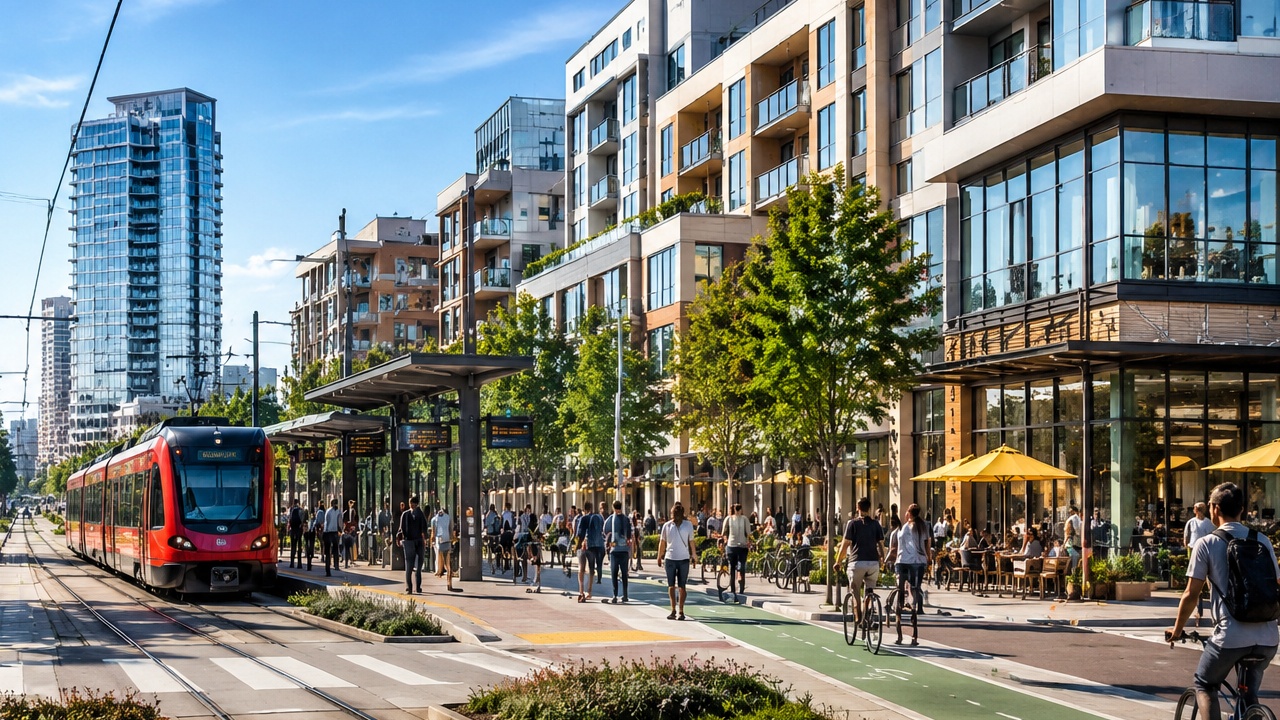
This is ground zero for the July 2026 activation. The stations added through the $2 billion Mid-Coast Trolley extension in 2021 sit at the center of the earliest SB 79 eligible areas, and land here has been underbuilt relative to the transit investment already in the ground. The complication some of these stations carry historically low ridership, which is exactly the kind of detail an investor should want quantified before assuming rent premiums that transit access alone may not deliver yet.
University City and the UC San Diego Corridor
Strong institutional demand, Blue Line access, and now expanded SB 79 eligibility make this one of the more durable opportunity sets in the city. The constraint is land cost and the reality that UC San Diego’s own on-campus housing pipeline is large enough to absorb meaningful private-sector demand before a developer’s units ever hit the market.
North Park and Normal Heights
These neighborhoods activated on the SB 79 timeline through qualifying bus stops rather than trolley stations, which makes site-by-site verification even more important given how the law treats bus rapid transit versus standard bus service differently by tier. Walkable, already-dense, and commercially active, these corridors reward small and mid-size infill more than they reward large assemblage plays.
Mission Valley and Grantville
Grantville has already proven the model works. A 100% affordable development built at the Grantville Transit Center through a partnership between a nonprofit developer and the region’s transit agency demonstrated what public land, transit-agency participation, and station-area redevelopment can produce together. Mission Valley’s broader opportunity is real but comes bundled with floodplain constraints, sea-level-resilience questions, and enough existing multifamily supply that a new project needs a genuine differentiation strategy, not just proximity to rail.
South Bay and the Blue Line
San Ysidro and Palm Avenue represent the highest-need, highest-ridership, and hardest-to-underwrite segment of San Diego’s TOD map. A regional feasibility study of the corridor found that even low-density housing prototypes were not financially viable without subsidy under current market conditions, a finding worth sitting with before assuming density alone solves a South Bay deal. The opportunity here belongs disproportionately to mission-driven and public-private partnership capital rather than conventional market-rate development.
The Risks Nobody Puts in the Pitch Deck
Every TOD deal being pitched right now leads with the density unlocked. Fewer lead with what that density costs to actually deliver.
- Affordability covenants that outlast the construction loan and shape the asset for decades, not just the permit cycle.
- Displacement and tenant-protection obligations on any site carrying existing occupied units, rent-controlled housing, or a mobile home park.
- Infrastructure gaps, sewer, stormwater, fire flow, and intersection capacity, that transit access does nothing to fix.
- A pedestrian access path that fails the one-mile walking test even when the straight-line distance looks perfect.
- Construction logistics on sites squeezed against active rail lines, station platforms, and constrained staging areas.
- Labor standard triggers on any building crossing the 85-foot threshold.
- A SANDAG stop map that has already moved twice this year and is not finished moving.
The developers who come out ahead in this environment are not the ones who move fastest on a density headline. They are the ones who verify eligibility against the current official layer, model more than one entitlement pathway before committing to a site plan, and price the affordability and infrastructure obligations into the deal from day one rather than discovering them in plan check.
Frequently Asked Questions
What qualifies a San Diego site for SB 79 transit-oriented development?
A site qualifies when it appears on the city’s official SB 79 Eligible Sites layer in ZAPP, is zoned for residential, mixed-use, or commercial use, sits within the applicable distance of a SANDAG-confirmed qualifying transit stop, and clears anti-displacement, mobile-home-park, and phasing restrictions. Straight-line distance on a generic map is not sufficient confirmation.
How much density does SB 79 allow near San Diego transit stops?
Qualifying sites within 200 feet of a stop can reach up to 140 units per acre, 4.0 FAR, and 85 feet in height. That scales down to 100 units per acre, 3.0 FAR, and 65 feet at a quarter mile, and 80 units per acre, 2.5 FAR, and 55 feet at a half mile.
Does SB 79 eliminate CEQA review for San Diego housing projects?
A qualifying SB 79 project processed as a ministerial building permit avoids project-level discretionary CEQA review, but it still must satisfy every other applicable requirement, including a Coastal Development Permit where relevant, and full building, fire, and utility permitting.
Is SB 79 better than San Diego’s Complete Communities program?
Neither program is universally better. SB 79 generally carries a smaller affordability set-aside, while Complete Communities can unlock a significantly higher FAR ceiling in certain Downtown, university, and Mobility Zone 3 locations in exchange for a deeper affordability commitment. The right choice depends on the specific site and the sponsor’s affordability strategy.
Are San Diego’s SB 79 eligible areas final?
No. SANDAG has expanded the qualifying stop map multiple times since the law’s July 2026 effective date, and the city is still developing a Transit Village Plan as an SB 79 Alternative Plan expected to reach City Council in early 2027. Sites near the eligibility boundary should be reverified close to the entitlement application date.
How JDJ Consulting Approaches a San Diego TOD Site
Every one of the pitfalls above is knowable in advance. It just requires someone to actually pull the official eligibility layer, walk the pedestrian route, model the competing entitlement pathways side by side, and price the affordability obligation before the architect starts drawing. That is the work that separates a TOD site that closes on schedule from one that stalls in plan check discovering a disqualifying overlay nobody caught.
JDJ Consulting has been running exactly that process for developers, architects, and investors moving on San Diego transit-area sites since long before SB 79 existed, and the firm’s San Diego permit expediting and entitlement consulting practice is built to verify site eligibility, sequence the right approval pathway, and keep a project moving through the city’s Development Services process without the surprises that erode a schedule.
For a market moving this fast, with a stop map that has already shifted twice this year and a phased implementation schedule that runs through 2031, the sites worth pursuing are the ones where eligibility has actually been confirmed, not assumed. Getting that confirmation right, before a purchase agreement gets signed, is the difference between capturing San Diego’s transit-density opportunity and chasing a number that was never really there.