Table of Contents
Suburban multifamily projects in Houston move through the Houston Permitting Center under Chapter 42, the city’s development code, rather than a conventional zoning ordinance. Developers submit multifamily site plans electronically through ProjectDox, complete a dwelling unit and parking analysis, satisfy parks dedication and floodplain requirements, then move into building permit review through iPermits. A realistic timeline from application to permit issuance runs eight to sixteen weeks, assuming two to three correction cycles, before final inspections clear the way to a Certificate of Occupancy.
Houston’s absence of use-based zoning gets described, often lazily, as a free-for-all. It isn’t. Chapter 42 does the work zoning does in most cities, and for suburban multifamily specifically, it does it with more moving parts than a single-family subdivision or an industrial shell ever requires. Anyone underwriting a garden-style or wrap-product deal in Cypress, Katy, or along the Grand Parkway needs to understand where those parts sit before they close on land, not after.
What Makes Houston’s Multifamily Entitlement Process Different?
Three things separate suburban multifamily review from other commercial permitting tracks in Houston. First, a dedicated multifamily site plan review runs through Planning and Development alongside the Fire Marshal, layered on top of the standard building permit set. Second, dwelling unit density triggers parks dedication fees or an in-lieu payment that single-family and industrial projects don’t face. Third, floodplain exposure across large portions of Harris County means finished floor elevation and detention requirements show up on the civil drawings for almost every suburban site, not just the obvious flood-prone ones.
Because none of this runs through a single hearing or a predictable zoning calendar, sequencing matters more than in jurisdictions with a formal rezoning process. Teams that treat Houston’s permit expeditors and entitlement consultants as a late-stage vendor rather than an early-stage partner tend to discover utility and drainage conflicts well after they’ve committed capital to design.
What Is the Step-by-Step Permitting Process for Suburban Multifamily?
1. Site Selection and Due Diligence
- Confirm Chapter 42 lot size, setback, and building line standards for the parcel, and check for private deed restrictions, historic overlays, or minimum lot size districts that condition multifamily use.
- Pull the FEMA flood determination early. Residential finished floor elevation typically needs to sit two feet above the 500-year floodplain, and Chapter 19 governs detention obligations.
- Screen utility capacity with CenterPoint Energy before finalizing unit count. Transformer lead times have run 40 to 60 weeks in recent cycles and can dictate the phasing of an entire project.
- Engage local civic associations and the relevant school district early. Suburban multifamily draws more scrutiny over traffic and school capacity than most commercial product types.
2. Multifamily Site Plan Review
Since September 2023, multifamily site plans have been submitted electronically through ProjectDox. Applicants choose between submitting the site plan alongside a sitework permit, or alongside a full building permit set. Either path requires a defined package of templates: project information (Template 42-230), a dwelling unit and parking analysis (Template 42-234), performance standard notes (Template 42-235), and parks dedication or in-lieu fee documentation (Templates 42-252/253).
3. Building Permit and Trade Permits
Once the site plan clears, the building permit application moves through iPermits with architectural, structural, and MEP drawing sets, a COMcheck energy compliance report, and, where applicable, a floodplain mitigation plan sealed by a licensed Texas engineer. A signed stormwater information form from the property owner rounds out the submittal.
4. Inspections and Certificate of Occupancy
Foundation, framing, MEP rough-in, insulation, and final inspections all have to clear before the city issues a Certificate of Occupancy, which is what actually allows leasing to begin. Projects sitting in a historic district carry one more step: a Certificate of Appropriateness from the Houston Archaeological and Historical Commission, required before the site plan can advance.
Where Is Suburban Multifamily Development Concentrated in Houston?
Demand has clustered hardest beyond Beltway 8, where master-planned community growth keeps pulling multifamily product along with it. Cypress and Northwest Houston have absorbed significant new supply, including luxury communities tied to Bridgeland and Towne Lake. Katy continues to pair strong single-family demand with new apartment product built to serve the same households at a different life stage. Spring and the Woodlands hold a more upscale suburban identity, with multifamily growth tracking corporate relocations into the corridor. Across the broader ring beyond Beltway 8, unit counts grew by roughly 35,900 over a recent multi-year stretch, a 13.3 percent increase that tells you how much capital has already found these submarkets.
Saturation here doesn’t mean the opportunity is gone. It means land is more expensive, large contiguous parcels are harder to assemble, and timelines stretch as review queues fill with competing applications. Developers still active in these submarkets are increasingly the ones who can move fastest through entitlement, not necessarily the ones who paid the least for dirt.
Which Submarkets Offer the Most Upside for New Investment?
The US 290 corridor, running through Cypress toward Prairie View and the Waller County line, is drawing residential and industrial growth in tandem, with large tracts still available at a fraction of core-suburb pricing. Highway 6 and FM 529 offer similar dynamics further west, and nodes along the Grand Parkway continue to open up as the ring road pulls infrastructure investment with it.
The tradeoff is real. Roads, utilities, and public services in these corridors often lag the pace of residential growth, and CenterPoint’s forecast of roughly 50 percent peak load growth over six years means new large multifamily loads may sit in a longer interconnection queue than a developer’s pro forma assumes. Sites near existing substations or with confirmed capacity letters in hand carry a meaningful advantage over ones that look attractive on a map but haven’t been vetted against the grid.
What Risks Do Developers, Architects, and Investors Face?
Suburban multifamily in Houston spreads risk unevenly across the project team. The table below breaks out where exposure typically concentrates by role.
| Stakeholder | Primary Risk Exposure |
|---|---|
| Developers / Investors | Land scarcity and pricing pressure in Cypress, Katy, and the Woodlands/Spring corridor, plus rising cost of capital that makes lease-up timing more consequential to project returns. |
| Architects / Engineers | Chapter 42 and Chapter 26 parking minimums, building line setbacks that vary by street classification, and drainage and detention design obligations in flood-prone suburban tracts. |
| General Contractors | Utility sequencing around long CenterPoint transformer lead times, skilled labor availability, and phasing site infrastructure to hit Certificate of Occupancy milestones. |
| Lenders / Capital Partners | Entitlement and utility timing risk that shifts cash flow projections, community opposition near residential interfaces, and submarket oversupply risk to rent growth assumptions. |
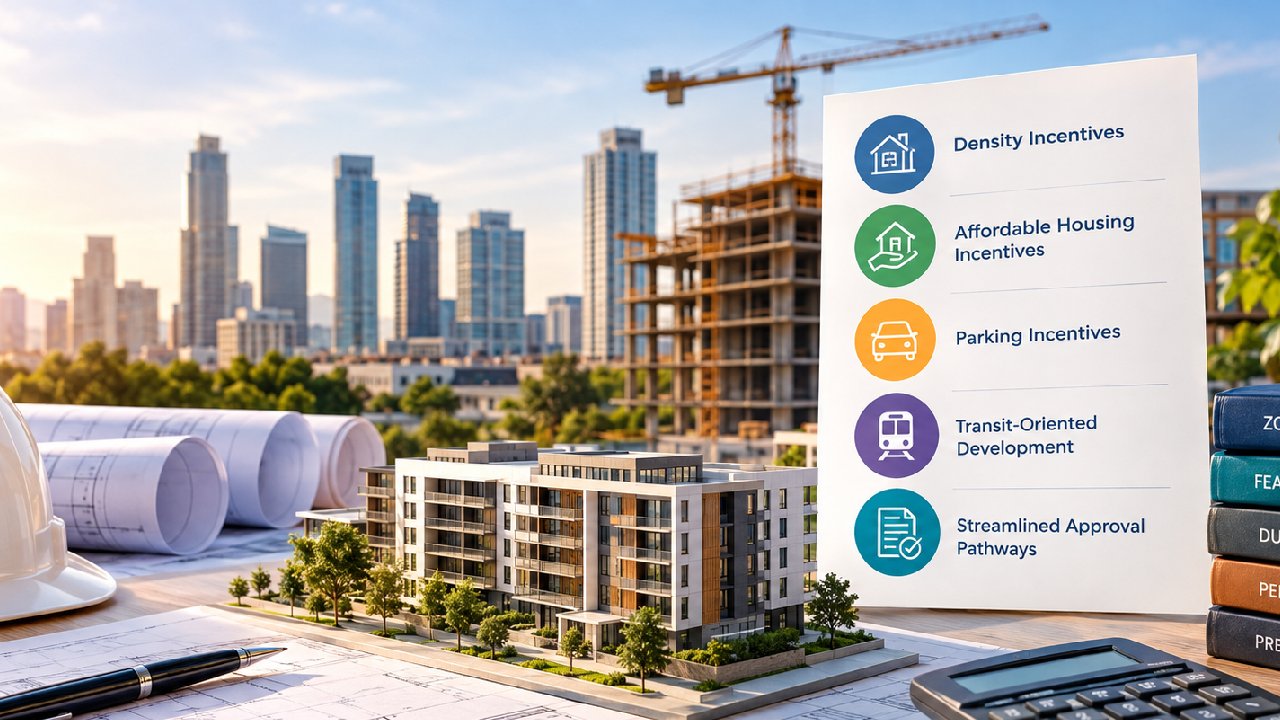
What Incentive Programs Are Available for Houston Multifamily Projects?
Several local, state, and federal programs can meaningfully improve project economics, particularly for developments with an affordable housing component.
Local
- Chapter 312 property tax abatement: up to 100 percent abatement on added value for up to ten years, generally requiring a minimum investment of $5 million ($1 million for deteriorated or demolished property, $500,000 within a Texas Enterprise Zone) and creation or retention of 25 permanent jobs (5 within a TEZ).
- Chapter 380 economic development agreements: negotiated grants, loans, infrastructure commitments, or sales-tax-sharing arrangements, structured case by case with the city.
- Tax Increment Reinvestment Zones (TIRZ): a portion of captured appraised value can be refunded toward infrastructure required to support the development.
State
- Texas Enterprise Fund: cash grants for projects creating significant jobs and capital investment, with urban thresholds generally at 75 or more new jobs paying at or above the county average wage.
- Texas Enterprise Zone Program: sales and use tax refunds on qualified expenditures, worth roughly $2,500 to $7,500 per qualifying employee depending on project scale.
- Low-Income Housing Tax Credit (LIHTC): federal credits administered at the state level, often the difference-maker for suburban affordable and workforce housing components.
Federal
- Opportunity Zones: capital gains tax incentives for qualifying investment in designated zones, several of which fall within Houston’s growth corridors.
- 45L Tax Credit: a federal credit for energy-efficient new construction, worth up to $2,500 per qualifying unit in a multifamily project.
None of these programs apply automatically, and stacking more than one requires coordination across city, state, and federal timelines that rarely run on the same clock as a construction schedule.
Frequently Asked Questions
Does Houston have zoning for multifamily development?
No. Houston has no use-based zoning ordinance, but Chapter 42 of the city code regulates lot size, setbacks, parking, and subdivision standards, functioning as the practical equivalent for development review purposes.
How long does multifamily entitlement take in Houston?
Initial plan review for commercial and multifamily new construction typically runs 15 to 37 business days. Factoring in two to three correction cycles, most projects reach permit issuance in 8 to 16 weeks from application.
What triggers a parks dedication fee for multifamily projects?
Dwelling unit density above certain thresholds under Chapter 42 requires either a parks dedication or an in-lieu fee payment, documented through Templates 42-252 and 42-253 during site plan review.
Which Houston submarkets have the most available land for suburban multifamily?
The US 290 corridor toward Prairie View, the Highway 6 and FM 529 corridors, and emerging nodes along the Grand Parkway currently offer more large, contiguous, and lower-cost parcels than saturated submarkets like Cypress, Katy, or the Woodlands.
What is the biggest schedule risk for suburban multifamily in Houston?
Utility interconnection and floodplain requirements are the two most common causes of schedule slippage, particularly CenterPoint transformer lead times, which have run 40 to 60 weeks in recent cycles.
Moving a Suburban Multifamily Project Through Houston’s Entitlement Process
Houston’s lack of formal zoning creates flexibility, but it shifts the real complexity into Chapter 42 review, utility coordination, and floodplain compliance, areas where a missed sequencing decision costs months rather than days. JDJ Consulting’s Houston permit expediting and entitlement consulting team works alongside developers, architects, and investors to map Chapter 42 requirements, coordinate utility due diligence, and identify which local, state, and federal incentive programs apply to a given site before capital is committed. For a fuller view of how that support extends across a project’s lifecycle, visit JDJ Consulting’s services page.