Table of Contents
Orlando isn’t short on hotel rooms. It’s short on interesting ones. Ask anyone who’s tried to underwrite a new hospitality deal here in the past couple of years and you’ll get some version of the same answer: the market can absolutely support more supply, but not just anywhere, and not just any product. For architects, developers, and investors circling this market, the real question has shifted. It’s not whether Orlando has room to grow. It’s where, in a metro this saturated with resorts and select-service brands, a new project can actually stand out.
Where you land on that question comes down to three things: jurisdiction, product type, and how patient you’re willing to be with an entitlement process that’s only gotten more procedurally involved as the region’s tourism economy has grown up. Below is a working guide to that process, plus a candid read on which submarkets are tapped out and which ones still have runway.
Start With the Product, Not the Site
It’s tempting to fall in love with a parcel first and figure out the product later. Don’t. Hospitality entitlements aren’t one-size-fits-all, and the zoning path, financing structure, and regulatory load all shift depending on what’s actually getting built. Product decisions need to come before site selection, not after it.
Orlando’s active pipeline generally falls into a handful of buckets: limited and select-service brands, full-service or convention-oriented resorts, extended-stay and dual-brand properties, hotel-condo or timeshare product (which drags in its own securities and registration requirements), and mixed-use projects that tuck a hotel component into retail, office, or residential density. A planning board reads each of these differently, and each comes with its own baggage around parking, height, and traffic mitigation.
Jurisdiction Decides More Than People Expect
The Orlando metro is really a patchwork of separate authorities, and which one your parcel falls under shapes almost everything downstream. A site inside the City of Orlando answers to a completely different zoning code, planning board, and fee structure than one in Winter Park, Lake Buena Vista, or unincorporated Orange County. Confirming Future Land Use designation and zoning district before the pro forma gets locked in isn’t a box-checking exercise. It determines whether your hotel use is permitted outright or whether you’re about to spend a year in rezoning.
Inside the City of Orlando, hospitality uses tend to cluster in Activity Center (AC), Mixed Use (MU), and Planned Development (PD) districts, along with a handful of commercial corridors. If the use is permitted by right, you move straight into site plan or master plan review. If it isn’t, you’re filing for rezoning or a PD amendment, which typically goes through the Municipal Planning Board first and then City Council or the County Commission. Special exceptions and variances come up for parking reductions, height allowances, or design departures from base code. For bigger, multi-phase resort projects, a PD or development agreement is often the smarter route, since it locks in entitlements and phasing over a longer stretch of time instead of forcing you back through approvals at every stage.
This is usually where projects either get ahead of the timeline or fall behind it. Entitlement and permitting guidance built around Orange County and City of Orlando processes can help a project team pin down which approval path a given parcel actually needs, before capital gets committed to a pro forma built on assumptions that don’t hold up.
The Licensing Layer That’s Unique to Hotels
Hotels carry a state licensing burden that most other real estate products simply don’t. As public lodging establishments, they fall under Florida Department of Business and Professional Regulation oversight per Chapter 509, which means sanitation, safety, and structural inspections both before opening and at every license renewal. Fire marshal review and local fire code compliance run alongside that. Any food and beverage outlet on the property needs its own separate DBPR license. And because Orange County collects a six percent Tourist Development Tax on stays under six months, TDT registration isn’t a one-time filing, it’s an ongoing operational obligation for as long as the property is open.
None of this replaces the local zoning and entitlement work. It stacks on top of it, which is a big part of why hospitality timelines tend to run longer than a residential or office project of comparable size.
Infrastructure Capacity Can Quietly Become the Real Constraint
Larger, resort-scale hospitality projects tend to draw a heavier infrastructure review than most other asset classes. Traffic and level-of-service analysis often surfaces the need for off-site improvements, turn lanes, signal upgrades, access control, especially on corridors that already carry heavy visitor traffic. Stormwater management and water and sewer capacity verification follow close behind, and in some submarkets utility allocation ends up being the thing that actually holds up entitlements, more so than the zoning question itself. Parking design, structured versus surface, is as much a budget decision as a code compliance one. Brand standards and municipal ratios can push construction costs well past what got modeled at the concept stage.
Financing Has Gotten Tighter, and Incentives Look Different Here
Hotel construction financing has always run with lower leverage and tighter underwriting than other asset classes, and rising construction and labor costs haven’t made lenders any looser. Debt and equity partners want strong sponsorship, real brand commitment, and a market study that holds up, which puts a lot of pressure on getting the entitlement and feasibility work right from the start.
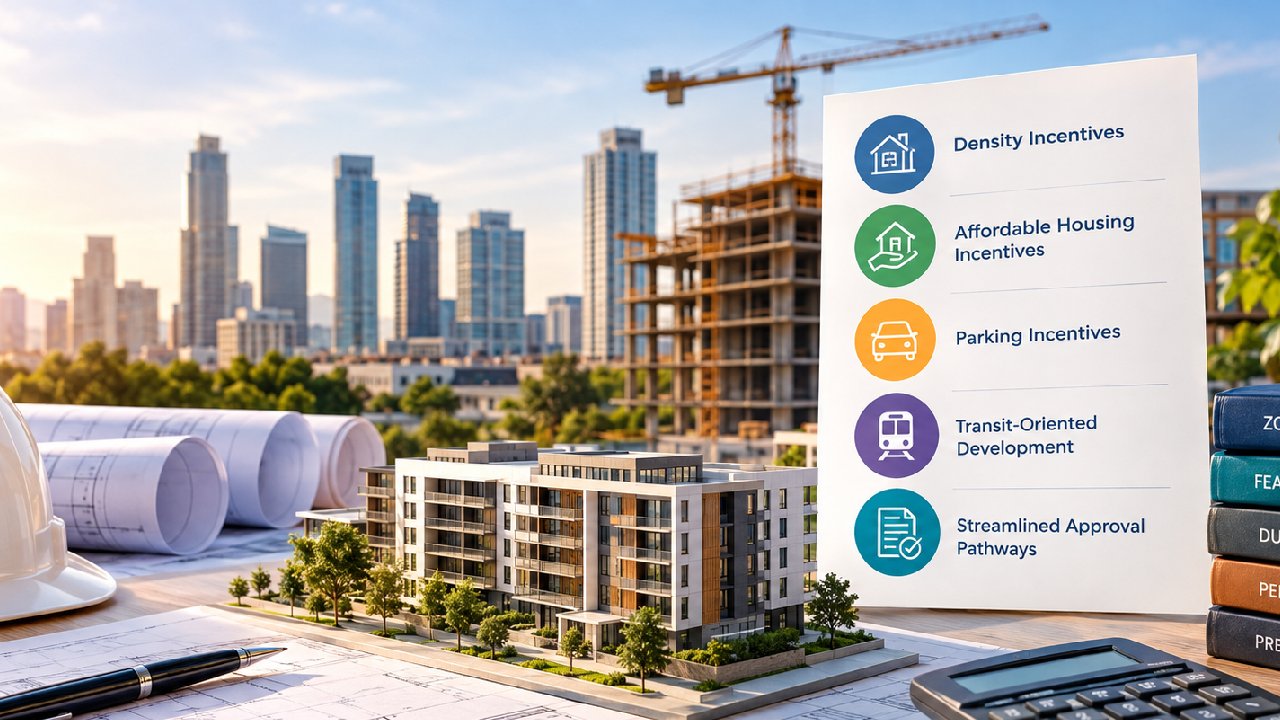
The incentive landscape also looks different than it would for a residential developer. Tourist Development Tax revenue funds tourism infrastructure, convention center expansion, sports and event venues, which isn’t a direct subsidy but does support demand over the long run. Community Redevelopment Areas, including Downtown Orlando and a few other corridors, offer CRA and TIF mechanisms for public improvements that can benefit an adjacent hotel project. And Planned Development bonuses, extra height or density in exchange for design quality, affordable components, or public realm improvements, remain one of the more direct tools available to anyone working within PD zoning.
Where the Market Has Already Filled Up
Three submarkets carry the highest hotel density in the metro, and in all three, the competition now happens on differentiation rather than raw demand.
International Drive and the Universal Boulevard corridor is still the most hotel-saturated stretch in the region, with new dual-brand and upscale projects entering the pipeline at a steady clip. Proximity to Universal, Epic Universe, SeaWorld, and the Convention Center more or less guarantees demand, but land costs are steep, traffic and parking constraints are real, and new projects get scrutinized hard on massing and level-of-service impact.
The Disney, Lake Buena Vista, and Celebration fringe is thick with resort and value product built to serve Disney visitors. Land here is often held by a handful of large owners, and any new ground-up hotel is competing directly against deeply entrenched brands with a head start of decades.
The Convention Center and Sand Lake Road area still pulls strong group and convention demand, but it’s already well covered across both full-service and select-service categories. A new project here needs a genuine point of difference, or a specific demand driver, or it’s just competing on rate.
In all three, the real risk is oversupply diluting RevPAR for anyone without a distinct concept, brand strength, or cost advantage going in.
Where There’s Still Room to Move
A few corridors are seeing real investment and demand growth without the density problems of the established tourism core.
Downtown Orlando is absorbing new high-rise, mixed-use development pairing 200-plus room hotel components with residential and retail, driven by office employment, convention activity, sports and cultural programming, and a genuine rise in urban living demand. Parking and traffic are still live issues, and individual projects do draw neighborhood pushback, but the city’s overall posture toward density in the core is friendlier than what you’d find in the suburbs.
The southeast Orlando and airport corridor has an active pipeline of limited-service and dual-brand hotels, riding airport traffic, nearby logistics and industrial growth, and spillover demand from the theme park core. Land is still comparatively available and cheaper than anything along International Drive.
Lake Nona and the Tavistock footprint run on a completely different demand thesis, medical, tech, and corporate rather than tourism, which opens the door for upscale select-service or extended-stay product built around business and medical travelers instead of vacationers.
Winter Park, Maitland, and Altamonte Springs bring an affluent local economy and growing appetite for boutique, lifestyle, and extended-stay product serving business and leisure travelers who’d rather stay outside the tourist corridor. Design and parking requirements tend to be more neighborhood-sensitive here, but the field of competitors is a lot thinner.
Winter Garden, Horizon West, and the Johns Lake area are earlier in the cycle than any of the above. Fast residential growth and new mixed-use nodes are generating demand for limited-service and lifestyle hotels to support new residents and retail, well ahead of where International Drive or the Disney fringe sit today.
The Obstacles That Actually Kill Projects
Across just about every submarket, the projects that stall or get scaled back tend to run into the same handful of problems. Public hearings for rezonings and PD approvals routinely bring out neighborhood opposition over traffic, noise, lighting, and what residents often describe, not always kindly, as the “touristification” of a corridor. Timelines stretch further when multiple boards, planning, zoning, council, review the same project sequentially instead of in parallel. Level-of-service and concurrency requirements can force expensive off-site road work or cap density outright, and structured parking requirements in higher-intensity districts add real cost that didn’t make it into the concept-stage budget. Financing conditions are still tighter than pre-pandemic norms, which raises the bar on sponsorship and market study quality. And in the already-saturated corridors, new supply risks diluting RevPAR and stretching out stabilization for everyone, including the project causing the dilution.
The Bottom Line
Hospitality development in Orlando rewards specificity, not ambition alone. A dual-brand product near the airport, a boutique concept in Winter Park, and a resort-scale project in Lake Nona aren’t variations on the same entitlement path. They’re different projects entirely, each with its own jurisdiction, licensing burden, and demand thesis. The developers who move efficiently through this market are the ones who lock in product and jurisdiction before capital gets committed, and who treat entitlement strategy as a decision that shapes the deal, not paperwork to get through after the deal is already shaped.
For teams evaluating a site in Orange County or within the City of Orlando, working through the jurisdiction-specific entitlement path early is often the difference between a project that stays on schedule and one that spends a year finding out its constraints in public hearings.