
Table of Contents
Ask anyone who has closed on a multifamily site in Broward County this year what changed the deal, and the conversation turns to the same law almost every time. Florida’s Live Local Act now lets qualifying projects skip local rezoning altogether, so long as at least 40% of units serve households earning up to 120% of Area Median Income. That one provision has quietly rewritten how land gets valued, how fast a project can move, and which sites are worth chasing across the county’s 31 municipalities.
This is a working playbook, not a policy summary. How the entitlement and permitting process actually runs in Broward. Why demand for workforce product has picked up so sharply. Where the pipeline is already crowded. And where, if you know where to look, sites still make sense.
What Counts as Workforce Housing in Broward County
The term gets used loosely, so it’s worth being precise. Workforce housing generally serves households earning between 60% and 140% of Area Median Income, the teachers, nurses, and first responders who earn too much for deeply subsidized housing and too little for market rate. Under the Live Local Act, Broward’s main lever for this product type, the threshold that actually governs deal structure is tighter: 40% of units at or below 120% AMI, locked in for 30 years.
Broward’s 2025 AMI came in at $96,200, which puts the Live Local qualifying cap at $115,440 for a household. That number drives rent ceilings and unit mix decisions directly, so it’s worth having it memorized before a pro forma gets built.
How the Entitlement and Permitting Process Actually Works
Here’s the part that trips up developers coming into Broward from other markets: there is no single county-wide permitting authority. Each of the 31 municipalities runs its own planning, zoning, and building department, and Broward County itself only has direct jurisdiction over the unincorporated Broward Municipal Services District. A process that works cleanly in Fort Lauderdale won’t necessarily hold up in Pembroke Pines or Coral Springs, and assuming otherwise is one of the more expensive mistakes an out-of-market team can make.
Absent Live Local eligibility, the baseline path runs through six stages.
Pre-application and due diligence comes first, confirming zoning and Future Land Use Map consistency, screening for overlays like coastal management or historic districts, and running early concurrency checks on traffic, drainage, and utility capacity.
Entitlements, if the project isn’t already by-right, come next. Projects aligned with the existing FLUM can often move straight to site plan review. Everything else needs rezoning, a conditional use approval, a planned development designation, or variances, each requiring public hearings before a Planning Board and City Commission.
Site plan and development review is where the real scrutiny happens: massing, unit mix, parking strategy, buffering, stormwater design, and, for multifamily specifically, traffic generation and neighborhood compatibility.
Engineering and utility approvals run separately, covering drainage, roadway access, and water and sewer capacity.
Building permit issuance follows land-use approval and requires signed and sealed plans, a current survey, and for larger projects a notice of commencement. Permits are valid for 180 days once issued, and extensions aren’t automatic, so timing matters more than most schedules account for.
Inspections and Certificate of Occupancy close the process, with multifamily projects facing particular attention on life safety systems, fire separation, elevators where applicable, and common areas.
A number of cities also fast-track workforce and affordable applications. Plantation, for instance, offers expedited processing for projects with 15% or more affordable units, and several municipalities route these through dedicated staff to trim weeks off the standard timeline.
Why the Live Local Act Changes the Math
If there’s one thing worth understanding before anything else in Broward right now, it’s this law. The Live Local Act allows multifamily or mixed-use residential development, administratively, on sites currently zoned commercial, industrial, or mixed-use, with no rezoning, no comprehensive plan amendment, no special exception, and no public hearing required.
The mechanics are specific. At least 40% of units must serve households at or below 120% AMI, held for 30 years. Local governments can’t cap density below whatever the highest density permitted anywhere else in the jurisdiction happens to be. Height has to reach at least the tallest structure permitted within a mile of the site, or three stories, whichever is greater. Qualifying projects also get meaningful parking reductions, and projects with 71 or more units dedicated to attainable housing at 120% AMI or below receive a 75% property tax exemption on assessed value, rising to a full 100% exemption for units rented below 80% AMI.
The results are already visible on the ground. Fort Lauderdale alone has eight proposed Live Local projects, three approved and five under review, adding up to 2,342 apartments and 1,156 workforce units, with heights ranging from six stories to 38. Cities are reporting roughly six-month approval timelines under Live Local, against something closer to a year under a conventional rezoning. That compression, on its own, is what’s driving a lot of the site acquisition activity happening right now.
Why Demand for Workforce Housing Is Accelerating
A few forces are stacking on top of each other. Incomes haven’t kept pace with housing costs, which leaves workforce households caught between market-rate product they can’t afford and deeply subsidized housing they don’t qualify for. Broward’s population and job base keep growing, fed by continued in-migration to Florida and, within South Florida, toward the relatively more affordable pockets of the county.
The fundamentals back it up. Broward posted a 6.9% vacancy rate in the first half of 2025, among the lowest in the state, with Class A demand growing more than 8% a year even as new supply comes online. Layer the Live Local Act’s administrative path, its density and height bonuses, and its tax exemptions on top of that, and the pro forma improves in a way that’s genuinely changed how institutional capital thinks about the sector.
Where the Pipeline Is Already Crowded
Some corridors have gotten competitive enough that “opportunity” isn’t really the right word anymore. Central Fort Lauderdale, particularly along Federal Highway, Broward Boulevard, and Andrews Avenue, has multiple Live Local projects approved or under review, including towers up to 38 stories. Broward’s core submarkets, Hollywood and Dania Beach, Pompano Beach and Deerfield Beach, Coral Springs, Plantation, and Sunrise, have absorbed heavy deliveries since 2023, and more than 8,800 units are currently under construction countywide.
In these corridors, entitlement risk isn’t really the constraint anymore. Land cost is. So is community pushback on height and traffic, especially in cases where Live Local removes the public hearing that would normally give neighbors a formal say. And lease-up risk climbs whenever several projects hit the same submarket at once.
Where Opportunity Still Exists
Three patterns keep showing up for developers still building out a pipeline. Secondary commercial and industrial corridors with decent access but a lower land basis, the older arterial strips and underused commercial parcels sitting just outside the densest activity centers, are one. Mixed-use Live Local sites outside the downtown cores are another, since they can still capture the Act’s height and density benefits while facing noticeably less competition at acquisition. And the western and northern edges of the county offer more available, cheaper land, with the tradeoffs being longer commutes, weaker transit access, and in some cases infrastructure that needs a closer look before it can support the density being proposed.
None of this is friction-free. Concurrency items, traffic level of service, drainage and flood capacity, school and park capacity, can still become gating issues that require mitigation or phasing. Community and political resistance doesn’t disappear just because Live Local removes the hearing requirement; it tends to resurface around height and traffic, which makes design quality and buffering a practical necessity rather than a nice-to-have. And environmental constraints, floodplain rules, coastal management, brownfield remediation where relevant, add cost and schedule risk that’s easy to underestimate on paper.
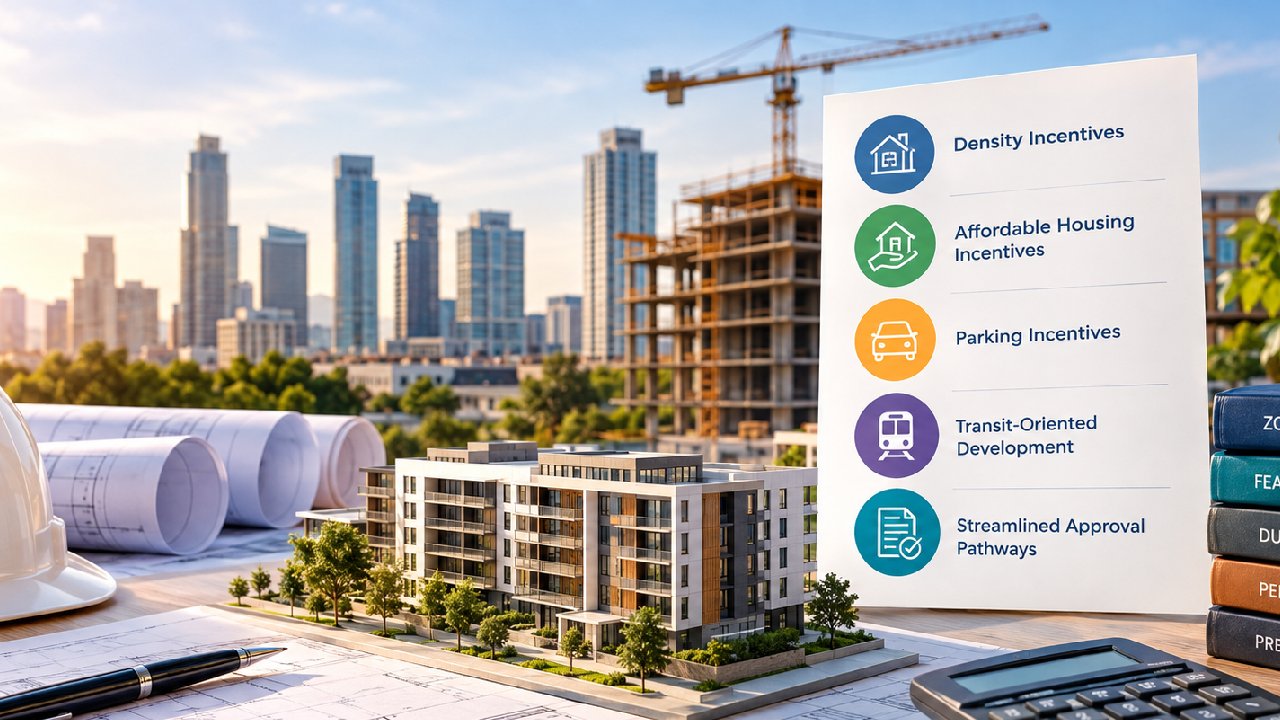
The Incentive Stack Worth Knowing
Beyond the Live Local Act itself, Broward’s incentive landscape is deeper than most developers give it credit for, and stacking these programs is where the strongest deals come from.
At the state level, the Florida Density Bonus Law allows density and height bonuses in exchange for affordable units, and the State Housing Initiatives Partnership program funds down payment assistance and workforce housing initiatives through local administration.
At the county and city level, Broward’s Affordable Housing Density Bonus Program awards tiered bonus units based on income targeting, from six bonus units per affordable unit at moderate income levels up to 19-for-1 at very-low income levels, with higher bonuses near transit and job centers. Fort Lauderdale’s own density bonus ordinance allows up to a 100% increase over the underlying Future Land Use density, capped at 50 units per acre on residential parcels and 100 on non-residential parcels, with no cap at all inside Regional Activity Center parcels.
Impact fee relief matters just as much. Broward County offers full waivers of county-imposed fees, road, park, transportation concurrency, for very-low and low-income certified projects, and school impact fee waivers up to $50,000 are available with School Board approval. Add expedited permitting tracks, parking reductions tied to affordable unit percentages, and surplus public land offered at 75% of appraised value to qualifying affordable housing proposals, and a pattern emerges. Live Local eligibility, a density bonus, impact fee waivers, expedited review, and tax exemptions, stacked together, is consistently what separates a workforce housing deal that pencils from one that doesn’t.
The Hurdles, By Who’s Actually Facing Them
Developers and investors are underwriting pro formas built on below-market rents, which makes incentive access, and sometimes public funding through SHIP, HOME, or LIHTC, essential rather than optional. Insurance and flood exposure near coastal edges and canals have become real line items, not footnotes. And lease-up risk climbs fast when several workforce projects deliver into the same submarket at once.
Architects and engineers are the ones managing the visual gap between what Live Local allows and what actually surrounds the site. A project permitted three or four times taller than its neighbors needs real thought put into massing, buffering, and shadow studies, or it invites exactly the kind of community pushback that Live Local’s administrative path was supposed to avoid. Incomplete technical detail and code conflicts remain the most common reasons plan review stalls.
General contractors are racing the 180-day permit clock while coordinating sub-permits across electrical, plumbing, and fire systems, all against continued materials and labor inflation that squeezes margins harder on rent-capped product than on market rate.
Lenders and investors, meanwhile, often find workforce assets genuinely harder to underwrite. Below-market rents and functional limitations, like reduced parking or fewer amenities, feed directly into appraised value and lease-up assumptions. And the 30-year affordability restriction that comes with most incentive programs limits exit flexibility, which shapes how reserve funds and long-term operating assumptions get structured from day one.
A Pre-Acquisition Checklist
Before a purchase agreement gets signed or design work starts, a few things are worth confirming up front. Jurisdiction and current zoning or FLUM consistency, with an early screen for Live Local eligibility based on the site’s commercial, industrial, or mixed-use zoning. A concurrency screen covering traffic, drainage, water and sewer, and schools and parks, run before design begins rather than after. A design approach built around neighborhood compatibility from the start, including height transitions and buffering. A full accounting of applicable incentives, tax exemptions, density bonus tiers, fee waivers, expedited review eligibility, and surplus land opportunities, built into the pro forma rather than treated as upside. And a realistic schedule that accounts for plan review cycles and that 180-day permit window, with sub-permits initiated early enough to avoid the cascading delays that eat margin.
Why Jurisdiction Is the Whole Ballgame
Everything above shifts depending on which of Broward’s 31 municipalities a site sits in. A Live Local project in Fort Lauderdale moves through different staff, different politics, and a different administrative culture than the same project in Pembroke Pines or Coral Springs. Density bonus formulas, expedited review criteria, and impact fee waiver eligibility are all set locally, not countywide, and generic guidance only carries a project so far before it needs to get specific.
This is usually where projects hold their timeline or lose it. JDJ Consulting works with developers, architects, and investors moving workforce housing projects through Broward’s entitlement and permitting process, translating the Live Local Act and the county’s layered incentive programs into a path that actually fits a given site and jurisdiction. For anyone evaluating a Broward acquisition right now, our Broward permit expediting and entitlement consulting services are built around exactly this kind of site-specific due diligence, from the first zoning check through Certificate of Occupancy.
Frequently Asked Questions
What percentage of units must be affordable under Florida’s Live Local Act?
At least 40% of units in a qualifying project must be affordable to households earning at or below 120% of Area Median Income, held for 30 years.
Does the Live Local Act require a public hearing?
No. Qualifying projects get administrative approval for the height, density, and zoning authorized under the Act, without a rezoning, special exception, conditional use approval, variance, or comprehensive plan amendment.
How long does workforce housing entitlement typically take in Broward County?
Under a conventional rezoning path, expect around 12 months. Live Local Act projects in Fort Lauderdale have averaged closer to six months on the administrative track.
How long is a Broward County building permit valid once issued?
180 days from issuance, and extensions aren’t automatic, so timing the application matters.
What income does a household need to qualify for workforce housing in Broward County?
Based on Broward’s 2025 AMI of $96,200, the Live Local qualifying cap is $115,440 for a household at 120% AMI.