
Table of Contents
In 2026, developers are dealing with changing zoning codes, housing policies, density incentives, evolving approval pathways, community expectations, infrastructure constraints, and increasingly complex development standards.
At the same time, real estate markets are shifting.
Population growth, housing demand, construction costs, interest rates, and migration patterns can all influence which development opportunities make sense. For example, Texas continues to attract significant relocation activity in 2026, while California communities are facing increasing pressure to accommodate housing through higher-density development.
The result is a development environment where understanding what a property can become is just as important as understanding what it is worth today.
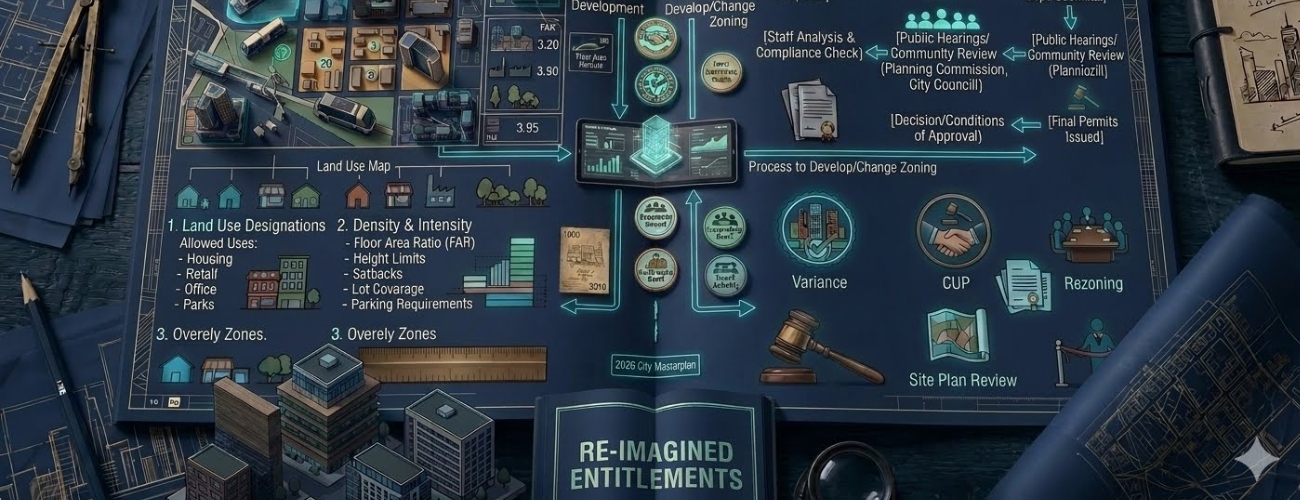
What Are Zoning and Entitlements?
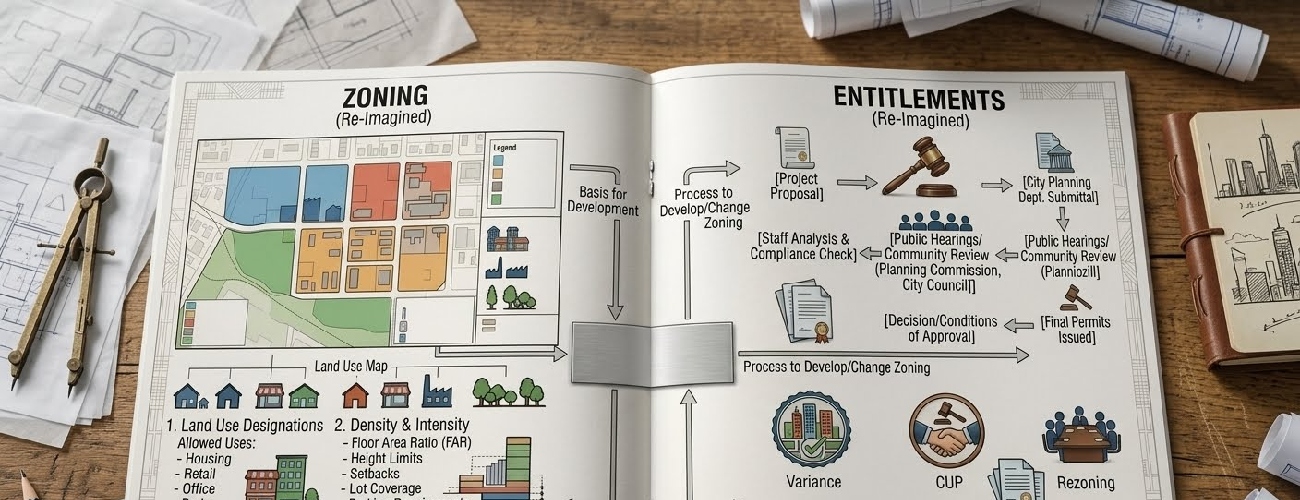
Zoning establishes the rules governing how land can be used and developed.
Depending on the jurisdiction, zoning regulations may control:
- Permitted uses
- Residential and commercial density
- Floor area ratio (FAR)
- Building height
- Setbacks
- Lot coverage
- Parking
- Open space
- Access
- Development standards
- Design requirements
Entitlements are the approvals needed to establish or modify a project’s legal development rights.
These can include:
- Zoning changes
- Conditional use permits
- Variances
- Subdivisions
- Site plan approvals
- Density bonus approvals
- General plan amendments
- Development agreements
- Other discretionary approvals
Zoning tells you what the rules allow. Entitlements determine how you obtain the approvals needed to move a project forward.
JDJ Consulting specializes in zoning and entitlement strategy, including zoning reclassification, variance requests, conditional use permits, land-use compatibility analysis, density strategies, and entitlement pathways.
Why Zoning and Entitlements Matter More in 2026
Zoning is no longer a static box that developers check at the beginning of a project.
Across the country, cities and states are adjusting land-use policies to respond to housing shortages, affordability concerns, population growth, and changing development patterns.
JDJ Consulting’s 2026 analysis notes that zoning reform can create new opportunities for density, flexible land uses, streamlined approvals, and incentive programs while simultaneously introducing additional regulatory complexity.
That creates an important development question:
Does a zoning change create a real opportunity—or simply create another layer of complexity?
The answer depends on the individual property.
1. Zoning Reform Is Creating New Development Opportunities
One of the biggest zoning trends in 2026 is the expansion of development flexibility in certain markets.
Depending on the jurisdiction, reforms may support:
- Additional housing units
- Missing-middle housing
- ADUs and JADUs
- Multifamily development
- Mixed-use projects
- Increased density
- Reduced parking requirements
- Affordable housing incentives
- Transit-oriented development
- Streamlined approvals
These changes can increase the development potential of land.
However, developers should avoid assuming that a headline zoning reform automatically applies to every parcel.
A property’s exact zoning designation, overlay districts, lot characteristics, existing conditions, and jurisdiction-specific requirements still matter.
Explore JDJ Consulting’s Land Use & Entitlement Strategy services.
2. Entitlement Strategy Can Affect Land Value
Zoning directly affects what can be built.
What can be built affects project revenue.
And potential revenue can affect what a developer is willing to pay for land.
This creates a direct relationship between:
Zoning → Development Potential → Feasibility → Land Value
For example, a parcel that appears to support a single-family project may have significantly different economics if a developer can legally pursue additional units, a density bonus, a subdivision, or another entitlement pathway.
That is why sophisticated developers evaluate zoning before treating a property as a finished investment opportunity.
3. Developers Are Looking Beyond the Zoning Map
A zoning map provides important information, but it does not tell the entire development story.
Two properties with identical zoning can have dramatically different feasibility.
Developers should also investigate:
- Lot dimensions
- Existing structures
- Easements
- Setbacks
- Height restrictions
- FAR
- Parking
- Access
- Utilities
- Topography
- Environmental constraints
- Historic restrictions
- Overlay zones
- Affordable housing requirements
- Design review
- Agency requirements
JDJ Consulting’s zoning and entitlement process combines feasibility analysis with zoning review to determine what a site can realistically support before the project moves into later stages.
4. By-Right Does Not Always Mean Simple
A common assumption is that a by-right project will automatically move quickly.
In reality, a project can still encounter:
- Building code requirements
- Design review
- Environmental requirements
- Infrastructure limitations
- Agency coordination
- Parking issues
- Utility requirements
- Site-specific restrictions
JDJ Consulting’s 2026 zoning analysis similarly emphasizes that by-right development can reduce uncertainty but does not eliminate every approval or implementation challenge.
For developers, the lesson is important:
Do not evaluate approval risk based only on whether a project is technically by-right.
Evaluate the entire approval pathway.
5. Entitlement Risk Should Be Part of Feasibility
Feasibility analysis should not stop at calculating the number of units.
A stronger feasibility review considers:
Legal feasibility
Can the proposed development be legally pursued?
Physical feasibility
Can the site physically accommodate the proposed project?
Financial feasibility
Do projected costs and revenues support the development?
Market feasibility
Is there sufficient demand for the proposed product?
Entitlement feasibility
Can the necessary approvals realistically be obtained?
These five questions provide a more complete picture of development potential.
See JDJ Consulting’s Feasibility Studies services for zoning analysis, density calculations, and entitlement risk assessment.
6. Market Conditions Are Changing the Entitlement Equation
Zoning decisions do not happen in a vacuum.
Market conditions can determine whether additional development capacity actually creates value.
For example, a city may permit greater density, but developers still need to consider:
- Construction costs
- Financing costs
- Rental rates
- Sales prices
- Vacancy
- Absorption
- Labor availability
- Insurance
- Infrastructure
- Local demand
Texas provides a useful example of why market context matters. Recent 2026 relocation data shows strong migration toward several Texas markets, while Austin’s property market is simultaneously dealing with the aftereffects of its earlier development boom and a more cautious market environment.
The implication for developers is clear:
More zoning capacity does not automatically equal more project value.
The development strategy must match the market.
7. AI Is Changing Early-Stage Zoning Analysis
One of the most important emerging trends is the use of artificial intelligence in real estate development.
Traditional site analysis can require developers to gather information from zoning codes, planning documents, maps, development standards, and other sources before they can even determine whether a property deserves deeper investigation.
AI-powered tools are beginning to accelerate this early-stage process.

• AI-POWERED
Know your SITE in seconds
Address IN, Feasibility OUT
AIEntitle is designed to help developers evaluate property feasibility using an address-based analysis.
Instead of starting with weeks of manual research, developers can use AI-powered analysis to quickly explore potential development scenarios and entitlement considerations.
This can help answer an important early question:
Is this site worth investigating further?
The goal is not to replace professional zoning and entitlement expertise.
Instead, AI can help developers identify potential opportunities and risks earlier, allowing human experts to focus on interpretation, strategy, approvals, and execution.
Try AIEntitle: https://aientitle.com
8. Zoning Intelligence Can Improve Acquisition Decisions
One of the best times to evaluate zoning and entitlements is before purchasing the property.
Developers who wait until after acquisition may discover:
- Lower-than-expected density
- Unexpected setbacks
- Parking constraints
- Overlay restrictions
- Difficult entitlement requirements
- Infrastructure problems
- Community opposition
- Longer approval timelines
These issues can dramatically affect project economics.
Pre-acquisition zoning analysis helps investors understand what they are actually buying.
Internal Link: Explore Due Diligence Consulting to understand how development due diligence can identify risks before significant capital is committed.
9. Community and Agency Relationships Still Matter
Technology can improve analysis, but development remains a human process.
Planning departments, zoning administrators, agencies, commissions, neighbors, property owners, and other stakeholders can all influence how a project moves forward.
Successful entitlement strategies therefore require more than simply finding a technical pathway.
Developers should understand:
- Agency expectations
- Community concerns
- Political considerations
- Planning priorities
- Public hearing requirements
- Documentation requirements
- Potential objections
Early communication can identify problems before they become expensive project delays.
JDJ Consulting’s entitlement strategy includes agency coordination and stakeholder management as part of its broader development process.
10. Austin Shows How Quickly Zoning Can Change
Austin provides a useful example of how zoning reform can affect development feasibility.
Recent zoning discussions have focused on expanding missing-middle housing, allowing more units on certain residential lots, supporting small-scale mixed-use activity, and changing compatibility standards.
These changes can create new opportunities for infill development, but they also increase the importance of understanding the exact rules applicable to a specific site.
For developers, the takeaway is broader than Austin:
When zoning changes, land-use assumptions should be rechecked.
A property analyzed six months ago may deserve a completely different development strategy today.
11. Zoning Barriers Can Become Development Costs
Zoning problems are not only regulatory problems.
They can become financial problems.
Every additional approval, redesign, hearing, study, or review can potentially increase:
- Carrying costs
- Professional fees
- Financing expenses
- Construction delays
- Opportunity costs
- Acquisition risk
JDJ Consulting’s analysis of zoning barriers notes that projects can stall because of restrictive zoning, discretionary reviews, community opposition, environmental requirements, and administrative complexity.
This is why entitlement strategy should be considered part of project economics—not a separate administrative task.
12. The Best Development Strategy Starts Before Design
A common development workflow looks like this:
Acquire → Design → Submit → Discover Problems → Redesign
A stronger workflow is:
Analyze → Test Feasibility → Identify Entitlement Path → Select Strategy → Design → Submit
That difference can be significant.
Early zoning analysis allows developers to understand the regulatory environment before spending heavily on architectural and engineering work.
It can also help compare multiple development scenarios.
A 2026 Zoning & Entitlement Checklist
Before acquiring or developing a property, developers should ask:
Property
- What is the exact zoning designation?
- What uses are permitted?
- What is the existing use?
- Are there overlays?
- Are there easements or other site constraints?
Density
- How many units are permitted?
- What FAR applies?
- Are density bonuses available?
- Are additional units possible?
- Does the site qualify for an alternative development pathway?
Entitlements
- Is the project by-right?
- Is a variance required?
- Is a CUP required?
- Is a zone change required?
- Is a subdivision required?
- Will public hearings be necessary?
Market
- Is there demand for the proposed development?
- What are comparable properties doing?
- Are construction costs compatible with the project?
- Does the additional density actually improve the economics?
Risk
- What could delay approval?
- What agencies must review the project?
- Are there environmental considerations?
- Could community opposition affect the timeline?
Strategy
- What is the highest-and-best-use scenario?
- What alternative development concepts should be tested?
- Should the property be acquired now?
- What information is still missing?
What Developers Should Do Next
The 2026 development environment rewards preparation.
Developers should not wait for a zoning problem to appear during design or permitting.
Instead, start with the property.
Step 1: Identify the zoning.
Understand the current land-use designation and applicable development standards.
Step 2: Test development potential.
Evaluate density, FAR, setbacks, height, parking, and other constraints.
Step 3: Identify entitlement pathways.
Determine whether the project requires a variance, CUP, zone change, subdivision, density strategy, or another approval.
Step 4: Evaluate the market.
Make sure the proposed development matches local demand and current economics.
Step 5: Quantify risk.
Estimate approval complexity, potential delays, and additional costs.
Step 6: Use technology strategically.
AI-powered site analysis can accelerate early research and help identify properties that deserve deeper investigation.
Step 7: Bring in specialists early.
Professional zoning and entitlement guidance can help translate regulations into an actionable development strategy.
The Bottom Line
In 2026, zoning and entitlements are becoming part of the investment strategy itself.
Zoning reform can create new opportunities for density and redevelopment. At the same time, changing regulations can introduce new layers of complexity.
Developers who rely on outdated zoning assumptions risk missing opportunities or overestimating a property’s development potential.
The smarter approach is to evaluate the site before committing significant capital.
Understand the zoning.
Test the feasibility.
Identify the entitlement pathway.
Evaluate the market.
Then design.
• AI-POWERED
Know your SITE in seconds
Address IN, Feasibility OUT
Use AIEntitle to accelerate early-stage property feasibility analysis and identify potential development opportunities.
Try AIEntitle
For professional guidance, JDJ Consulting provides Zoning & Entitlement Strategy, Feasibility Studies, Due Diligence, and permit and development consulting across California, Texas, and Florida.
Frequently Asked Questions
What are zoning and entitlements?
Zoning establishes the rules governing land use and development. Entitlements are the approvals required to establish, modify, or obtain development rights for a specific project.
Why are zoning and entitlements important in 2026?
Zoning regulations and development policies are changing in response to housing demand, affordability concerns, population growth, and urban development pressures. Developers therefore need current, site-specific analysis rather than relying on older assumptions.
How does zoning affect property value?
Zoning affects what can legally be developed on a property. Greater density or additional permitted uses can increase development potential, while restrictive regulations can reduce it.
What is an entitlement strategy?
An entitlement strategy identifies the approvals, regulatory pathway, agency requirements, risks, and potential opportunities needed to move a development project toward approval.
Should zoning be analyzed before buying property?
Yes. Pre-acquisition zoning and entitlement analysis can help investors understand development potential and identify regulatory risks before committing substantial capital.
Can AI replace a zoning consultant?
AI can accelerate information gathering and preliminary feasibility analysis, but professional interpretation remains important. Complex zoning regulations, discretionary approvals, agency requirements, and project-specific circumstances require experienced judgment.
How can developers prepare for zoning changes?
Developers should monitor policy changes, perform current zoning analysis, evaluate multiple development scenarios, understand entitlement pathways, and update feasibility assumptions before acquisition and design decisions.
What is the first step in evaluating a development site?
Start with a site-specific zoning and feasibility review. Determine what the property allows today, identify potential entitlement opportunities, and evaluate whether the development concept makes sense from both regulatory and market perspectives.