Table of Contents
Say “Palm Beach” to three different people in this business and you’ll get three different maps in their heads. There’s the Town of Palm Beach, the City of West Palm Beach, and the sprawling Palm Beach County market that runs from Jupiter down to Boca Raton. Conflating them is one of the more common ways a promising deal turns into a slow one. For industrial and flex development specifically, the Town itself is barely worth a phone call. The action is in West Palm Beach, unincorporated County land, and a handful of submarkets that each behave differently: Riviera Beach, Palm Beach Gardens, Lake Worth Beach, Boynton Beach, Delray Beach, and Jupiter.
Knowing which of these are genuinely tight and which are quietly absorbing a wave of new supply is what separates a well-underwritten site from a building that sits dark for a year and a half. Below is a working guide to the fundamentals, the strongest and weakest pockets of the county, the entitlement path, and the mistakes that trip up developers, architects, and lenders here specifically.
Is the Palm Beach County industrial market oversupplied?
Not really, and not evenly. The county closed out 2025 with roughly 44.1 million square feet of industrial inventory and an overall vacancy rate of 7.9%. That headline number, though, papers over a fairly dramatic spread. West Palm Beach sat at 3.4% vacancy across nearly 15 million square feet. Lake Worth was almost impossibly tight at 0.3%. Riviera Beach held at 5.2%. Then, on the other end, Boynton Beach, Delray Beach, and Jupiter posted vacancy of 15.1%, 15.5%, and 26.0% respectively, mostly the result of recent deliveries and buildings still working through lease-up.
So the honest read is this: the older, centrally located corridors are supply-constrained and worth fighting for. The newer, more peripheral submarkets carry real absorption risk, and pricing a deal off the countywide average is a good way to get surprised.
| Area | Vacancy Rate | Development Implication |
|---|---|---|
| West Palm Beach | 3.4% | Strong demand, but limited land and high acquisition costs |
| Lake Worth | 0.3% | Extremely tight supply; redevelopment and small-bay infill favored |
| Boca Raton | 2.4% | Strong demand, expensive land, entitlement-sensitive |
| Riviera Beach | 5.2% | Established logistics base with port, rail, and highway access |
| Palm Beach Gardens / Jupiter | up to 26.0% | More available space, but longer lease-up periods |
| Boynton Beach / Delray Beach | 15.1% – 15.5% | Speculative construction needs careful phasing and preleasing |
For context, the countywide construction pipeline at year-end 2025 was about 811,000 square feet, with a 515,000-square-foot industrial park in Boynton Beach doing most of the heavy lifting.
Where should a developer actually look first?
1. Palm Beach International Airport area
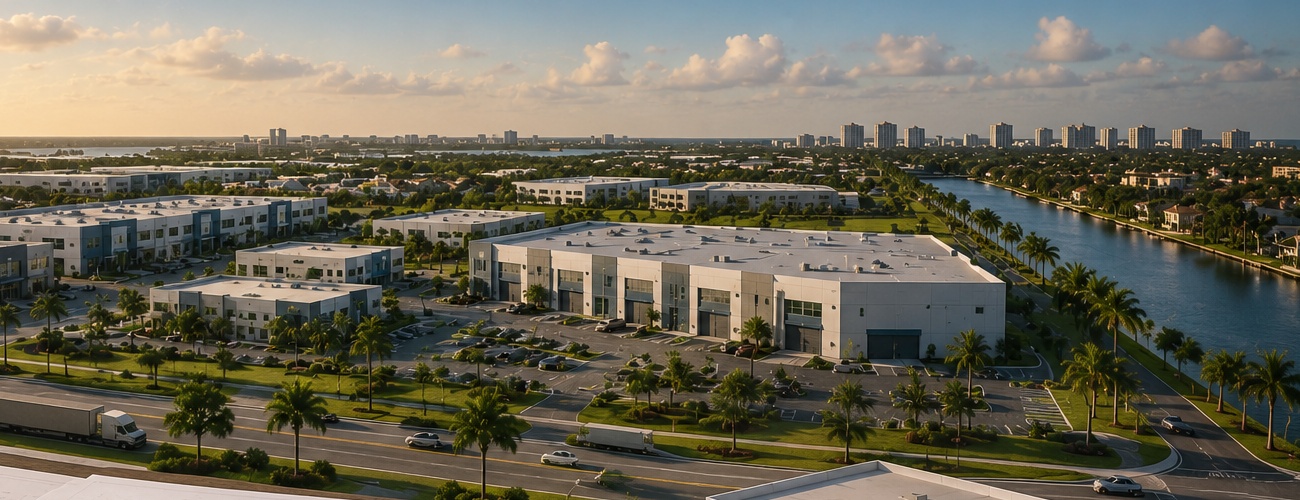
If there’s one location in the county that consistently earns the hype, it’s this one. The area is well suited to logistics, aviation-adjacent industry, light manufacturing, contractor services, and better-quality flex product. The County’s PBIA Overlay, roughly bounded by Belvedere Road, Southern Boulevard, the Florida Turnpike, and the airport itself, lets qualifying land pursue Light Industrial or Planned Industrial Park zoning without needing a Future Land Use Atlas amendment, subject to the usual policies and exceptions.
The upside is straightforward: airport, Turnpike, and I-95 access, strong regional visibility, and an established employment base that can support campus-style industrial and flex development. But the diligence list is longer here than almost anywhere else in the county. Airport compatibility, height limits, noise, and bird-strike restrictions all apply. Southern Boulevard and Belvedere Road traffic draws scrutiny fast. Some parcels carry real drainage and wetlands constraints. And because County land and West Palm Beach land sit right next to each other in this corridor, a site that looks contiguous on a map can mean two entirely different approval processes.
2. West Palm Beach industrial districts
The city’s established industrial and flex pockets, near the airport, Southern Boulevard, Military Trail, 45th Street, and Northpoint, work well for small-bay flex, contractor yards, light manufacturing, wholesale and distribution, and redevelopment of the older one-story buildings scattered through these corridors. The catch is policy direction. West Palm Beach has been leaning toward higher-value urban redevelopment for years now, and industrial land is under real, ongoing pressure from residential and mixed-use proposals that simply pencil better.
3. Riviera Beach and Palm Beach Gardens
Riviera Beach is one of the county’s more established logistics locations, largely thanks to its proximity to the Port of Palm Beach, I-95, and rail. Palm Beach Gardens and the northern county, meanwhile, offer room for clean industrial, research, medical, and flex uses near major arterials, though this submarket is noticeably more design-conscious than a typical logistics market. Large distribution buildings in particular tend to run into community pushback over traffic and scale.
4. Lake Worth and the Park of Commerce
At 0.3% vacancy, Lake Worth isn’t really a ground-up story anymore. It’s a repositioning story: dividing oversized buildings into smaller bays, adding mezzanines, upgrading loading and fire systems, and modernizing older stock for contractors and light manufacturers who can’t find space anywhere else. The trade-off is limited land, aging infrastructure, and residential neighbors close enough to matter.
5. Boynton Beach and Delray Beach
Both markets have land and an active construction pipeline, but the higher vacancy numbers are a real signal, not noise. A new building here won’t lease itself. Build-to-suit deals, preleased flex, and smaller high-quality bays tend to perform better than a purely speculative box competing against a growing shadow inventory.
What is the entitlement and permitting process for industrial and flex projects in Palm Beach County?
The specifics shift depending on jurisdiction, but the typical County or West Palm Beach path runs through seven stages.
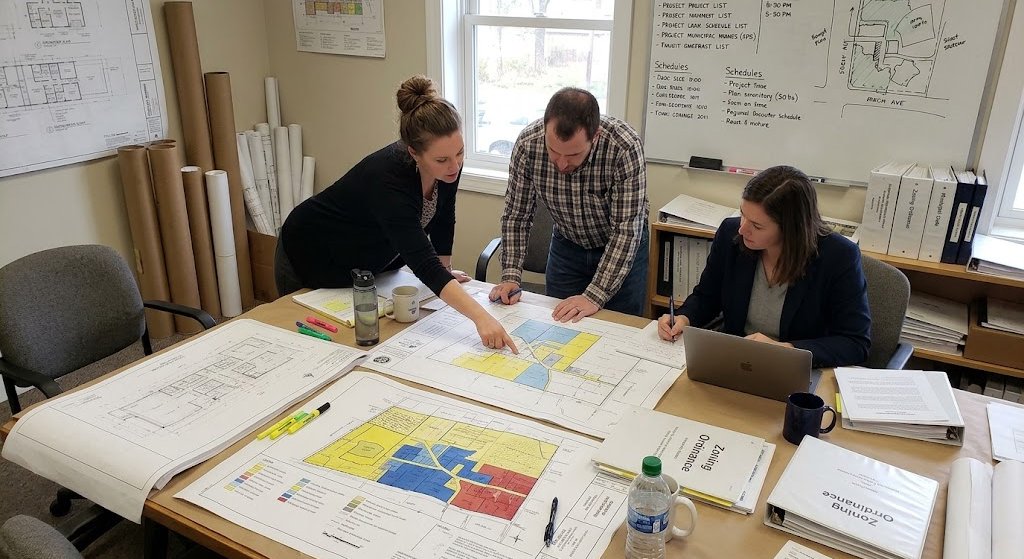
- Confirm jurisdiction and site status. Before a site gets underwritten, someone needs to nail down municipal jurisdiction, zoning, Future Land Use designation, overlay districts, airport protection status, flood zone, environmental constraints, existing development orders, and utility providers. Pull this from the County’s Future Land Use Map and GIS tools directly rather than trusting a broker’s summary of the zoning.
- Obtain zoning confirmation. “Flex industrial” is a leasing term, not a legal use category, and it’s worth remembering that. A single project might combine warehouse, wholesale, light manufacturing, office, contractor storage, outdoor storage, and repair or service uses, and each of those has to be checked separately against the applicable use matrix.
- Schedule a pre-application conference. This should happen before civil and architectural design gets too far along. It’s the meeting that surfaces whether the project actually needs a rezoning, a Future Land Use amendment, a special exception, a variance, site-plan approval, a plat, or a development-order amendment.
- Determine the entitlement path. On the easy end, uses and dimensions already comply and the project moves through administrative site-plan review. On the harder end, the proposal is inconsistent with current zoning or Future Land Use, and a rezoning or Atlas amendment becomes necessary.
- Complete technical site-plan review. This is where access, Traffic Performance Standards, loading and truck maneuvering, parking, landscaping, stormwater, floodplain, utility capacity, lighting, signage, noise, and airport compatibility all get evaluated, among other things.
- Obtain outside agency approvals. Depending on scope, this could involve County Engineering, FDOT, the South Florida Water Management District, Environmental Resources Management, Fire Rescue, the relevant utility, the airport authority, and possibly the Army Corps of Engineers if wetlands are involved.
- Plat, site-development, and building permits. Platting, final civil plans, building permit review across every discipline, fire-rescue review, inspections, and finally a Certificate of Occupancy close out the process.
What are the biggest mistakes developers make in this market?
The single most common misstep is treating “industrial zoning” as if it were the same thing as an approved industrial project. It isn’t. It’s a starting point. Beyond that, a few patterns show up again and again, and they tend to hit different people on the deal team differently:
- Developers often buy land off a broker’s description without confirming Future Land Use, underestimate how long a rezoning or public hearing can take, and miscalculate parking, loading, or truck circulation needs.
- Architects sometimes design more building than the site’s FAR, coverage, and buffer requirements will actually allow, or don’t fully plan for loading-dock screening and industrial-residential compatibility standards until it’s too late to be cheap.
- Civil engineers run into drainage, utility capacity, and easement conflicts that surface late in the process when County, city, FDOT, and SFWMD standards weren’t reconciled early on.
- Investors and lenders frequently lean too hard on countywide vacancy figures instead of submarket-specific data, which leaves thin lease-up reserves for the weaker pockets like Jupiter or Delray Beach.
Are there incentive programs for industrial development in Palm Beach County?
There are, though the rules move often enough that nothing here should be treated as guaranteed money on a pro forma without confirming it first. At the County level, the toolkit includes Industrial Development Revenue Bonds (tax-exempt bonds can finance up to $10 million, with no stated cap on taxable bonds), the economic-development ad valorem tax exemption for qualifying job-creating businesses, job-growth and attraction grants, brownfield redevelopment incentives, and Opportunity Zone financing where it applies.
Inside West Palm Beach specifically, the City lists programs including the Building Improvement Grant, the Business Expansion and Retention Support Grant, the Climate Smart Business Grant, and an ad valorem tax exemption tied to job creation. Most of these grants are first-come, first-qualified until the funds run out, and a few newer programs still have details listed as pending. Florida’s incentive landscape has also shifted quite a bit in recent years, including the earlier repeal of the Qualified Target Industry Tax Refund, so any incentive assumption belongs in a pro forma only after written confirmation from the agency actually administering it.
A practical sequence for evaluating a site
- Start with West Palm Beach, the PBIA overlay, Riviera Beach, Lake Worth, and select Palm Beach Gardens parcels.
- Separate infill and repositioning opportunities from ground-up speculative ones. They’re different businesses.
- Favor small-bay and mid-bay flex over large speculative logistics boxes where the site allows it.
- Confirm zoning and Future Land Use before signing an unconditional contract, not after.
- Run a truck-routing, drainage, airport, and utility screen during due diligence, even if it feels early.
- Get a pre-application meeting on the calendar with the governing jurisdiction as soon as it’s reasonable to.
- Line up tenant interest or letters of intent before committing to speculative construction in Boynton Beach, Delray Beach, or Jupiter.
- Apply for any relevant incentives before the location decision is locked in, since many programs require the application before commitment, not after.
- Build a longer approval and lease-up runway into the schedule for rezonings, public hearings, and sites near the airport or residential neighbors.
Put it all together and the strongest near-term play in this county is rarely a large speculative warehouse on unentitled land. More often it’s a small- to mid-bay industrial or flex project, either a redevelopment in a genuinely tight submarket or a phased, preleased development near the airport corridor.
Working through the process
Nothing above is unusual by Florida standards. What makes Palm Beach County its own animal is the overlapping jurisdictions, the airport constraints, and how differently each submarket behaves. Developers who confirm entitlement feasibility before land goes hard, rather than after, tend to have a much easier year. That’s usually the point where a permit expediting and entitlement consulting partner earns its fee: verifying zoning and Future Land Use, structuring the pre-application submittal, and keeping County, municipal, and outside-agency approvals moving so a project doesn’t stall out six months into design.
JDJ Consulting works with developers, architects, and investors across Palm Beach County on exactly this kind of due diligence and entitlement strategy. If a site is in play, our Palm Beach permit expediting and entitlement consulting services page walks through how we typically get involved, and our broader services overview covers everything we handle from feasibility through permit issuance.
Frequently Asked Questions
Is the Town of Palm Beach a viable location for industrial development? Not really. The Town’s land base is dominated by residential, resort, and institutional uses with strict architectural and historic-preservation controls, and its review process can pull in the Architectural Commission, Landmarks Preservation Commission, and Town Council. Any flex or industrial-type use would be limited to small-scale service or back-of-house functions, not a conventional warehouse.
What is the tightest industrial submarket in Palm Beach County? Lake Worth, at 0.3% vacancy at year-end 2025, followed by West Palm Beach at 3.4% and Boca Raton at 2.4%.
Which Palm Beach County submarkets carry the highest lease-up risk? Jupiter, Delray Beach, and Boynton Beach, with vacancy rates of 26.0%, 15.5%, and 15.1% respectively, driven mainly by recent deliveries and active construction pipelines.
Does industrial zoning guarantee approval of a warehouse or flex project? No. Zoning is a starting point. Use, intensity, traffic, drainage, access, and building design still have to satisfy technical review, and a project can still need a special exception, variance, or rezoning depending on the specifics of the site.
Schema note for implementation: mark up the FAQ section with FAQPage JSON-LD, and consider HowTo schema for the seven-step entitlement process to support featured snippet and AI Overview eligibility.