Table of Contents
Why San Diego’s Best Flex Sites Are Protected, Not Just Zoned, and What That Means for Your Next Deal
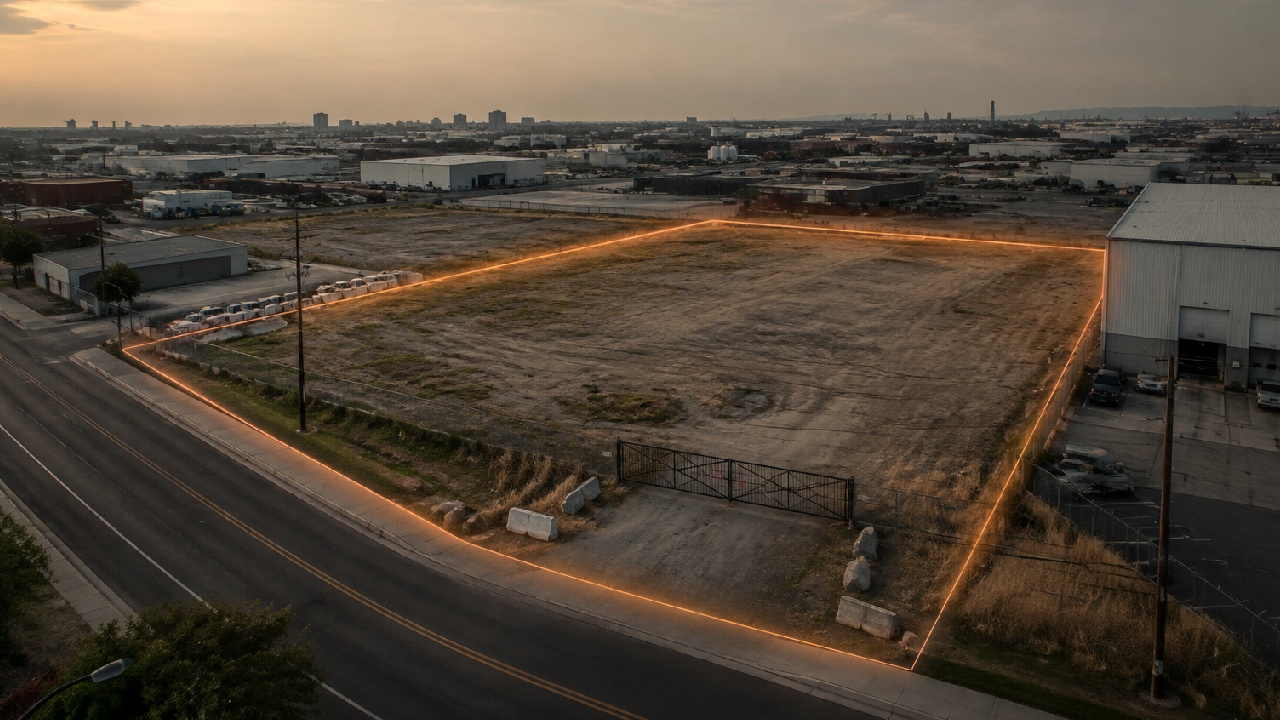
A developer walks a vacant parcel in Kearny Mesa. The zoning map says industrial. The broker says buildable. The pro forma says office-flex with a life-science kicker, because that’s where the rent growth lives. Every signal points go.
Then the pre-application meeting happens, and a planner says four words that stop the deal cold: this is Prime Industrial Land.
That single designation, stacked on top of ordinary zoning, has quietly become the most consequential fact in San Diego industrial real estate. It doesn’t show up on a listing flyer. It rarely comes up in a broker’s opinion of value. But it can decide whether a site becomes a 200,000-square-foot manufacturing campus or a stalled application sitting in a drawer for eighteen months.
San Diego isn’t short on industrial land in the way Los Angeles or the Bay Area are short on land. It’s short on the right kind of certainty. The city is actively working to keep manufacturing, R&D, and distribution capacity from being quietly converted into something else, one entitlement at a time. For architects, developers, and investors used to reading a zoning code and moving, that’s a different game. This is the game as it’s actually played in 2026.
San Diego’s Industrial Market Isn’t Tight. It’s Selective.
The headline vacancy number tells a misleading story. Total industrial vacancy across San Diego sat near 7.4 percent in the second quarter of 2026, which sounds like a market with plenty of breathing room. But that figure hides a submarket spread wide enough to make or break an underwriting model.
Kearny Mesa was running at 4.4 percent vacancy, essentially full by industrial standards. Mira Mesa and Miramar sat at 8.7 percent. Sorrento Mesa was looser still at 9.7 percent. Otay Mesa, the market’s primary growth engine, was the loosest of all at 11.6 percent, carrying the bulk of a proposed pipeline that topped 6.7 million square feet.
Read those numbers side by side and the strategy writes itself. This is not a market where a generic big-box speculative building gets rewarded. It’s a market where functional, infill, small- and mid-bay space near labor, freeways, airports, defense contractors, and cross-border trade routes commands the premium, and where undifferentiated large-format product competes against a supply wave that’s still working through Otay Mesa.
What ‘Flex’ Actually Means Before You Buy the Site
Flex is a leasing term, not a zoning term, and treating it as interchangeable with a specific use is where a surprising number of entitlement timelines go sideways. A building marketed as flex space could end up housing a defense subcontractor running secure assembly lines, a medical-device manufacturer with cleanroom requirements, a contractor storage yard, or a straightforward warehouse-office hybrid. Each of those has a materially different regulatory path.
The variables that actually move the entitlement needle include the volume and type of any manufacturing on site, hazardous-material inventory, air emissions, wastewater discharge, outdoor storage, truck frequency and size, hours of operation, noise and odor, high-piled combustible storage, and the ratio of office to industrial square footage. A generic flex label tells a planner nothing useful. A precise operational-use matrix, built before the site is even under contract, tells them everything.
The Zoning Layer Everyone Checks. The Land-Use Layer Almost Nobody Does.
San Diego’s industrial base zones include International Business and Trade, Industrial Heavy, Industrial Light, Industrial Park, and Industrial Small Lot, each carrying its own permitted-use table and development standards.
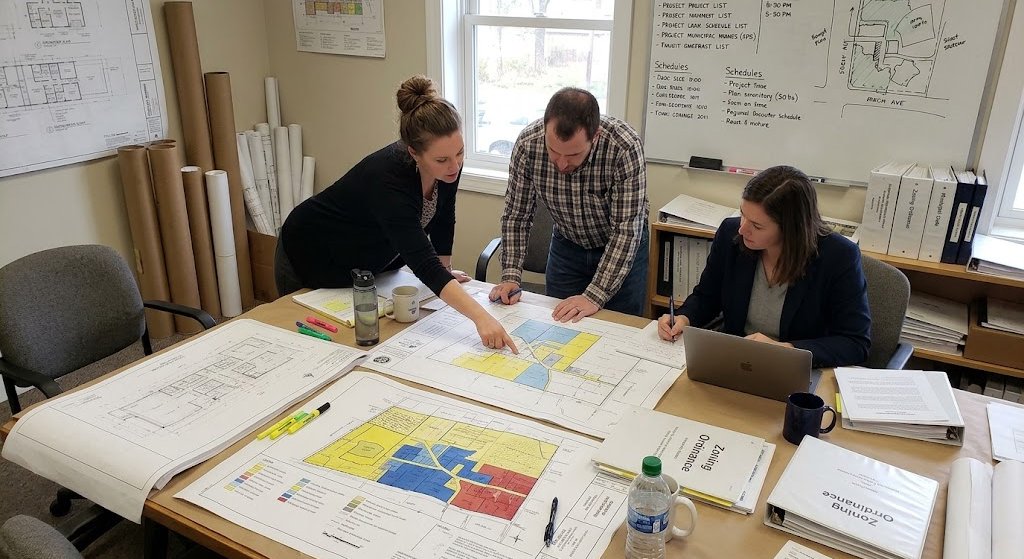
The city’s own zoning information portal makes clear that the zone designation alone is not sufficient; the applicable land-use plan and use table have to be checked in parallel, because each zone carries different permitted uses and development regulations that a base zone label won’t reveal on its own.
That’s the layer most site-selection teams stop at. The layer that actually determines feasibility for a lot of infill sites sits above it: whether the parcel carries a Prime Industrial Land or Prime Industrial Land–Flex designation. Those designations exist specifically to protect manufacturing and distribution capacity from being displaced by office, laboratory, retail, or residential redevelopment, and they can limit or complicate exactly the kind of pivot a developer might want to make once market conditions shift mid-project.
The practical question for any site under consideration is not just what can be built here today, but what happens if I need to build something else in five years. On Prime Industrial Land, that flexibility narrows considerably. Ignoring the designation during due diligence is one of the more expensive mistakes a buyer can make in this market, because it surfaces after acquisition, not before.
The Entitlement Path, Realistically Mapped
Step one: classify the use with precision
Warehouse and distribution, small-bay industrial, contractor storage, light or heavy manufacturing, R&D, incubator flex, medical-device assembly, aerospace or defense production, cold storage, laboratory space, outdoor storage, or a hybrid of several of these. Each classification changes which permits apply and how long the process realistically takes.
Step two: screen the site before falling in love with it
This means confirming the base zone, the community-plan designation, any Prime Industrial Land status, permitted-use tables, height and FAR limits, airport overlays, coastal overlays, environmentally sensitive lands, flood and drainage conditions, existing easements, truck routes, utility and sewer capacity, fire flow, and any legacy environmental contamination. On a former industrial parcel, that last item alone can reshape a budget.
Step three: bring agencies into the room early
Development Services, planning and zoning staff, Fire-Rescue, transportation and stormwater staff, environmental services where hazardous materials are involved, airport authorities where relevant, and utility providers should all weigh in before a purchase agreement is signed, not after. The goal of this preliminary round is a clear answer to one question: is this use permitted by right, or does it trigger discretionary review.
Step four: know which approvals are actually in play
Depending on the use and the site, that list can include a Conditional Use Permit, Site Development Permit, Planned Development Permit, Coastal Development Permit, rezone, community-plan amendment, variance, tentative or parcel map, easement vacation, or a Development Agreement. A straightforward tenant improvement often avoids this entirely. A new building, even one branded as flex, does not get a pass simply because of the label on the leasing brochure.
Step five: environmental review, sized to the risk
Where discretionary approval is required, CEQA review typically follows, ranging from a categorical exemption up through a full environmental impact report depending on traffic, air quality, hazardous materials, soil and groundwater conditions, stormwater, noise, and airport compatibility. A recent Sorrento Valley project offers a useful template: the site carried an Industrial Employment designation and IL-3-1 zoning, and its environmental review worked through storage, stormwater, and hazardous-materials consistency against the land-use plan before clearing.
Where the Deals Actually Pencil, Submarket by Submarket
Kearny Mesa: full, central, and expensive for a reason
At 4.4 percent vacancy and average direct rents near $2.03 per square foot per month NNN, Kearny Mesa is the tightest major industrial submarket in the county. Central location, strong labor access, and proximity to Montgomery-Gibbs Executive Airport keep defense, medical-device, and technology tenants competing for the same limited inventory. The constraint is land, not demand. Small-bay infill and adaptive reuse of aging stock are where the realistic opportunity sits, provided a developer can clear the higher basis.
Mira Mesa and Miramar: bigger sites, more moving parts
Vacancy near 8.7 percent and average rents around $1.80 reflect a submarket with more room to build than Kearny Mesa, anchored by defense, aerospace, and technology demand tied to MCAS Miramar. Military airspace and traffic are the recurring friction points, but the parcel sizes here support a build-to-suit strategy that Kearny Mesa’s fragmented lots simply can’t.
Sorrento Mesa and Sorrento Valley: the R&D overlap zone
Sorrento Mesa’s 9.7 percent vacancy and Sorrento Valley’s tighter 6.2 percent sit inside San Diego’s life-science and medical-device corridor, close to UC San Diego and Torrey Pines. Average direct rents run $1.99 and $1.81 per square foot respectively. Adaptive reuse of aging R&D buildings is a live opportunity here, but only where clear height, floor loading, and utility infrastructure can actually support a lab or manufacturing tenant, not just an office user.
Otay Mesa: the growth engine, and the supply risk that comes with it
Otay Mesa carried roughly 11.6 percent vacancy with about 746,000 square feet under construction and average rents near $1.04 per square foot NNN, the lowest basis of any major submarket. It also represented close to 60 percent of the county’s proposed development pipeline. That combination makes Otay Mesa the strongest large-parcel, cross-border, and logistics opportunity in San Diego, and simultaneously the riskiest place to build speculative product without a tenant already attached. Build-to-suit, phased delivery, and manufacturing-specific design are the strategies that hold up against that supply wave.
Chula Vista and East County: the overlooked value plays
Chula Vista’s roughly 9.4 percent vacancy came with meaningful leasing activity and positive year-to-date absorption, positioning it as a credible landing spot for local service-industrial and medical-supply tenants. East County ran far tighter at approximately 3.7 percent vacancy, offering a lower basis for contractors, light manufacturing, and small distribution users priced out of the central submarkets, at the cost of distance from the port and border.
The Risks That Show Up After the Land Is Bought
Stakeholder | Primary exposure |
|---|---|
Developers & owners | Industrial-land protections limiting future use pivots; environmental liability on legacy industrial parcels; lease-up risk in oversupplied Otay Mesa |
Architects & engineers | Programming for multiple potential tenant types on one shell; truck court geometry on constrained infill lots; retrofitting obsolete buildings for modern clear height and power |
General contractors | Long-lead switchgear and transformers; unknown subsurface and contamination conditions; late tenant-driven process equipment changes |
Investors & lenders | Tenant concentration and government-contract dependence; obsolescence risk; residual value if the site’s protected industrial status limits exit options |
Incentives Worth Screening Before Groundbreaking
San Diego’s industrial framework rewards projects that reinforce, rather than displace, employment-generating land. A handful of the more relevant tools for flex and industrial development include:
- California Competes Tax Credit for tenants adding jobs or capital investment in the state
- Partial sales-and-use-tax exemption on qualifying manufacturing and R&D equipment
- CAEATFA financing support for alternative-energy and advanced-transportation manufacturers
- SDG&E Economic Development Rate discounts and electrification incentives for high-energy users
- Foreign Trade Zone benefits for Otay Mesa assembly and cross-border supply chains
- Industrial Development Bonds for owner-occupied manufacturing and processing facilities
- Employment Training Panel and workforce grants tied to a defined job-creation plan
None of these are automatic, and several attach to the operating tenant rather than the building itself. The value comes from matching the right program to the right party (owner, tenant, equipment purchaser, or workforce provider) early enough that it actually influences deal structure instead of showing up as an afterthought.
The Fee Question Nobody Budgets Correctly the First Time
Development-impact fees, water and sewer connection fees, stormwater inspection fees, and Housing Trust Fund fees on qualifying nonresidential projects can shift a pro forma by a meaningful margin, and the obligation varies by use, square footage, existing building credit, and intensity of the proposed operation. Getting a detailed, site-specific fee estimate before acquisition, not after entitlement, is one of the simpler ways to protect a project’s numbers.
Frequently Asked Questions
Does San Diego industrial zoning automatically allow flex and R&D uses?
Not automatically. The base industrial zone sets the outer boundary of what’s possible, but the permitted-use table, the community plan, and any Prime Industrial Land or Prime Industrial Land–Flex designation all have to be checked together. A use that’s technically zoned-compatible can still require discretionary review if it falls outside the by-right use table for that specific site.
What is Prime Industrial Land, and why does it matter for a flex project?
It’s a land-use designation layered on top of standard zoning that protects sites for manufacturing and distribution capacity, limiting the ability to convert them to office, lab, retail, or residential uses. A site carrying this designation can be harder to repurpose later, which matters directly for exit strategy and long-term flexibility.
Which San Diego industrial submarket has the most room to build right now?
Otay Mesa has by far the largest active and proposed pipeline, along with the lowest rents and the most available large parcels. That also means it carries the highest lease-up risk for speculative, undifferentiated product, which is why build-to-suit and tenant-backed strategies tend to outperform there.
How long does industrial entitlement typically take in San Diego?
It depends entirely on whether the use is permitted by right or triggers discretionary review. A straightforward tenant improvement in an existing building can move quickly. A new building requiring a Conditional Use Permit, CEQA review, or a rezone can take considerably longer, particularly on sites with environmental complexity or airport-compatibility questions.
What’s the biggest mistake developers make on San Diego industrial sites?
Treating the base zoning designation as the whole story. Skipping the Prime Industrial Land check, the environmental due diligence, and the airport or aviation overlay review is what turns a promising site into a stalled application well after the purchase agreement has closed.
A Practical Starting Point
Before a San Diego industrial or flex site goes under contract, the sequence that holds up best in practice is an operational-use matrix built first, a land-use protection check second, a functional test fit third, and an infrastructure and environmental audit fourth, all completed before the site is fully committed. Getting that sequence backwards is how a well-located parcel turns into an eighteen-month entitlement fight.
That’s the layer of work our team handles daily. JDJ Consulting’s San Diego permit expediting and entitlement team runs the zoning and Prime Industrial Land screening, agency coordination, and CEQA pathway analysis before capital is committed, not after a stalled hearing forces a redesign.
For developers weighing a build-to-suit in Otay Mesa against an infill play in Kearny Mesa, or an architect trying to program a shell flexible enough for three different tenant profiles, that early screening is usually the difference between a project that moves and one that stalls at the counter.
A conversation with an entitlement team that already knows which San Diego submarkets are protected, which are permissive, and which are quietly running out of room tends to save more time than it costs. Learn more about JDJ Consulting’s land use and permitting services across California, Texas, and Florida markets.