Table of Contents
Drive down Lake Avenue or Fair Oaks Avenue in Altadena today and you will see two versions of the same street. On one block, a boarded storefront waiting on insurance proceeds. On the next, a contractor’s truck parked outside a gutted retail bay, framing already underway. Eighteen months after the Eaton Fire tore through this unincorporated stretch of Los Angeles County, the question facing property owners, investors, and small business tenants is no longer whether Altadena rebuilds its commercial corridors. It is who moves first, and how quickly they can get through the permitting process to do it.
For architects, developers, and investors evaluating neighborhood-serving retail in Altadena, the opportunity is real. So is the procedural complexity. Because Altadena has no city hall of its own, every retail project here answers to Los Angeles County rather than a municipal planning department, and that distinction shapes nearly every decision that follows.
Why Altadena Retail Projects Run Through the County, Not a City
Altadena is unincorporated Los Angeles County. There is no Altadena Planning Department, no Altadena Building Official. Instead, neighborhood-serving retail projects are reviewed by LA County Regional Planning for zoning clearance and by LA County Public Works, Building and Safety, for construction permits, with the Los Angeles County Fire Department conducting plan check and inspections on top of that.
That structure matters for anyone used to working in the City of Los Angeles or Pasadena. The forms, the review sequencing, and even the staff contacts are different. Developers who assume County process mirrors a nearby city’s process tend to lose weeks correcting that assumption.
What Counts as Neighborhood-Serving Retail
The category is broader than it sounds. Grocery stores, dry cleaners, salons, cafes, small restaurants, boutiques, and personal service businesses all fall under the neighborhood-serving retail umbrella, and most are permitted outright in the County’s commercial zones, with conditional approval sometimes available in residential or mixed-use areas.
Four commercial zoning designations govern most of Altadena’s retail footprint:
C1, Limited Commercial, covers small-scale retail, personal services, and offices, typically found along neighborhood corridors rather than regional destinations.
C2, General Commercial, allows larger retail formats, restaurants, and entertainment uses, and often permits mixed-use development with residential above ground-floor commercial.
C3, Central Commercial, supports more intensive uses, including department stores, hotels, and theaters.
C4, Regional Commercial, is reserved for large-scale retail, shopping centers, and substantial mixed-use projects.
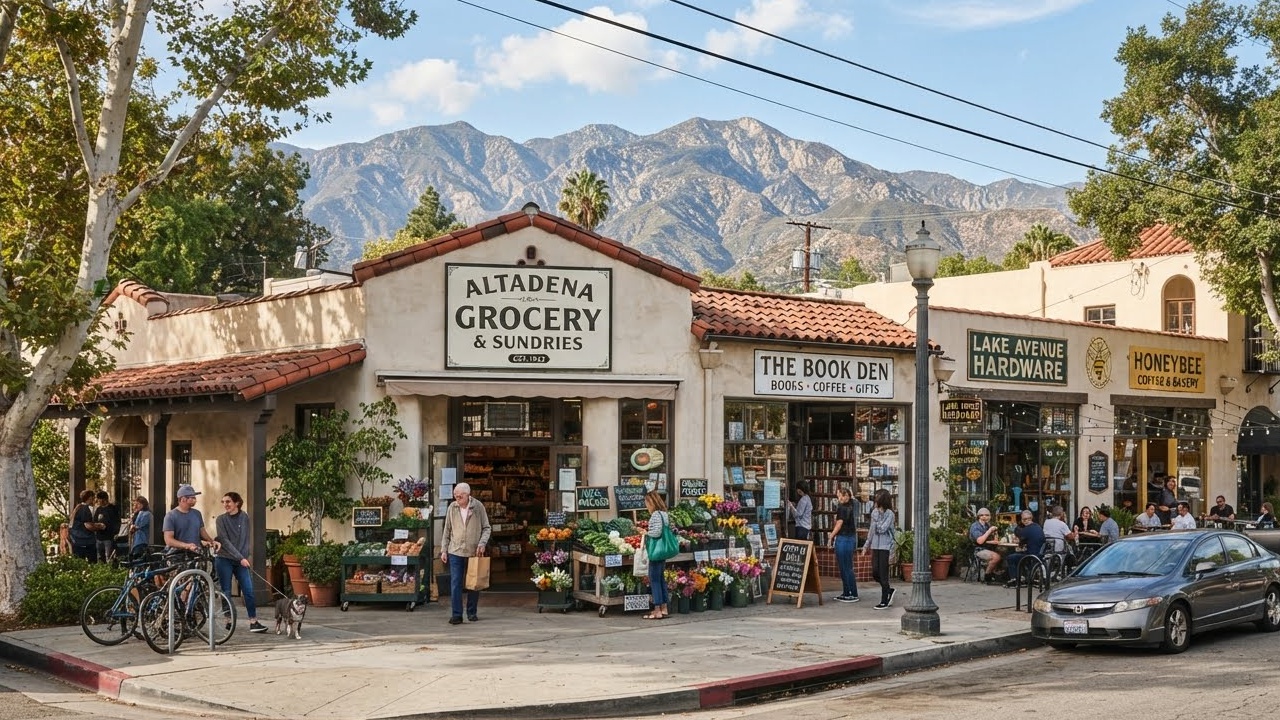
In practice, Altadena’s commercial activity concentrates along four corridors: Lake Avenue, Fair Oaks Avenue, Lincoln Avenue, and Foothill Boulevard. Lake Avenue and Fair Oaks carry much of the C2 and C3 zoning and the bulk of post-fire redevelopment interest. Foothill Boulevard, zoned C2 and C4 in stretches, serves a more regional customer base. Lincoln Avenue remains the corridor with the most unrealized potential, a semi-blighted west-end stretch increasingly discussed as a candidate for upzoning and mixed-use investment.
The Five-Step Path From Concept to Certificate of Occupancy
Step one is feasibility and pre-application review. Before drawing a single wall, confirm the parcel’s zoning, lot size, and whether it sits within a hillside or fire hazard overlay that could affect height, setbacks, or wildland urban interface (WUI) requirements. Altadena’s One-Stop Permit Center, at 464 W Woodbury Rd, Suite 210, provides property-specific packets and can clarify early whether a proposed use is allowed by right or will require discretionary review.
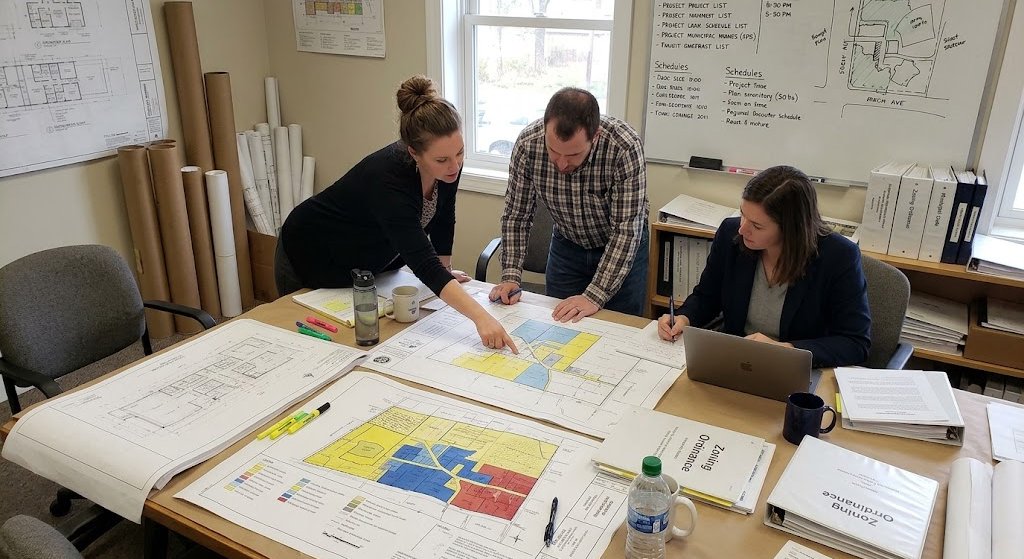
Step two is zoning clearance through Regional Planning. This requires a complete site plan, floor plans, and elevations showing building size, height, setbacks, parking, and signage. Under state law, the County must act on complete, objective-standard applications within sixty days, and most straightforward retail projects are processed administratively rather than through a hearing. Projects that require a Conditional Use Permit face a longer runway, including a public hearing before the Planning Commission.
Step three is the building permit and Fire Department plan check, which run in parallel. This stage covers structural plans and calculations, Title 24 energy compliance, and, for anything in a Very High Fire Hazard Severity Zone, Chapter 7A wildfire-hardening requirements: ember-resistant vents, ignition-resistant materials, tempered or multi-pane glazing, and Class A roofing. Depending on occupancy and square footage, interior fire sprinklers may also be required. Food service uses need a separate Public Health clearance, and larger projects may need a water agency will-serve letter or a traffic study.
Step four is permit issuance and construction, which cannot begin until every permit clears and which proceeds through the standard inspection sequence: foundation, framing, mechanical-electrical-plumbing, and final.
Step five is the Certificate of Occupancy, the last gate before a business can open its doors.
For a retail project that meets objective standards, from initial submission to a Certificate of Occupancy typically runs ten to sixteen weeks. Hillside sites, projects requiring a Conditional Use Permit, or larger-format developments should plan for a longer timeline.
Where the Process Gets Difficult
Every stakeholder in a neighborhood retail project faces a different set of friction points.
Developers and investors contend with zoning uncertainty when a proposed use is not permitted by right and requires a Conditional Use Permit, which adds both time and outcome risk. Community sentiment is a real variable too. Altadena’s Land Use Committee and neighboring town halls have shown organized concern about proposals perceived as altering neighborhood character or adding traffic, and that scrutiny has only intensified as fire recovery reshapes the corridor. Acquisition risk compounds the picture, since many commercial parcels were damaged or destroyed outright and their redevelopment now depends on insurance settlements, financing, and a still-forming read on post-fire retail demand. Parking is its own constraint, with typical requirements of one space per two hundred to three hundred square feet of floor area, a ratio that can be difficult to satisfy on Altadena’s smaller commercial lots.
Architects and designers carry the technical burden of Chapter 7A compliance in Very High Fire Hazard Severity Zones, along with objective setback and height standards that, if respected, keep a project on the faster administrative track and, if exceeded, invite additional discretionary review. Signage is regulated separately under County code, and oversized or noncompliant signage packages are a recurring source of delay. Because the sixty-day County review clock only applies to complete applications, incomplete site plans, floor plans, elevations, or missing Title 24 documentation are one of the most common and most avoidable causes of lost time.
General contractors manage utility coordination, including separate metering and, on fire-impacted parcels, addressing tied to emergency access requirements. Construction costs remain volatile, with permit fees alone running roughly eight thousand to sixteen thousand dollars in unincorporated LA County before accounting for size, finishes, or site work. On fire-recovery lots specifically, sequencing with debris removal, geotechnical and soils reporting, and temporary utility service adds another layer of coordination that has no equivalent on a standard infill project.
Investors and lenders are watching three risk categories closely: insurance shortfalls that leave rebuilding costs exceeding available coverage, genuine uncertainty about retail demand recovery along the hardest-hit corridors, and financing gaps for smaller operators who lack the collateral or credit history to secure a conventional rebuild loan.
Where Opportunity Is Concentrated, and Where It Still Waits
Retail activity is already visible on Lake Avenue, where C3 zoning supports a wide range of commercial and mixed-use formats and where several post-fire parcels are actively being marketed for redevelopment. Fair Oaks Avenue, zoned C2 and C3, continues to host a working mix of retail, restaurants, and personal services. Foothill Boulevard’s C2 and C4 zoning supports more regional-scale retail and services.
The corridor with the most unrealized upside is Lincoln Avenue, a west-end stretch that planners and community groups increasingly discuss as a candidate for upzoning paired with new housing and retail in a mixed-use format. Beyond Lincoln, the clearest opportunities sit at the intersection of three conditions: parcels along established corridors with existing utility and parking infrastructure, vacant or fire-damaged lots offering a genuine blank-canvas redevelopment opportunity, and mixed-use zones where an existing residential base already supports neighborhood-serving retail demand.
The constraints on that opportunity are worth naming plainly. Hillside overlays limit height, footprint, and placement on a meaningful share of Altadena parcels. Small lot sizes make parking compliance genuinely difficult in places. Community sentiment, while broadly supportive of retail recovery, can still turn sharply against specific use types, particularly restaurants proposing outdoor seating or late-night operations. And Very High Fire Hazard Severity Zone designations layer additional WUI compliance costs onto projects that are already navigating a complex rebuild.
Incentives Worth Building Into the Pro Forma
Several financial and process incentives are currently stacking in Altadena’s favor for neighborhood retail recovery.
On the grant side, the Rooted and Rebuilding Grant Program, administered by Inclusive Action, distributed 510,000 dollars to small businesses in Altadena and surrounding neighborhoods across two 2025 and 2026 funding rounds, with priority given to legacy businesses and business owners who have not yet received other support. The LAEDC is offering direct financial grants to small businesses affected by the January 2025 Palisades and Eaton fires, with amounts varying by applicant. The ACOC Business Recovery Fund provides smaller emergency grants, generally five hundred to fifteen hundred dollars, for wildfire-impacted businesses and nonprofits in Altadena, though funding is limited and moves quickly.
On the process side, the state-mandated sixty-day approval clock for complete, objective-standard applications remains the single biggest lever available to a well-prepared applicant. Many retail projects also qualify for CEQA exemptions, removing what is often the longest and most unpredictable entitlement hurdle on a conventional commercial project. Altadena’s One-Stop Permit Center, which co-locates Planning, Building and Safety, and Fire Department reviewers specifically for fire rebuild projects, has meaningfully compressed coordination time for applicants who use it.
On financing, SBA disaster loans remain available to small businesses affected by the Eaton Fire for rebuilding costs, inventory, and working capital, and SoCalGas’s Residential Energy Efficient Fire Rebuild Program offers enhanced rebates for qualifying multifamily and, in some cases, commercial rebuilds, provided the application is submitted before construction begins.
The Practical Takeaway
Altadena’s commercial corridors are being rebuilt lot by lot, and the projects moving fastest share a common trait: they arrived at Regional Planning with a complete, objective-standard application, a WUI-compliant design already baked in, and a parking and signage plan that did not need to be renegotiated mid-review. The sixty-day clock is real, but it only starts once the application is actually complete.
Every retail project also carries its own combination of zone, overlay, fire hazard designation, and incentive eligibility, and getting that combination right at the feasibility stage is what separates a ten-week approval from a ten-month one. For a closer look at how these same entitlement dynamics are playing out on the residential side of Altadena’s recovery, and in the Palisades, see JDJ Consulting’s analysis of the Altadena and Palisades wildfire rebuild process.
JDJ Consulting works with architects, developers, and investors navigating LA County’s zoning and entitlement process on fire-recovery and infill commercial projects alike, from initial feasibility review through final Certificate of Occupancy. More on our approach is available at jdj-consulting.com/services.