
In Los Angeles County, every property has its own unique identity. That identity comes in the form of an Assessor’s Parcel Number (APN). Think of it as your property’s fingerprint — no two parcels share the same number.
Table of Contents
The Los Angeles County Assessor’s Office assigns an APN to every parcel of land for property tax and public record purposes.
Once you know your APN, you can quickly access important information tied to your property, including tax bills, assessed value, parcel maps, zoning details, and payment history.
With an APN, you can:
Find current and past property tax records
Check assessed land and improvement values
View parcel maps and zoning information
Access official county property records
Verify exemptions and ownership details
While you can sometimes search using a property address or owner name, the APN is the most accurate and reliable way to locate records — especially in a large county like Los Angeles.
The good news is that finding your APN and accessing property tax records online only takes a few minutes. In this guide, we’ll walk you through the exact steps to search Los Angeles County property records using official county resources.
How to Find Your Los Angeles APN Number Quickly
You can find your Los Angeles County Assessor’s Parcel Number (APN) online in just a few minutes using official county resources.
Your APN allows you to access property tax records, assessed values, parcel maps, zoning details, and other public property information.
- Visit the official: LA County Assessor Property Search Portal
- Enter your property address, owner name, or parcel information into the search tool.
- Locate your property in the results and copy the listed APN number.
- Use your APN to view:
- Property tax bills
- Assessment history
- Parcel maps and zoning records
- Payment status and exemptions
Planning a Property or Development Project?
JDJ Consulting Group helps clients with zoning research, due diligence, permit expediting, and development strategy across Los Angeles, Austin, and Miami.
Understanding APNs in Los Angeles County
Before we start searching, let’s break down what an APN actually is in Los Angeles. An APN in LA County is a 10-digit number that follows a consistent pattern:
Example: 1234-567-890
First four digits = Map book number. This tells you which large area of the county your property is in.
Next three digits = Page number within that map book.
Last three digits = Parcel number on that page.
This number is created and maintained by the County Assessor. It’s used in many county systems, including:
Assessor’s database (ownership and value data).
Tax Collector’s database (bills, payment history, delinquencies).
County Recorder’s office (legal documents like deeds and liens).
A few important points about APNs in LA County:
Your APN stays with the property, even if the ownership changes.
If a property is split into smaller parcels or merged into a larger one, the APN can change.
APNs are public information — anyone can look them up online.
APNs in Los Angeles are different from parcel IDs in other states; the format and numbering system are specific to this county.
When you search for property tax records, LA County will always ask for the APN first. That’s because it’s the fastest way to bring up the exact property without confusion over similar addresses or owner names.
Step-by-Step: Finding Your APN
Before you can search for your property tax records, you need the APN itself. In Los Angeles County, there are several easy ways to find it.
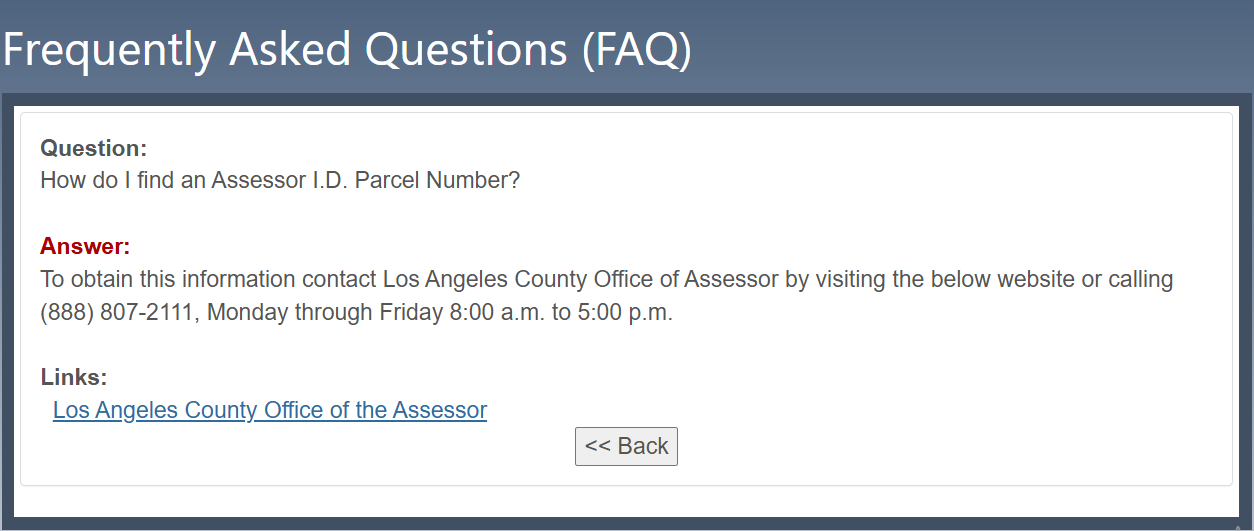
Look on your property tax bill
Your APN will be printed near the top of the bill, usually labeled “Assessor’s Identification Number” or “AIN” — both terms mean the same thing.
It will be in the format
1234-567-890with dashes.Example from a bill:
Assessor’s Identification Number: 2465-012-015
Check your deed or title report
If you recently purchased the property, the Grant Deed or Warranty Deed will have the APN in the property description section.
Title companies also list the APN in their preliminary title reports.
Look at your mortgage or escrow documents
Lenders use the APN when setting up tax payment accounts. It’s often on the escrow closing statement or mortgage statements.
Use the LA County Assessor’s Online Property Search
Click Property Search.
You can search by address or legal description if you don’t know the APN.
Once you find your property, the APN will be displayed on the results page.
Table: Where to Find Your APN in Los Angeles County
| Source | Format You’ll See | Fastest Option? | Cost |
|---|---|---|---|
| Property tax bill | 1234-567-890 | Yes | Free |
| Grant deed / title report | 1234-567-890 | Yes | Free (if you have a copy) |
| Mortgage documents | 1234-567-890 | Sometimes slower | Free |
| LA County Assessor’s online search | 1234-567-890 | Yes | Free |
| Parcel maps (LA County Public Works) | 1234-567-890 | Not for beginners | Free |
Tip: Always write down your APN in the exact format it’s shown — some county systems won’t find your property if you remove dashes or change spacing.
Step-by-Step: Using Your APN to Get Tax Records Online
Once you have your APN, you can use it to pull up your property tax records in Los Angeles County in just a few minutes.
Go to the Los Angeles County Assessor’s website
On the homepage, click Property Search.
Enter your APN exactly as shown on your bill (including dashes).
Press Search.
The results will show the property’s basic details — owner name, mailing address, land use code, and assessed value.
Link to the Tax Collector’s Office
On the Assessor results page, look for a link to the Treasurer and Tax Collector website.
The Tax Collector is the department that issues bills and collects payments.
Clicking this link will take you directly to the tax payment portal for your property.
View your tax bill and payment history
On the Treasurer and Tax Collector page, you’ll see the current year’s bill and any unpaid balances.
You can also click View Tax Bill for a detailed breakdown.
Use View Payment History to see prior years’ payments. This is useful for confirming if your lender paid on time or checking past amounts.
Download or print copies
Most bills can be downloaded as PDFs.
Save these on your computer or cloud storage — you may need them for:
Refinancing your home.
Appealing your property tax assessment.
Selling your property.
Pro Tip for LA County Searches:
If the system says “Parcel Not Found”, try:
Removing dashes in the APN.
Adding or removing leading zeros.
Double-checking that you’re using the current APN (recently split or merged parcels may have a new number).
What You’ll See on Your Tax Record Page
Once you enter your APN and pull up your property in the Los Angeles County system, you’ll see several important pieces of information. Understanding each section will help you read your tax record with confidence.
Owner Information
Name – The person(s) or entity listed as the legal owner of the property.
Mailing Address – This is where the county sends tax bills and notices. It might be different from the property’s street address, especially for rental properties or investment properties.
Property Location and Description
Situs Address – This is the actual location of the property. In some cases, vacant land may not have a formal street address.
Legal Description – A formal description of your property as recorded in county records. Often refers to tract maps and lot numbers.
Assessed Value Details
The Assessor determines the assessed value, which is used to calculate your property taxes. You’ll see:
Land Value – The taxable value of the land itself.
Improvement Value – The taxable value of any buildings or structures on the land.
Total Assessed Value – The sum of land and improvements, minus any exemptions.
Exemptions
Certain exemptions can reduce your taxable value:
Homeowners’ Exemption – Reduces taxable value for your primary residence.
Veterans’ Exemption – For eligible veterans.
Senior or Disability Exemptions – For qualifying residents.
If you don’t see an exemption you qualify for, you may need to apply through the Assessor’s Office.
Tax Rate and District Information
Shows the percentage used to calculate your annual property tax.
Lists taxing agencies and special districts (like school districts or water districts) that receive portions of your tax payment.
Tax Bill and Payment History
This section is the most practical for most property owners:
Current Bill – Lists the total amount due, including installment breakdowns.
Prior Years’ Bills – Shows amounts billed and paid for previous years.
Delinquent Amounts – Any unpaid taxes from previous periods.
Parcel Map Links
Some APN search results include links to parcel maps or GIS viewer tools, which visually show your property’s boundaries. This is especially helpful for large lots or irregular parcels.
Tip: Always review your tax record for accuracy. Errors in assessed value, mailing address, or exemption status can lead to overpaying or missing critical notices.
How to Download, Print, and Save Your Tax Records
Having a copy of your property tax records can save you headaches later — especially if you’re refinancing, selling, or appealing your tax assessment.
Viewing and Downloading Your Tax Bill
On the Treasurer and Tax Collector page, click View/Print Tax Bill.
A PDF will open in your browser or download to your computer.
The PDF will include:
Owner and mailing address
Property location
Assessed values
Tax rate
Current year’s charges
Payment instructions
Saving a Copy for Your Records
Save the PDF to a dedicated folder on your computer.
Consider naming the file something clear like:
2024-PropertyTax-2465-012-015.pdf(Replace the APN in the file name so it’s easy to find later.)
Printing Your Tax Bill
Most browsers have a Print option in the PDF viewer.
Printing is helpful if you need a hard copy for a loan application or to mail with a payment.
Keeping Multiple Years for Comparison
It’s smart to save at least the last three years of bills:
Helps you see trends in assessed value changes.
Useful for verifying lender payments.
Handy when challenging an assessment — you can show a pattern of increases.
Storing Securely
Store electronic copies on your computer and a cloud backup.
Keep printed copies in a labeled folder or safe.
Avoid emailing tax bills unless necessary — they contain your name, mailing address, and property details.
Pro Tip for LA County:
If you ever need certified copies of tax bills or payment histories, you must request them from the Treasurer and Tax Collector’s office. Certified copies often require a small fee but are sometimes necessary for court or legal proceedings.
Need Help in Property or Development Requirements?
JDJ Consulting Group supports developers, investors, architects, and property owners with permit expediting, land-use strategy, due diligence, feasibility studies, and agency coordination across Los Angeles, Austin, and Miami.
(818) 793-5058
sales@jdj-consulting.com
Common Problems LA Residents Face and How to Solve Them
Even with an APN, searching for property tax records in Los Angeles County isn’t always smooth. Here are the most common problems property owners face — and how to fix them.
“Parcel Not Found” Error
Why it happens:
APN entered in the wrong format.
The property was recently purchased, and the records aren’t updated yet.
The parcel was split, merged, or renumbered.
Solutions:
Try entering the APN with dashes (
1234-567-890) and without dashes (1234567890).Add or remove leading zeros (
0123-456-789).If it’s a new property, wait a few weeks after closing — the Assessor’s database updates periodically.
Call the LA County Assessor’s Office for the latest APN if it’s a newly created parcel.
Owner Name or Mailing Address Is Wrong
Why it happens:
The deed hasn’t been fully processed by the County Recorder.
The mailing address hasn’t been updated in the Assessor’s system.
Solutions:
File a Change of Mailing Address form with the Assessor’s Office.
If ownership is wrong, check your deed at the County Recorder’s Office to make sure it was recorded correctly.
Missing Exemptions
Why it happens:
Homeowner or veteran exemptions were never filed.
You moved in but didn’t submit the exemption form.
Solutions:
File for the Homeowners’ Exemption with the Assessor — it can save you up to $7,000 in assessed value each year.
Submit forms before the annual deadline to get the benefit for the current tax year.
Outdated Payment History
Why it happens:
Online records can take a few days to update after payments.
Solutions:
If you paid recently, wait 3–5 business days before checking online.
Keep your bank or lender’s payment confirmation for proof.
Confusion Over Property Boundaries
Why it happens:
The APN covers a lot that doesn’t match what you think you own.
Solutions:
View the parcel map linked in the search results.
Contact LA County Public Works GIS for detailed mapping.
Alternative Ways to Get Your Tax Records If Online Search Fails
Sometimes, even with your APN, the online search won’t work — or you may need official copies for legal or financial purposes. Here are alternative methods.
Visit the Los Angeles County Assessor’s Public Service Counters
Location: Kenneth Hahn Hall of Administration, downtown LA.
What to bring: APN, property address, valid ID.
Services: View assessment records, request APN verification, apply for exemptions.
Contact the Treasurer and Tax Collector by Phone
Phone: (213) 974-2111
Provide your APN and request a mailed copy of your tax bill or payment history.
Small fees may apply for mailing or certified documents.
Request Records by Mail
Write a letter including your APN, property address, and the tax years you need.
Send to the Treasurer and Tax Collector’s office with any required fees.
Use a Title Company or Escrow Officer
If you’re in the middle of a transaction, your title or escrow company can pull APN-based tax records for you.
They often have access to subscription-based property data systems.
Check with the County Recorder’s Office
While they don’t handle tax bills, they store deeds, liens, and legal documents tied to your APN.
Sometimes, these documents reference tax details or past assessments.
Pro Tip:
For urgent matters — like a looming tax sale or pending foreclosure — always go in person to the Treasurer and Tax Collector’s office. Online delays can cost you valuable time.
Why Your APN Matters Beyond Property Taxes
Most property owners think an Assessor’s Parcel Number (APN) is only for paying taxes. In reality, your APN is a master key for dozens of property-related processes in Los Angeles County.
Here’s why it matters beyond taxes:
Zoning Research
Your APN links directly to the county’s property database, which contains zoning classifications, land use restrictions, and development history. JDJ Consulting uses this information to confirm whether your planned project is even possible before you invest time and money.
Permit Applications
City departments often require your APN on building permit applications. If your APN is entered incorrectly, your permit request could be delayed or denied.
Property Records Searches
Title companies, real estate agents, and consultants all use APNs to pull accurate lot size, map coordinates, and subdivision information.
Environmental and Planning Reviews
Agencies use APNs when checking if a property falls in a flood zone, seismic hazard zone, or other special planning area.
JDJ Tip: When we work with clients in Los Angeles, we treat the APN as the “anchor” record for all planning and development work. It’s often the first thing we verify when starting zoning analysis, permit expediting, or entitlement services.
How JDJ Consulting Group Can Help You Use APN Data Strategically
JDJ Consulting Group doesn’t just help you find your APN — we help you leverage it.
Here’s how we turn that simple number into valuable insights for your property goals:
Zoning & Land Use Verification
We check your APN against city zoning maps, land use codes, and special overlay districts.
This confirms whether your property can be used for residential, commercial, or mixed-use projects.
Pre-Development Feasibility Studies
Using your APN, we pull all relevant site data before you submit any plans.
This prevents costly rework if a project conflicts with local codes.
Permit Application Support
We ensure your APN matches the official Assessor’s records on every form.
Small errors here can trigger weeks of delays.
Property Tax & Valuation Analysis
If your APN is linked to an incorrect assessed value, we can help guide you through the appeal process.
Compliance & Legal Risk Reduction
An accurate APN ensures you are working with the right parcel boundaries, avoiding disputes with neighbors or the city.
Why it matters: By using APN data strategically, property owners save time, reduce risk, and gain a clear path toward project approvals. At JDJ, this is part of how we turn complicated bureaucracy into clear action steps.
Case Studies: LA Property Owners Who Benefited from Understanding Their APN
Real examples show how a simple number can unlock big opportunities. Here are three Los Angeles cases where knowing — and using — an APN made a major difference.
Case 1: Avoiding a Permit Denial in Hollywood
A homeowner wanted to add a second story to their house. During the planning phase, the city’s system flagged a mismatch between the property address and APN on the permit application. JDJ Consulting identified the error, corrected the APN, and resubmitted the paperwork. Without that fix, the client would have lost months in processing time.
Case 2: Unlocking a Development Opportunity in Downtown LA
An investor bought a small commercial building but wasn’t aware that the property’s APN linked to two adjoining parcels. JDJ used APN records to confirm both parcels were zoned for mixed-use redevelopment, allowing the investor to propose a larger project than originally planned.
Case 3: Reducing an Inflated Tax Assessment in West Los Angeles
A property owner received a much higher tax bill after a remodel. Using the APN, JDJ Consulting compared the assessor’s data to actual construction records and discovered incorrect square footage in the county file. The correction reduced the property tax bill by 18% the following year.
Takeaway: APNs are not just clerical details — they can influence your project’s scope, budget, and approval timeline.
Final Checklist for LA County APN Lookups
Before you start your property tax or development research, follow this checklist to avoid common mistakes:
Find Your Correct APN
Use the Los Angeles County Assessor’s Office website or your tax bill.Verify APN Matches Official Records
Cross-check on multiple platforms (city zoning map, title report, assessor’s site).Note Zoning & Use Restrictions
Use JDJ’s zoning research services to understand what your APN reveals about your property’s allowed uses.Check for Special Designations
Look for flood zones, seismic zones, or historic preservation restrictions linked to your APN.Use APN on All Official Forms
Ensure every permit, application, or report lists the correct APN.Keep a Digital Copy of Your APN Records
This makes future filings faster and prevents errors from creeping in.
Pro Tip from JDJ Consulting: If you’re planning a remodel, new construction, or property purchase, send us your APN first. We can quickly identify any red flags before you spend on plans, contractors, or applications.
Ready to Use Your APN for More Than Just Taxes?
Your APN is more than a line on a property tax bill. In Los Angeles County, it’s a key to unlocking a property’s full story — from ownership history and legal boundaries to zoning rights and development opportunities. Whether you’re a homeowner, investor, or developer, understanding and using your APN strategically can save time, prevent costly mistakes, and open new possibilities.
At JDJ Consulting Group, we specialize in taking that raw APN data and translating it into actionable insights. We look at how your parcel number interacts with:
Local zoning codes and building regulations
Permit history and approval timelines
Development feasibility and potential red flags
Opportunities for land assembly or subdivision
Likewise, we go beyond “finding the number.” We help you see the bigger picture, align your property goals with city requirements, and move projects forward without unnecessary delays.
Work With JDJ Consulting Group
Your project’s success starts with the right details.
Before you spend time or money on designs, contractors, or applications, let’s ensure your APN, zoning data, and property profile are accurate and ready to work in your favor.
Call us today at (818) 793-5058