Getting a permit violation notice can feel stressful. It often comes without warning. You may not even know what went wrong. The good news is this: most violations are fixable. You just need to act quickly and follow the right steps.
In this guide, we’ll walk you through what a permit violation means in Texas, why it happens, and what you should do next. The goal is simple—help you fix the issue and avoid bigger problems.
Table of Contents
What Is a Permit Violation Notice in Texas?
A permit violation notice is an official letter from your local city or county. It tells you that some work on your property does not meet the rules. This could be about construction, renovation, electrical work, plumbing, or land use. In simple terms, it means something was done without proper approval or does not meet code.
Simple Definition
A permit violation notice means:
Work was done without a permit, or
Work does not meet local building codes, or
Required inspections were missed
The notice usually includes:
A description of the problem
A deadline to fix it
Possible penalties if you don’t respond
Each city in Texas has its own process. But the basic idea is the same everywhere—fix the issue or face penalties.
Why You Received This Notice
There are a few common reasons why people get these notices. Most of the time, it’s not intentional.
Here are the main causes:
You started work without getting a permit
Your permit expired before the work was finished
You skipped required inspections
The work does not meet building codes
The property is being used in the wrong way (zoning issue)
Sometimes, even hiring a contractor does not protect you. If they skip permits, you are still responsible as the property owner.
Who Sends the Notice?
In Texas, permit violations are usually issued by:
City code enforcement departments
Building inspection departments
County authorities (in some areas)
They may find violations through:
Routine inspections
Complaints from neighbors
Property sales or appraisals
Common Types of Permit Violations in Texas
Not all violations are the same. Some are simple to fix. Others can take more time and money. Let’s go over the most common ones.
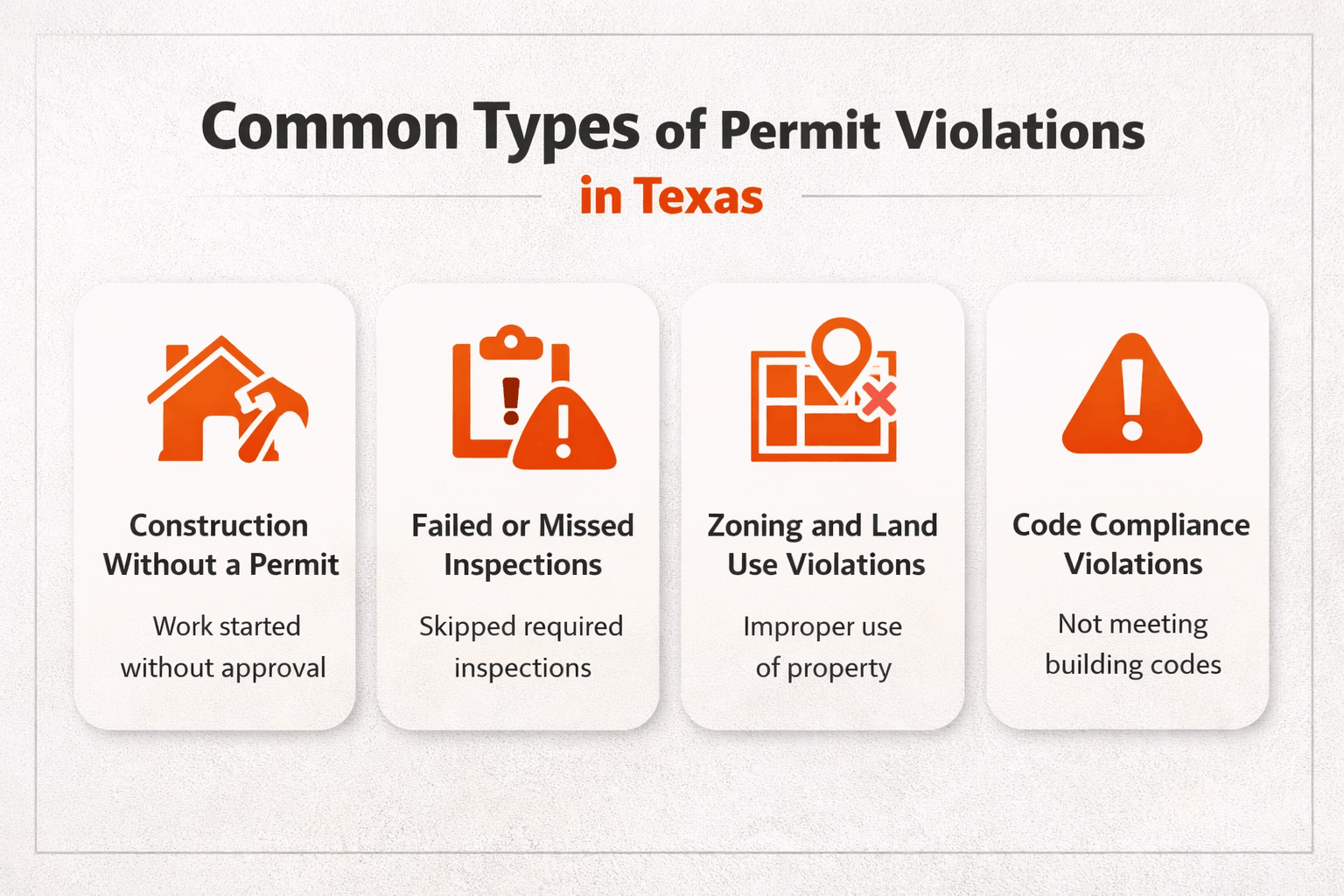
Construction Without a Permit
This is the most common issue in Texas. It happens when someone starts work without approval. This includes:
Room additions
Garage conversions
Commercial renovations
Structural changes
Many people assume small projects don’t need permits. That’s often not true. Even minor work can require approval, depending on the city.
Failed or Missed Inspections
Getting a permit is only part of the process. You also need inspections at different stages. If you skip inspections, it can lead to a violation.
Common examples:
Electrical work not inspected
Plumbing not approved
Final inspection never completed
Even if the work looks fine, it still needs official approval.
Zoning and Land Use Violations
Zoning rules control how a property can be used.
You may get a violation if:
A residential property is used for business
A commercial space is used incorrectly
The building does not match approved plans
These violations can be harder to fix because they involve legal use of the property.
Code Compliance Violations
These are related to safety and building standards.
Examples include:
Unsafe wiring
Poor structural work
Fire safety issues
Plumbing problems
These violations are taken seriously because they can affect safety.
Quick Overview Table
Here’s a simple breakdown of common violations and what they mean:
| Violation Type | What It Means | Difficulty to Fix |
|---|---|---|
| No Permit | Work started without approval | Medium |
| Missed Inspection | Required inspection skipped | Easy to Medium |
| Code Violation | Work does not meet standards | Medium to Hard |
| Zoning Issue | Property used incorrectly | Hard |
What Happens After You Receive a Permit Violation Notice?
Once you receive the notice, the clock starts ticking. It’s important to understand what happens next so you don’t make things worse.

Immediate Consequences
At first, the notice is a warning. It gives you a chance to fix the issue.
But it also includes:
A deadline to respond
Details about the violation
Instructions on what to do next
Ignoring it is a bad idea. Problems grow quickly if you delay.
Stop-Work Orders
In some cases, the city may issue a stop-work order.
This means:
All construction must stop immediately
You cannot continue until the issue is resolved
If you ignore a stop-work order, penalties can increase fast.
Inspection and Review Process
After the notice, the city may:
Inspect your property
Review your documents
Ask for updated plans
This helps them decide what needs to be fixed.
Possible Timeline (Simple View)
| Step | What Happens | Timeframe |
|---|---|---|
| Notice Issued | You receive violation letter | Day 1 |
| Response Period | You review and respond | 5–30 days |
| Inspection | City checks property | Varies |
| Fix Required | You correct the issue | Depends on scope |
| Final Approval | Violation is closed | After compliance |
What If You Act Quickly?
If you respond early:
You may avoid higher fines
The process becomes smoother
You reduce delays in your project
Most cities are more cooperative when you show effort to fix the issue.
What If You Ignore It?
If you do nothing:
Fines may increase daily
Legal action can start
You may face court involvement
The project could be shut down
In serious cases, the city may require you to remove or redo the work
Step-by-Step: What to Do After Getting a Permit Violation Notice
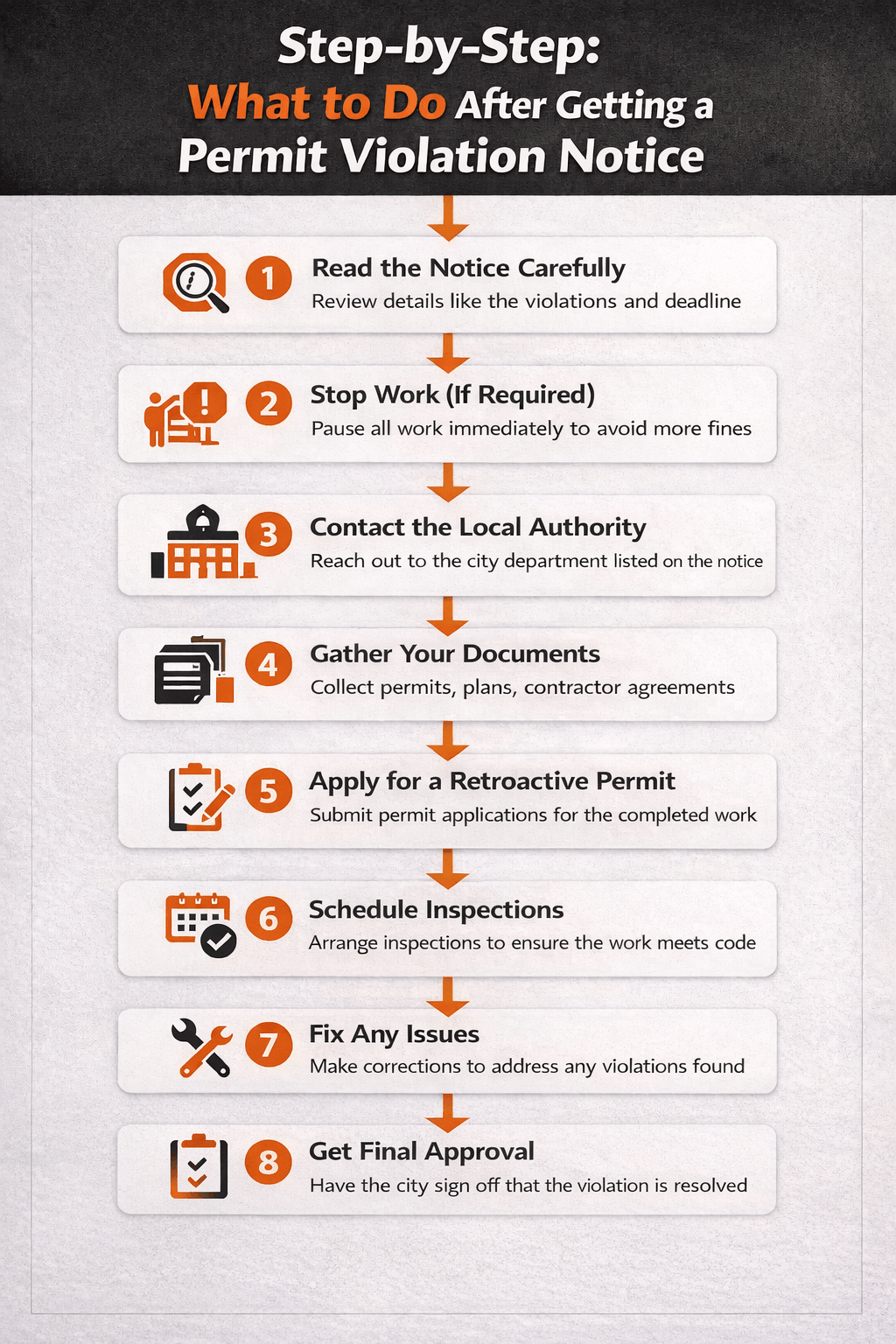
Now let’s get into the most important part—what you should actually do. If you follow these steps in order, you can fix most permit issues without major trouble. The key is to stay calm and act early.
Step 1 – Read the Notice Carefully
Start with the basics. Read the notice line by line.
Look for:
What the violation is
The exact location (if mentioned)
The deadline to respond
Any case or reference number
Do not guess or assume anything. Small details matter here. If something is unclear, make a note of it. You’ll ask about it later.
Step 2 – Stop Work (If Required)
If the notice includes a stop-work order, pause all work right away. This is important.
Continuing work can lead to:
Higher fines
More violations
Legal trouble
Even if the work is almost done, stop until you get approval.
Step 3 – Contact the Local Authority
Next, reach out to the department that issued the notice.
This could be:
Building inspections
Code enforcement
Permitting office
Keep the conversation simple and professional.
Ask:
What exactly needs to be fixed?
What are my options?
What documents do I need?
What is the timeline?
Take notes during the call or visit.
Step 4 – Gather Your Documents
Before you move forward, collect all related documents.
This may include:
Any existing permits
Construction plans
Contractor agreements
Inspection records
Photos of the work
Having everything ready will save time later.
Step 5 – Apply for a Retroactive Permit
In many cases, you’ll need an “after-the-fact” permit. This means you are applying for approval after the work is already done.
Be prepared for:
Higher permit fees
Possible plan revisions
Additional inspections
Even though it costs more, this step is necessary to fix the violation.
Step 6 – Schedule Inspections
Once your permit is in progress, you’ll need inspections. These checks confirm that the work meets code.
Common inspections include:
Electrical
Plumbing
Structural
Final inspection
Make sure someone is available on-site during the inspection.
Step 7 – Fix Any Issues
If the inspector finds problems, you’ll need to correct them.
This may involve:
Small repairs
Reworking parts of the project
Updating materials or systems
Some fixes are simple. Others may require professional help.
Step 8 – Get Final Approval
After all issues are fixed, the city will close the case.
You’ll receive confirmation that:
The violation is resolved
The work is approved
No further action is needed
Keep this record safe. You may need it in the future, especially if you sell the property.
Quick Action Checklist
Here’s a simple checklist to keep things on track:
Read the notice
Stop work (if required)
Contact the city
Gather documents
Apply for permit
Schedule inspections
Fix issues
Get final approval
Penalties for Permit Violations in Texas
Penalties can vary by city, but the pattern is similar across Texas. The longer you wait, the more it can cost.
Fines and Daily Penalties
Most violations come with fines.
These may be:
One-time fines
Daily fines until the issue is fixed
Daily penalties add up fast. Even a small fine can become expensive over time.
Increased Permit Costs
If you apply after the work is done, expect higher fees.
Cities often charge:
Double permit fees
Additional review costs
This is meant to discourage skipping permits in the first place.
Legal Consequences
If the violation is ignored, it can move into legal action.
This may include:
Court notices
Misdemeanor charges
Legal fees
At this point, the issue becomes more serious and harder to resolve.
Stop-Work and Project Delays
A stop-work order can delay your entire project.
This can affect:
Contractors
Business operations
Project timelines
Delays often cost more than the fine itself.
Severe Cases
In rare situations, the city may take strict action.
This can include:
Removing unsafe work
Requiring demolition
Revoking approvals
These cases usually involve safety risks or repeated violations.
Penalty Overview Table
| Situation | Possible Outcome | Impact Level |
|---|---|---|
| First-time violation | Warning or small fine | Low |
| Ongoing violation | Daily fines | Medium |
| Ignored notice | Legal action | High |
| Safety issue | Immediate correction required | High |
| Severe non-compliance | Demolition or shutdown | Very High |
How to Fix a Permit Violation in Texas (Detailed Process)
Fixing a violation is not just about paying a fine. You need to bring everything up to code. Let’s break down how that works.
When You Need Corrections
If the work does not meet code, changes are required.
This could involve:
Adjusting structural elements
Updating electrical systems
Fixing plumbing issues
Always follow the inspector’s instructions.
When You Need Re-Inspection
After fixing issues, you’ll need another inspection.
Make sure:
All corrections are complete
The site is ready
Documents are updated
Passing inspection is key to closing the case.
When Work Must Be Redone
In some cases, the work may need to be removed or rebuilt.
This usually happens when:
The work is unsafe
It does not meet basic standards
It cannot be approved as-is
This is costly, but sometimes unavoidable.
Working With Professionals
Some violations are simple. Others are not.
You may need help if:
The issue involves multiple systems
Plans need to be updated
Deadlines are tight
Professionals can help you move faster and avoid mistakes.
Simple Fix Process (Overview)
Identify the issue
Get proper permits
Make required changes
Pass inspections
Close the violation
At this point, you should have a clear idea of how to respond, what it may cost, and how to fix the issue step by step.
Can You Ignore a Permit Violation Notice?
Short answer—no, you should not ignore it. It may feel tempting to wait or hope it goes away. But that usually makes things worse.
What Happens If You Ignore It
Ignoring a notice can lead to:
Daily fines that keep increasing
Additional violations added to your case
Legal notices or court involvement
Trouble selling or refinancing your property
In some cities, unresolved violations become part of public records. That can create long-term issues.
Why Acting Early Matters
When you respond early:
Inspectors are more cooperative
You may avoid higher penalties
The process stays simple
Delays often lead to more paperwork, more inspections, and more costs.
Real-Life Scenarios (What This Looks Like in Practice)
These examples will help you understand how permit violations play out in real situations.
Scenario 1 – Home Addition Without a Permit
A homeowner builds a room extension without approval.
What happens next:
The city issues a violation notice
The owner must apply for a retroactive permit
Inspections are required
If the work meets code, it can be approved. If not, parts of the structure may need changes.
Scenario 2 – Commercial Renovation Issue
A business renovates a space but skips permits.
Results:
Stop-work order issued
Business operations may pause
Fines increase daily
Commercial cases are usually stricter. They involve safety rules and public access.
Scenario 3 – Selling Property With Violations
A property owner tries to sell a building with an open violation.
What happens:
Buyers hesitate or back out
Lenders may refuse financing
Property value drops
Most buyers want a clean record. Violations create risk.
Key Takeaway From These Scenarios
In every case, the outcome depends on how fast you act.
Quick response → easier fix
Delayed response → higher cost and stress
When You Should Hire a Permit Consultant
Not every case needs outside help. But some situations are more complex. Here’s when hiring a consultant makes sense.
Complex Violations
If your case involves:
Multiple violations
Structural or safety issues
Confusing city requirements
A consultant can simplify the process.
Tight Deadlines
If you have limited time to respond:
Consultants can speed things up
They know how to handle paperwork quickly
Commercial Projects
Commercial properties usually involve:
More rules
More inspections
Higher penalties
Professional support can prevent delays and losses.
Repeated Violations
If you’ve had issues before:
A consultant can help fix the root problem
They can also prevent future violations
How JDJ Consulting Group Can Help
Handling permit issues alone can take time. It can also lead to mistakes. This is where JDJ Consulting Group comes in.
Permit Correction and Filing
We help you:
Apply for the right permits
Fix errors in existing applications
Prepare complete documentation
Code Compliance Support
We review your project and:
Identify what needs to be fixed
Help bring everything up to code
Reduce the risk of failed inspections
City Communication
Dealing with city departments can be confusing.
We help by:
Communicating with officials
Clarifying requirements
Keeping the process smooth
Faster Resolution
Our goal is simple:
Resolve violations quickly
Reduce delays
Help you move forward with confidence
How to Avoid Permit Violations in the Future
Once you fix a violation, the next step is to avoid it happening again. Simple habits can save you time and money.
Always Get Permits Before Starting Work
Before any project:
Check local requirements
Confirm if a permit is needed
Never assume small work is exempt.
Work With Licensed Professionals
Experienced contractors usually:
Understand permit rules
Follow inspection processes
But still, verify everything yourself.
Keep Your Documents Organized
Maintain records like:
Permits
Plans
Inspection approvals
This helps if questions come up later.
Schedule Inspections on Time
Do not skip inspection stages. Each step matters for final approval.
Prevention Checklist
Check permit requirements before work
Hire qualified professionals
Keep records safe
Follow inspection timelines
Ask questions when unsure
Final Thoughts: Fix It Early, Save Time and Money
A permit violation notice is not the end of the world. But it does require action.
If you handle it early:
The process stays manageable
Costs stay lower
Projects stay on track
If you delay:
Problems grow quickly
Costs increase
Legal risks rise
The best approach is simple—take it seriously and fix it step by step.
Dealing with a permit violation can feel stressful. But you don’t have to figure it out alone. At JDJ Consulting Group, we help property owners fix violations, handle permits, and move projects forward without delays.
If you’ve received a notice and aren’t sure what to do next, just reach out. We’ll walk you through it step by step. Call us at (818) 793-5058 and schedule your consultation with our clients.
FAQs About Permit Violation Notice
What is a permit violation notice in Texas?
A notice of violation is an official enforcement document issued by local Code Enforcement when a construction project does not meet building code or regulatory requirements.
This can happen when:
Work is completed without a building permit
Required inspections are skipped
Construction does not meet Code Compliance standards
The violation notice typically outlines the issue, required corrective action, and a deadline to resolve it.
What should I do first after receiving a notice of violation?
Start by reviewing the violation notice carefully to understand the issue and timeline.
Then:
Stop work if a Stop Work Order is issued
Contact the local Code Enforcement office
Gather your construction documents and permit records
Early response helps avoid enforcement actions, reduces civil penalties, and supports faster voluntary compliance.
Can I ignore a notice of violation in Texas?
No, ignoring a notice of violation can escalate the situation.
If no action is taken:
Additional administrative citation or civil fine may be issued
The case may move into legal action
A property lien could be placed on the property
Responding early helps you avoid costly enforcement remedies and delays.
How much are permit violation fines in Texas?
Fines vary based on the type of code violation and local administrative code.
Common scenarios include:
One-time civil fine for minor violations
Daily penalties for ongoing issues
Higher fines for life safety or structural concerns
Unresolved violations can lead to increased permit fees and additional enforcement actions.
What is a stop-work order?
A Stop Work Order is issued by an enforcing officer to immediately halt all construction activity on a construction site.
It is typically enforced when:
Work proceeds without a valid building permit
There are serious code violations
Safety risks are identified
Ignoring a Stop Work Order can trigger severe legal action and higher penalties.
Can I get a permit after the work is already done?
Yes, through retroactive permitting, you can apply for a building permit after work is completed.
However:
Fees are usually higher
Additional inspections may be required
Corrections may be needed to meet Code Compliance
This process ensures the project aligns with building code and local permitting requirements.
How long do I have to fix a violation?
The timeline depends on the violation notice and the local administrative code.
Most notices include:
5 to 30 days for initial response
Additional time for corrective action
Failing to meet deadlines can trigger further enforcement actions or legal action.
Will a violation affect selling my property?
Yes, unresolved code violations can impact your ability to sell.
Buyers and lenders may:
Require full Code Compliance before closing
Delay the transaction
Reduce the property value
In some cases, violations tied to ownership can affect your ownership interest in the transaction.
Who is responsible for a violation, the owner or the contractor?
In most cases, Property Owners are considered the Responsible Party.
Even if a contractor caused the issue:
The notice of violation is issued to the owner
The owner must ensure corrective action is completed
This is why verifying permits and building permit status before starting work is critical.
Do all construction projects require permits in Texas?
Not all projects require permits, but many types of land development and structural work do.
Permits are typically required for:
Structural modifications
Electrical and plumbing systems
Major renovations
Always confirm permitting requirements with local Code Enforcement before starting work.
What happens if I fail an inspection?
Failing an inspection means the work does not meet building code or Code Compliance standards.
Next steps include:
Completing required corrective action
Scheduling a re-inspection
Updating construction plans if needed
This is a normal part of the enforcement process and can usually be resolved quickly.
Can violations lead to legal action?
Yes, unresolved code violations can escalate into legal action.
Possible outcomes include:
Court proceedings in Municipal Court
Increased civil penalties
Additional enforcement actions
Legal escalation is typically the final step if voluntary compliance is not achieved.
What is a code compliance violation?
A Code Compliance violation occurs when a property does not meet required building code or safety standards.
Examples include:
Unsafe wiring or plumbing
Structural deficiencies
Violations of life safety regulations
These issues must be corrected to avoid further enforcement actions.
Can I continue working while fixing a violation?
It depends on the violation notice.
If a Stop Work Order is issued → all work must stop
If not → limited construction activity may continue with approval
Always confirm with your local Code Enforcement office before proceeding.
What documents do I need to fix a violation?
Typical documents include:
Approved building permit records
Updated construction documents
Inspection reports
Contractor information
Having these ready helps speed up the permit expediting process and resolution.
Can a violation delay my project?
Yes, a notice of violation can significantly delay a construction project.
Common impacts:
Work stoppages due to Stop Work Orders
Additional inspections and approvals
Extended project schedule
Delays can increase costs and disrupt overall project management.
What is a retroactive permit?
A retroactive permit is issued after unapproved work has already occurred.
It typically involves:
Reviewing completed work
Ensuring compliance with building code
Paying higher permit fees
This is a common enforcement remedy to resolve violations.
When should I hire a permit consultant?
Consider hiring a consultant or permit expeditor if:
The case involves multiple code violations
You are facing strict deadlines
The enforcement process is complex
They can help manage permit approvals, coordinate with regulatory agencies, and reduce risks.
How can I avoid violations in the future?
To prevent future violation notices:
Always secure the required building permit
Follow approved construction plans
Schedule inspections on time
Stay compliant with building code and administrative code
These steps ensure smoother Code Compliance and fewer enforcement actions.