Cost overruns remain one of the biggest risks in construction projects. Even well-planned developments often exceed budgets due to delays, poor coordination, and unexpected changes. This is where AI in construction is becoming a practical solution. It helps developers and builders make better decisions early, track costs in real time, and reduce uncertainty across every stage of a project.
Today’s projects are more complex than ever. Zoning regulations are stricter. Permit timelines are longer. Material prices fluctuate quickly. Without strong data and planning tools, even experienced teams struggle to stay on budget. AI brings structure to this complexity. It uses historical data, predictive insights, and automation to reduce errors and improve planning accuracy.
For developers, investors, and architects, the goal is not just saving money. It is about controlling risk. When cost overruns are reduced, projects stay viable, timelines stay predictable, and returns remain stable. This guide explains how AI works in construction and how it helps prevent budget failures from the start.
Table of Contents
Key Development & Permitting Statistics
U.S. construction projects exceed budgets by ~28% on average
Poor planning causes 39% of project cost overruns
Permit delays can increase costs by 10–20% annually
Rework contributes up to 30% of total construction costs
These numbers highlight a clear pattern. Most cost overruns are not random. They come from predictable issues such as planning gaps, permit delays, and poor coordination. This is exactly where AI creates value.
What Causes Cost Overruns in Construction
Cost overruns rarely come from a single mistake. They are usually the result of several small issues that build up over time. Understanding these causes is the first step toward preventing them.
Inaccurate Cost Estimation
Many projects still rely on manual estimates or outdated data. This creates a gap between projected and actual costs. Small errors in early estimates can grow into major budget problems later. Without real-time data, teams cannot adjust quickly when conditions change.
Delays in Permits and Approvals
Permitting delays are one of the most common causes of increased costs. Zoning restrictions, unclear requirements, and agency backlogs slow projects down. Each delay adds holding costs, financing expenses, and scheduling disruptions. Many developers underestimate how much this impacts the final budget.
Poor Project Planning
A weak project plan leads to inefficiencies at every stage. Scheduling conflicts, resource shortages, and misaligned timelines all increase costs. When teams lack clear coordination, delays become unavoidable.
Change Orders and Rework
Design errors and miscommunication often lead to rework. This is one of the most expensive problems in construction. Fixing mistakes requires additional labor, materials, and time. It also disrupts the entire project schedule.
Market Volatility
Material prices and labor costs can change quickly. Without predictive tools, it is difficult to adjust budgets in time. Sudden increases in costs can push projects far beyond their original estimates.
Each of these issues is preventable to some extent. The key is identifying them early and managing them proactively. This is where advanced technology plays a critical role.
What Is AI in Construction and How It Works
AI in construction refers to the use of advanced algorithms and data systems to improve decision-making across a project lifecycle. It does not replace human expertise. Instead, it supports teams by analyzing large amounts of data and identifying patterns that are difficult to detect manually.
At its core, AI works by learning from past projects. It compares historical data with current conditions to predict outcomes. This allows teams to make informed decisions before problems occur.
Key technologies include:
Machine learning for pattern recognition
Predictive analytics for forecasting risks
Computer vision for monitoring construction progress
Automation tools for repetitive tasks
AI is used across three main phases:
Pre-construction phase
Feasibility analysis
Cost estimation
Risk assessment
Construction phase
Budget tracking
Progress monitoring
Resource allocation
Post-construction phase
Performance analysis
Cost evaluation
Data feedback for future projects
The biggest advantage of AI is its ability to provide real-time insights. Instead of reacting to problems, teams can prevent them. This shift from reactive to proactive management is what reduces cost overruns.
How AI in Construction Reduces Cost Overruns
Reducing cost overruns requires more than better estimates. It requires continuous control over every stage of a project. AI provides that control by improving accuracy, visibility, and decision-making.

Predictive Cost Estimation
AI improves cost estimation by using historical and real-time data. It analyzes similar projects, market conditions, and design details to create more accurate forecasts. This reduces the risk of underestimating costs at the start.
Unlike traditional methods, AI models update estimates as new data becomes available. This keeps budgets aligned with actual conditions throughout the project.
Risk Detection Before Construction Starts
Many risks are visible before construction begins, but they are often overlooked. AI tools analyze zoning data, site conditions, and regulatory requirements to identify potential issues early.
For example, AI can flag:
Zoning conflicts
Permit approval risks
Site constraints
This allows developers to address problems during planning instead of during construction, where costs are much higher.
Real-Time Budget Monitoring
One of the biggest advantages of AI is real-time tracking. Instead of waiting for periodic reports, teams can monitor costs continuously.
AI systems track:
Labor costs
Material usage
Equipment expenses
If spending starts to exceed projections, the system alerts the team immediately. This allows quick adjustments before the issue grows.
Schedule Optimization
Delays are one of the main drivers of cost overruns. AI helps optimize schedules by analyzing dependencies, resource availability, and potential risks.
It can:
Predict delays before they happen
Suggest schedule adjustments
Improve coordination between teams
This reduces downtime and keeps projects on track.
Minimizing Rework
Rework is expensive and often avoidable. AI reduces rework by improving design accuracy and coordination.
Using tools like computer vision and clash detection, AI can:
Identify design conflicts early
Ensure alignment between disciplines
Monitor construction quality
By catching errors early, teams avoid costly corrections later.
How AI Helps Control Budget Risks
Cost overruns are closely linked to budget risks. Managing these risks requires continuous planning, monitoring, and adjustment. AI provides the tools needed to maintain control.
Scenario Planning and Forecasting
AI allows teams to test different scenarios before making decisions. This helps developers understand how changes in cost, timeline, or design will impact the overall budget.
For example:
What happens if material costs increase by 10%?
How will a permit delay affect financing costs?
AI provides clear answers, allowing better decision-making.
Smart Resource Allocation
Efficient use of resources is essential for staying within budget. AI analyzes project needs and allocates resources based on priority and availability.
This includes:
Labor scheduling
Equipment usage
Material distribution
Better allocation reduces waste and improves efficiency.
Supply Chain Risk Management
Supply chain disruptions can significantly impact costs. AI helps predict these risks by analyzing market trends and supplier data.
It can:
Identify potential shortages
Suggest alternative suppliers
Optimize procurement timing
This reduces the impact of unexpected changes.
Permit and Compliance Tracking
Permitting is often a hidden source of cost risk. AI tools track compliance requirements and approval timelines to prevent delays.
They can:
Monitor application status
Flag missing documentation
Predict approval timelines
This improves coordination with agencies and reduces delays.
Need help reducing project risk before construction begins? Talk to our team for a free consultation. We guide feasibility, permits, and cost planning nationwide, including Los Angeles, Austin, and Miami. Call (818) 793-5058 or email sales@jdj-consulting.com.
Step-by-Step Process: Using AI in Construction Projects
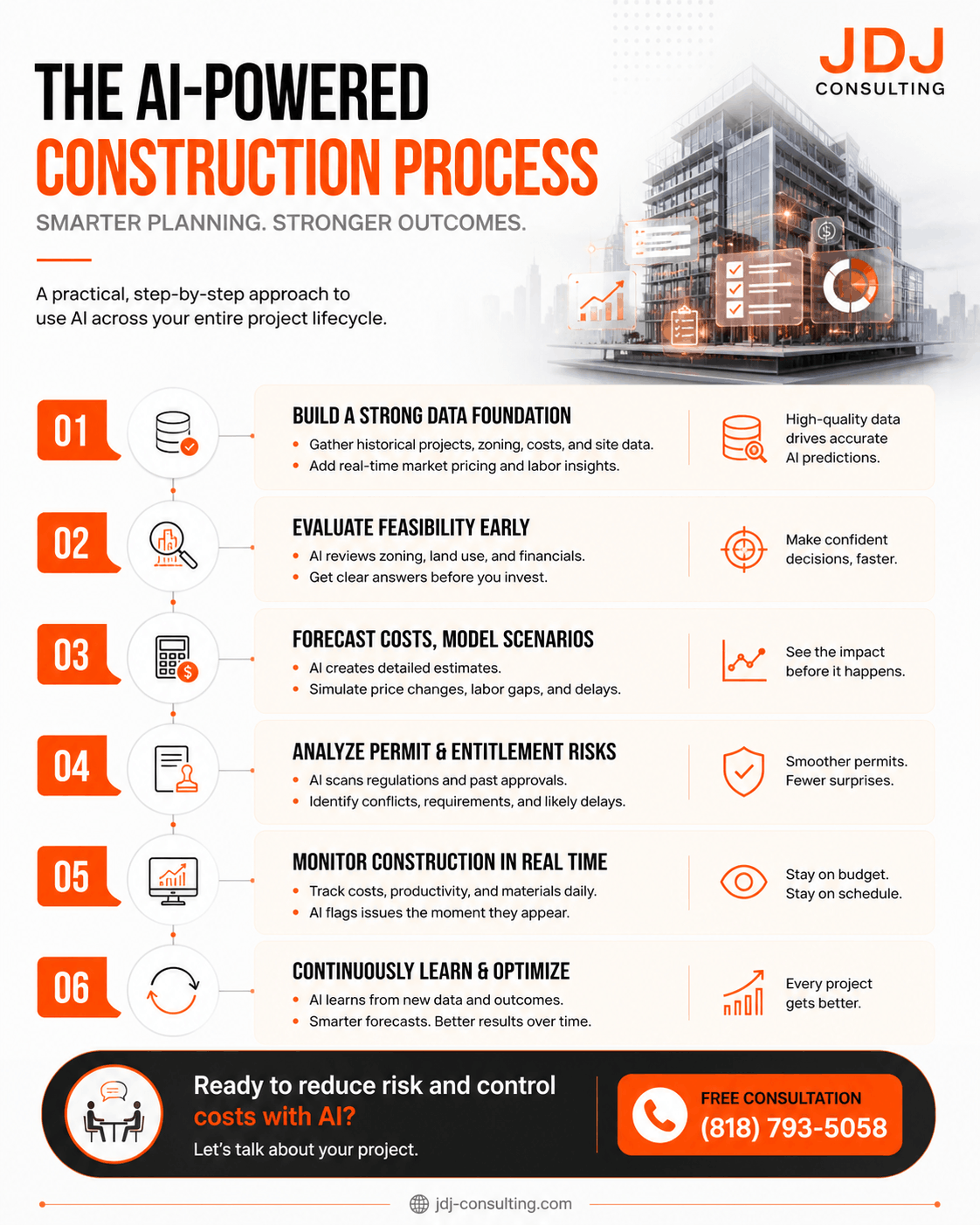
Using AI effectively requires a structured approach. It is not just about adopting tools. It is about integrating data, planning, and decision-making into one system. When done correctly, AI becomes a core part of how projects are managed from start to finish.
1. Data Collection and Integration
Every AI system depends on data quality. The process begins by gathering historical project data, zoning information, cost records, and site-specific details. This includes past budgets, timelines, permit durations, and construction outcomes.
Accurate data creates a reliable foundation. Without it, predictions become weak and unreliable. Teams should also integrate real-time data sources, such as market pricing and labor availability. This ensures the system reflects current conditions rather than outdated assumptions.
2. Feasibility Analysis with AI Tools
Once data is collected, AI is used to evaluate project feasibility. It analyzes multiple factors at once, including zoning constraints, land use regulations, and financial viability.
This step helps answer key questions early:
Is the project financially viable?
Are there zoning risks or entitlement challenges?
What is the expected timeline for approvals?
AI provides faster and more detailed insights than traditional feasibility studies. It allows developers to make informed decisions before committing significant capital.
3. Cost Estimation and Scenario Modeling
AI then generates detailed cost estimates based on project inputs. It does not rely on static assumptions. Instead, it models different scenarios to reflect real-world uncertainty.
For example, it can simulate:
Changes in material prices
Labor shortages
Permit delays
This allows teams to prepare for multiple outcomes. Instead of a single budget estimate, developers gain a range of possible costs with associated risks.
4. Permit and Entitlement Risk Analysis
Permitting is often underestimated during planning. AI evaluates entitlement risks by analyzing local regulations, past approval timelines, and agency requirements.
It identifies:
Potential zoning conflicts
Required approvals and documentation
Likely delays based on similar projects
This helps teams prepare complete applications and avoid unnecessary back-and-forth with agencies.
5. Construction Monitoring and Reporting
During construction, AI systems track progress continuously. They compare actual performance with planned schedules and budgets.
Key monitoring areas include:
Daily cost tracking
Labor productivity
Material usage
If deviations occur, the system highlights them immediately. This allows teams to correct issues before they escalate into major problems.
6. Continuous Optimization
AI does not stop after monitoring. It continuously improves project performance by learning from new data. As conditions change, the system updates forecasts and recommendations.
This creates a feedback loop:
Analyze → Adjust → Improve
Over time, this process leads to better planning and lower risk across future projects.
Real-World Example of AI Reducing Construction Costs
Consider a mid-size mixed-use development project in a dense urban area. The project includes residential units, retail space, and structured parking. Initially, the developer faced challenges with cost estimation, permit approvals, and coordination between teams.
Before using AI, the project relied on traditional planning methods. Cost estimates were based on limited historical data. Permit timelines were uncertain. Coordination between architects, engineers, and contractors was inconsistent. As a result, the project experienced delays and budget increases.
After integrating AI tools, the process changed significantly.
First, AI analyzed zoning regulations and identified potential entitlement risks. This allowed the team to adjust the design before submitting applications. As a result, the approval process became smoother and faster.
Second, AI improved cost estimation. It used data from similar developments to create more accurate forecasts. It also updated these estimates as market conditions changed. This reduced the gap between projected and actual costs.
Third, real-time monitoring helped control spending during construction. When labor costs began to rise, the system flagged the issue early. The team adjusted schedules and resource allocation to stay within budget.
Finally, AI reduced rework by identifying design conflicts before construction began. This improved coordination and minimized costly changes later.
The outcome was clear:
Fewer delays
Lower rework costs
Improved budget accuracy
Faster project completion
This example shows that AI does not just improve efficiency. It directly impacts financial performance.
AI vs Traditional Construction Planning
AI changes how construction projects are planned and managed. Traditional methods rely heavily on experience and static data. While experience is valuable, it often lacks the precision needed for complex projects.
Here is a comparison of both approaches:
Comparison of traditional vs AI-driven construction cost management
| Factor | Traditional Approach | AI-Driven Approach |
|---|---|---|
| Cost Estimation | Manual, static | Dynamic, predictive |
| Risk Detection | Reactive | Proactive |
| Budget Tracking | Periodic updates | Real-time monitoring |
| Decision Making | Experience-based | Data-driven insights |
Traditional planning often reacts to problems after they occur. This leads to delays, cost increases, and inefficient resource use. In contrast, AI focuses on prevention. It identifies risks early and provides actionable insights.
Another key difference is visibility. AI provides a clear, real-time view of project performance. This allows teams to make faster and more informed decisions. It also improves accountability across all stakeholders.
While traditional methods still play a role, they are no longer sufficient on their own. Combining experience with data-driven tools creates a stronger and more reliable approach.
Role of Pre-Construction Analysis in Cost Control
Pre-construction is the most critical phase for controlling costs. Decisions made at this stage determine the overall direction of the project. Once construction begins, changes become more expensive and difficult to manage.
AI enhances pre-construction analysis by providing deeper insights and more accurate predictions. It helps teams evaluate feasibility, optimize design, and identify risks before they impact the budget.
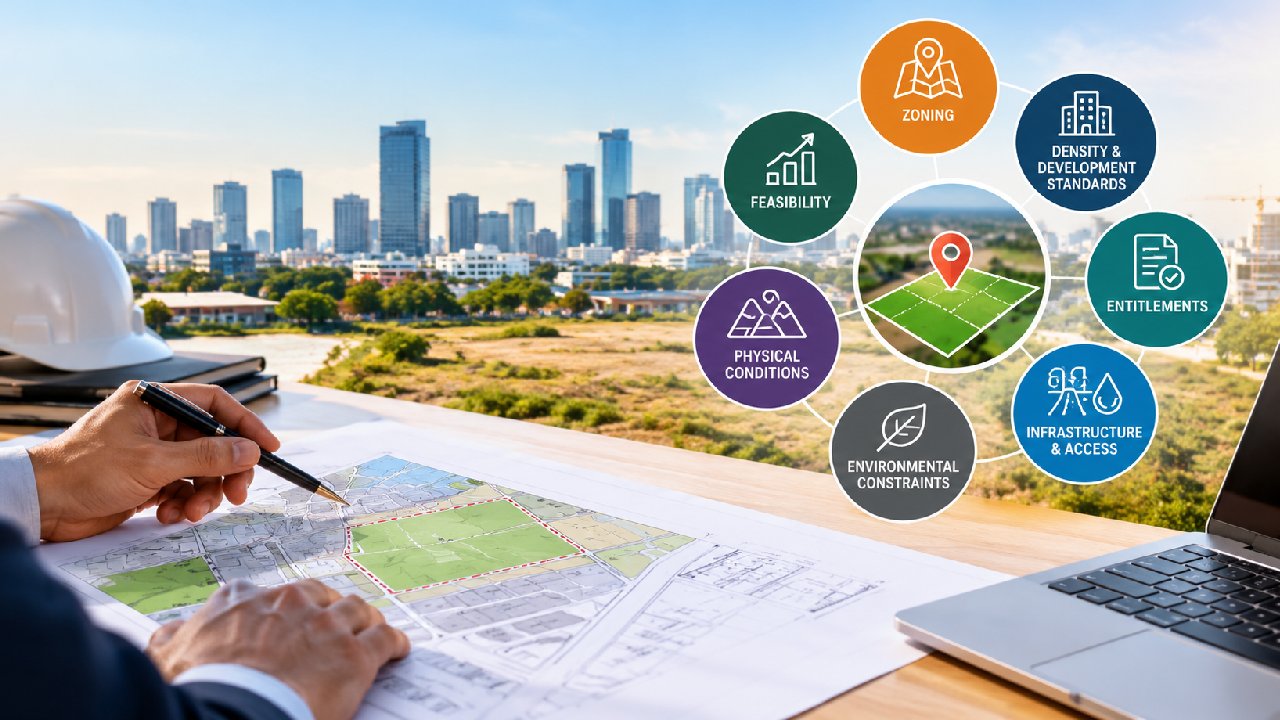
One of the most important aspects is feasibility analysis. AI assesses whether a project makes financial and regulatory sense. It considers factors such as land use, zoning restrictions, and market demand. This ensures that only viable projects move forward.
Another key element is highest and best use analysis. AI evaluates different development scenarios to determine the most profitable option. This helps developers maximize returns while minimizing risk.
Early risk identification is also essential. AI highlights potential issues related to permits, site conditions, and design constraints. Addressing these issues early prevents costly changes later.
For developers seeking structured support, professional guidance is often necessary. Services such as feasibility studies and consulting play a critical role in aligning project goals with real-world conditions. By combining AI insights with expert analysis, developers gain a clear and reliable foundation for decision-making.
AI and the Entitlement & Permitting Process
The entitlement and permitting process is one of the most complex parts of development. It involves multiple agencies, regulations, and approvals. Delays in this process can significantly increase project costs.
AI improves this process by providing better visibility and coordination. It analyzes past approval timelines, identifies common bottlenecks, and predicts potential delays.
One of the key benefits is early identification of zoning conflicts. AI reviews project plans against local regulations to ensure compliance. This reduces the likelihood of rejection or revision.
AI also improves communication with agencies. By organizing documentation and tracking requirements, it ensures that applications are complete and accurate. This reduces back-and-forth and speeds up approvals.
Another advantage is timeline prediction. AI estimates how long each approval step will take based on historical data. This helps developers plan more accurately and avoid unexpected delays.
For projects in complex markets, having a clear entitlement strategy is essential. Professional support can help navigate these challenges effectively. By combining AI tools with expert guidance, developers can streamline approvals and reduce associated costs.
Common Mistakes Developers Make Without AI
Many cost overruns are not caused by external factors. They come from avoidable decisions made early in the project. Without data-driven tools, developers often rely on assumptions or incomplete information. This creates gaps that grow into financial risks later.
One common mistake is underestimating total project costs. Traditional estimates often exclude hidden expenses such as permit delays, financing costs, and rework. These costs may seem small at first but compound over time. Without accurate forecasting, budgets quickly lose control.
Another issue is ignoring data-driven insights. Many teams still rely only on past experience. While experience is valuable, it does not always reflect current market conditions. Material prices, labor availability, and regulations change frequently. Without updated data, decisions become less reliable.
Delaying feasibility analysis is also a major risk. Some developers move forward without fully understanding zoning restrictions or site limitations. This leads to design changes later, which are far more expensive. Early analysis helps prevent these issues.
Poor coordination with agencies is another frequent problem. Incomplete applications, missing documents, or unclear communication slow down approvals. Each delay increases holding costs and disrupts timelines.
These mistakes highlight a simple truth. Cost overruns are often predictable. With the right tools and planning, they can be reduced or avoided.

Future Trends of AI in Construction
AI adoption in construction is growing rapidly. As technology evolves, its impact on cost control and project efficiency will continue to expand. Developers who understand these trends will be better prepared for future challenges.
One major trend is the use of digital twins. These are virtual models of physical projects that update in real time. They allow teams to simulate construction processes, test scenarios, and identify risks before they occur. This improves planning accuracy and reduces uncertainty.
Another important development is automated permit analysis. AI systems are becoming capable of reviewing zoning codes and identifying compliance issues instantly. This reduces the time required for entitlement reviews and improves approval rates.
Integration with smart city infrastructure is also increasing. As cities adopt more data-driven systems, AI tools will have access to better information. This includes traffic patterns, utility networks, and environmental data. This improves site planning and project design.
AI is also becoming more accessible. Cloud-based platforms and software solutions allow smaller developers to use advanced tools without large upfront investments. This levels the playing field and increases adoption across the industry.
Finally, predictive analytics will continue to improve. As more data becomes available, AI systems will provide more accurate forecasts. This will further reduce cost overruns and improve project outcomes.
When to Hire a Construction & Land Use Consultant
Even with advanced technology, expert guidance remains essential. AI provides insights, but it does not replace experience in navigating complex development processes. Knowing when to involve a consultant can significantly impact project success.
Developers should consider hiring a consultant when dealing with complex zoning environments. Projects in dense urban areas often involve multiple regulations and agencies. Navigating these requirements without guidance can lead to delays and increased costs.
High-value developments also benefit from professional support. Larger projects carry greater financial risk. Even small errors can result in significant losses. A consultant helps ensure that planning, permitting, and execution are aligned.
Tight timelines are another key factor. When deadlines are strict, there is little room for error. Consultants help streamline processes and avoid delays.
Risk-heavy projects, such as mixed-use developments or projects requiring multiple approvals, also require expert involvement. These projects involve more variables and greater uncertainty.
Working with a consultant provides structured guidance. It ensures that AI insights are applied effectively and that decisions are grounded in real-world experience.
Conclusion
Cost overruns and budget risks are not unavoidable. They are often the result of gaps in planning, coordination, and data. By addressing these gaps early, developers can significantly improve project outcomes.
AI in Construction provides a practical way to reduce uncertainty. It improves cost estimation, identifies risks early, and enables real-time budget control. This allows teams to make better decisions at every stage of a project.
However, technology alone is not enough. Combining AI with strong pre-construction analysis and expert guidance creates the most effective approach. This ensures that projects are not only efficient but also financially sustainable.
As the industry continues to evolve, developers who adopt data-driven strategies will have a clear advantage. They will be better equipped to manage risks, control costs, and deliver successful projects.
Planning a project? Start with clarity. Get a free consultation to assess feasibility, permits, and cost risks. Call (818) 793-5058 or email sales@jdj-consulting.com.
FAQs About AI in Construction
How does AI in Construction reduce cost overruns?
AI reduces cost overruns by improving accuracy and visibility across the entire project lifecycle. It uses predictive analytics to estimate costs more precisely and identify risks before construction begins. This allows teams to address potential issues early, when they are less expensive to fix.
During construction, AI tracks costs in real time. It monitors labor, materials, and schedules continuously. If spending starts to exceed the budget, the system alerts the team immediately. This enables quick adjustments and prevents small issues from becoming major problems.
AI also reduces rework by detecting design conflicts before construction starts. This improves coordination and minimizes costly changes later. Overall, it shifts project management from reactive to proactive, which is key to controlling costs.
Is AI expensive to implement in construction projects?
The cost of implementing AI depends on the size and complexity of the project. While there is an initial investment, the long-term savings often outweigh the cost. AI reduces inefficiencies, prevents delays, and improves budget accuracy.
For many projects, the biggest savings come from avoiding rework and delays. These are often the most expensive issues in construction. By addressing them early, AI delivers strong return on investment.
Cloud-based solutions have also made AI more accessible. Developers can use advanced tools without large upfront costs. This makes it a practical option for both large and mid-size projects.
Can AI help with permit approvals?
Yes, AI can significantly improve the permitting process. It analyzes zoning regulations, identifies compliance issues, and ensures that applications are complete before submission. This reduces the likelihood of rejection or delays.
AI also tracks approval timelines and monitors application status. This improves communication with agencies and helps teams stay organized. By reducing errors and improving coordination, AI speeds up the approval process.
However, complex projects may still require expert guidance. Combining AI tools with professional support ensures the best results.
What types of projects benefit most from AI?
AI is especially useful for complex and large-scale projects. Mixed-use developments, urban infill projects, and high-value constructions benefit the most. These projects involve multiple variables and higher risks.
However, smaller projects can also benefit. Even simple developments face challenges such as cost estimation and permit approvals. AI helps improve planning and reduce uncertainty regardless of project size.
The key factor is complexity. The more variables involved, the greater the value of AI.
Does AI replace project managers?
AI does not replace project managers. Instead, it supports them by providing better data and insights. Project managers still make decisions, coordinate teams, and oversee execution.
AI handles data analysis and pattern recognition. It processes large amounts of information quickly and identifies trends. This allows project managers to focus on strategy and problem-solving.
The combination of human expertise and AI technology creates a stronger and more effective management approach.
How accurate is AI cost estimation?
AI cost estimation is generally more accurate than traditional methods. It uses historical data, real-time inputs, and predictive models to generate forecasts. This reduces the risk of underestimating costs.
Accuracy improves over time as the system learns from new data. Each project adds more information, making future predictions more reliable.
However, accuracy still depends on data quality. Reliable inputs lead to better outputs. This is why proper data collection is essential.
What are the risks of not using AI?
Not using AI increases the risk of cost overruns, delays, and inefficiencies. Without data-driven insights, teams rely on assumptions and outdated information. This leads to inaccurate planning and poor decision-making.
Common risks include:
Underestimated budgets
Delayed permits
Increased rework
Inefficient resource use
These issues can significantly impact project success. As projects become more complex, relying only on traditional methods becomes less effective.
Can small developers use AI tools?
Yes, AI tools are increasingly accessible to small developers. Many platforms offer scalable solutions that can be adapted to different project sizes. Cloud-based tools reduce the need for large investments.
Small developers can use AI for cost estimation, scheduling, and risk analysis. Even basic tools provide valuable insights that improve planning and reduce uncertainty.
The key is selecting tools that match project needs and budget.
How does AI reduce rework in construction?
AI reduces rework by identifying design and coordination issues early. Tools such as clash detection analyze different project elements to ensure they align properly. This prevents conflicts during construction.
Computer vision systems also monitor construction quality. They compare actual work with design plans and detect deviations. This allows teams to correct issues before they become costly problems.
By improving accuracy and coordination, AI minimizes the need for rework.
What role does data play in AI construction tools?
Data is the foundation of AI systems. It provides the information needed to analyze patterns, predict outcomes, and generate insights. Without high-quality data, AI cannot function effectively.
Data sources include:
Past project records
Market trends
Site conditions
Regulatory information
The more accurate and comprehensive the data, the better the results. Continuous data collection also improves system performance over time.
How early should AI be used in a project?
AI should be used as early as possible, ideally during the pre-construction phase. Early use allows teams to evaluate feasibility, estimate costs, and identify risks before making major decisions.
Using AI early reduces the likelihood of costly changes later. It ensures that planning is based on accurate data and realistic assumptions.
Waiting until construction begins limits the benefits of AI.
Can AI predict market fluctuations?
AI can analyze trends and provide insights into market conditions. It uses historical data and real-time inputs to identify patterns in material prices and labor availability.
While it cannot predict every change, it improves forecasting accuracy. This helps developers prepare for potential fluctuations and adjust budgets accordingly.
Better forecasting reduces financial risk and improves decision-making.
Want to avoid costly mistakes before they happen? Book a free consultation with our team. We help developers navigate permits, feasibility, and risk across the U.S. Call (818) 793-5058 or email sales@jdj-consulting.com.