Table of Contents
For a long time, the story along Orlando’s stretch of the I-4 Corridor was theme parks and rooftops. That’s no longer the whole picture. Amazon, Publix, and a growing roster of last-mile carriers have staked out serious ground here, and the land use policy underneath them is moving almost as fast as the deliveries themselves. If you’re an architect, developer, or investor sizing up a warehouse, distribution, or flex/R&D project near Orlando, the demand fundamentals are hard to argue with. What’s harder to gauge from the outside is how the entitlement process actually behaves once you’re in it.
That’s what this article is really about: how projects move through Orlando and Orange County in practice, which submarkets are getting crowded, which ones still have room, and the hurdles that tend to blindside developers who assume this process looks the same everywhere.
Why the I-4 Corridor Matters for Industrial Development
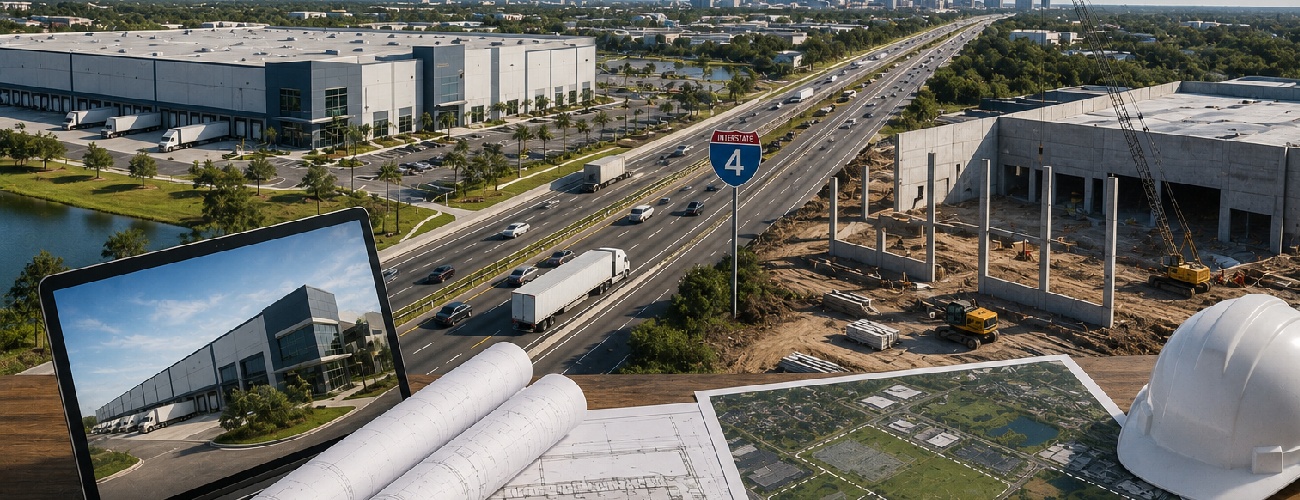
Florida’s planners and brokers alike have leaned into calling I-4 the state’s distribution backbone, and the label holds up. The corridor sits between Tampa and Orlando, connects directly to the interstate system, sits close to Orlando International Airport, and serves a population base that keeps pulling in more e-commerce and last-mile demand every year. Put simply, that geography is doing a lot of the leasing team’s work for them.
The practical result is steady tenant appetite across several product types: big-box regional distribution, last-mile logistics closer to rooftops, flex and R&D space, and a growing slice of cold chain and temperature-controlled facilities. The question most developers are actually wrestling with isn’t whether to build here. It’s where along the corridor a deal still pencils, and which entitlement path gets them there without losing a year to a rezoning fight.
Site Selection and Jurisdiction: The First Fork in the Road
Before anything else gets decided, there’s a question that quietly shapes the entire project: is the site inside the City of Orlando, or out in unincorporated Orange County? It sounds like a formality, but it isn’t. Each jurisdiction runs its own zoning code, its own planning board process, and its own fee structure, and that answer determines the Future Land Use designation and zoning district you’re actually working within.
Most industrial and logistics uses in the Orlando area land in Industrial General (I-G) districts, with Planned Development (PD) zoning reserved for larger, custom campuses. Sites near MCO often carry I-G/AN designations tied to airport compatibility requirements. Access to I-4, SR-417, SR-429, or an existing rail spur still drives most of the site value conversations, but access alone won’t get you through entitlements cleanly. We’ve seen plenty of sites with great highway frontage stall out over truck routing conflicts or unresolved proximity to residential neighbors, issues that rarely show up on the site tour but always show up in the DRC comments.
This is exactly where a generic read on zoning gets developers into trouble. What’s true in Orange County isn’t automatically true a few miles over in the City of Orlando, and that gap has cost projects real time.
Zoning and Entitlements: The Discretionary vs. Ministerial Divide
Once jurisdiction is settled, the next fork is whether the use is permitted by right or requires discretionary approval, and this distinction matters more than almost anything else on the schedule.
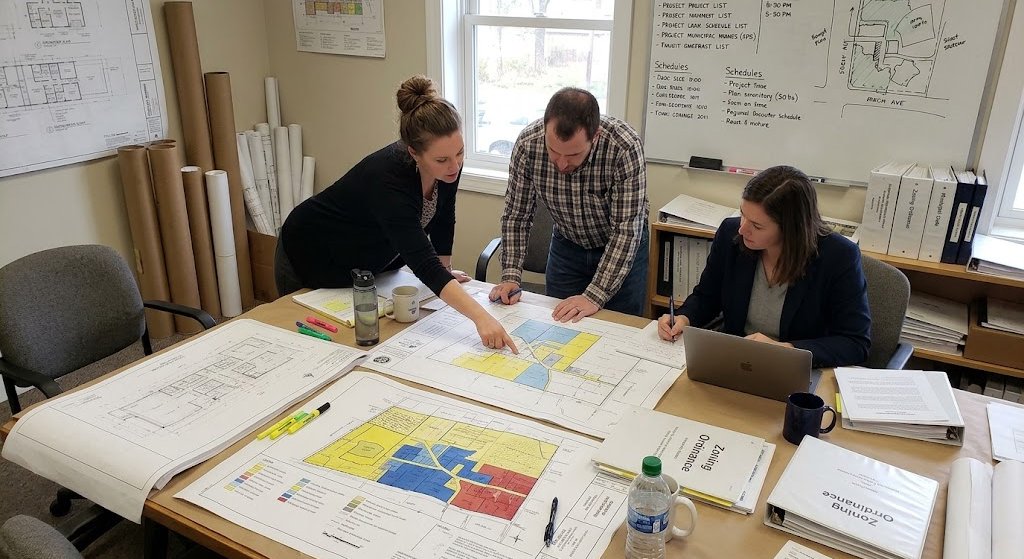
If the use is permitted by right, the project moves fairly directly into site plan and building permit review. It’s a ministerial process, which means the timeline is largely in your hands. If it isn’t, the project heads to the Municipal Planning Board or Planning & Zoning Board, then on to City or County Commission review, complete with public hearings and the schedule uncertainty that comes with them. Special exceptions or variances get layered in for anything touching parking, height, setbacks, or design departures, and nearly every industrial project, regardless of path, still needs site plan or master plan approval through a Development Review Committee that looks at traffic, stormwater, landscaping, and buffering together.
For the larger distribution centers going up along this corridor, a lot of developers opt into a PD or development agreement on purpose, specifically to lock in phasing, building envelopes, and infrastructure commitments before construction financing closes. It costs some upfront flexibility, but on a project with multiple phases stretched over several years, that certainty tends to pay for itself.
The Hurdles That Actually Slow Projects Down
Three things, more than anything else, decide whether an Orlando-area industrial project stays on schedule.
Traffic is usually first. Level-of-service analysis and truck movement studies are often the item that holds up an approval, and it’s common for jurisdictions to require turn lanes, signal upgrades, or dedicated truck entrances before they’ll sign off. None of this is usually obvious when a site first goes under contract, which is why getting a traffic scoping opinion early matters more here than it does for almost any other asset class.
Community and residential compatibility comes next. As rooftops keep pushing into what used to be purely industrial territory, buffering, noise, and lighting requirements have gotten more attention in review. A site sitting near planned residential growth should expect closer scrutiny, and sometimes land set aside purely to satisfy compatibility standards.
Then there’s environmental and infrastructure capacity. Central Florida’s hydrology makes stormwater and wetland permitting a real factor on larger sites, and utility capacity, electric service especially, can require off-site extensions or upgraded feeders for bigger boxes. Anything near rail or the airport may also run into height restrictions or noise overlay review tied to MCO.
None of these are unusual on their own. What actually derails a schedule is when two or three show up together on a timeline that was built assuming none of them would.
Timeline: What to Actually Expect
For a ground-up facility somewhere in the 200,000 to 500,000 square foot range along the corridor, plan on roughly 18 to 30 months from concept to first occupancy, entitlements, design, and construction included. Projects that need rezoning or PD approval tend to land at the longer end. Straightforward, permitted-by-right site plans move faster. And it’s worth saying plainly: long-lead items like switchgear, generators, racking systems, and cold-storage equipment often end up driving the critical path more than the entitlement process itself. Get those on order early.
Where the Orlando I-4 Corridor Is Tightening, and Where It Still Has Room
Not every submarket along this corridor is at the same point in its cycle, and treating them as interchangeable is a mistake we see investors make more than anyone else.
Prime infill near Orlando, particularly around the Airport Industrial Park and the broader MCO employment corridor, has gotten tight. Land is scarce and priced accordingly. It’s still attractive for last-mile product because of how close it sits to population density, but developers going after these sites should walk in expecting competition and a more demanding entitlement environment.
Further out, there’s still real room. The Southeast Orlando Sector Plan area, more than 19,000 acres east of the airport, is explicitly earmarked for aerospace, advanced manufacturing, and logistics-supporting uses, and developable parcels remain, backed by strong public support for high-wage industrial jobs. Beyond that, the Sunbridge planning area, somewhere in the range of 24,000 to 27,000 acres southeast of MCO, is being positioned as a long-term employment engine that folds industrial and logistics into a broader mix of housing and amenities over the next two or three decades. For developers with a longer investment horizon, that’s a genuinely different risk profile than fighting over infill near the airport.
Financing and Incentives Worth Understanding Early
There’s a real incentive toolkit available for qualifying projects in the Orlando area: property tax exemptions on new capital improvements, impact fee mitigation tied to job creation and wage thresholds, and matching grants through programs like the City of Orlando’s Business Assistance Program. Qualified Targeted Industry status at the state level can open the door to additional local incentives, and Foreign Trade Zone 79 is worth a look for anyone running import- or export-heavy logistics through the corridor.
None of these are automatic, though. They’re performance-based and competitive, which means the applications that actually land are the ones built around a documented entitlement strategy from the start, not assembled after the fact once someone realizes there’s money on the table.
Why the Entitlement Path Deserves Early, Dedicated Attention
Look back at almost any delayed I-4 Corridor project and the story tends to rhyme: solid site, workable use, and an entitlement strategy that got treated as an afterthought until it wasn’t. The jurisdictional differences between Orlando and Orange County, the discretionary-versus-ministerial split, traffic and buffering requirements, the sequencing of DRC review, none of it is complicated in isolation, but it compounds fast if it isn’t mapped out before due diligence closes.
This is where having someone on the ground who actually knows how these approvals move locally tends to be worth more than another generic checklist. JDJ Consulting works directly with architects, developers, and investors moving industrial and logistics projects through Orlando’s entitlement and permitting process, turning that jurisdictional complexity into a clear, sequenced path from site control to permit issuance. For a closer look at how that process typically unfolds, and where the most common delays actually originate, our resource on Orlando permit expediting and entitlement consulting walks through it in more detail.
For the fuller range of feasibility, entitlement, and permit expediting services available for I-4 Corridor projects, visit JDJ Consulting’s services page.
Frequently Asked Questions
How long does industrial entitlement take along the I-4 Corridor in Orlando? Most ground-up projects in the 200,000 to 500,000 square foot range take 18 to 30 months from concept to first occupancy, with rezoning or PD approvals adding time compared to permitted-by-right site plans.
What zoning applies to industrial and logistics projects near Orlando? Industrial General (I-G) is the most common designation, with Planned Development (PD) zoning used for larger custom campuses and I-G/AN designations applying near MCO for airport-compatible sites.
Which Orlando-area submarkets still have industrial development opportunity? The Southeast Orlando Sector Plan area and the Sunbridge planning area both retain developable parcels and strong policy support, in contrast to tighter, higher-priced infill sites near the Airport Industrial Park.