Table of Contents
Medical office development in Broward County requires navigating 31 separate municipal zoning codes plus the unincorporated Broward Municipal Services District, securing concurrency approval for traffic and infrastructure, and sequencing a building permit that stays valid for only 180 days. The reward for getting it right is access to one of Florida’s most durable asset classes, backed by demographic growth that shows no sign of slowing.
For architects, developers, and investors evaluating a medical office building (MOB) in South Florida, Broward sits in an unusual position right now: strong long-term fundamentals colliding with short-term leasing softness. Understanding that tension, and the entitlement path underneath it, is the difference between a project that pencils and one that stalls in review.
Why Medical Office Demand Is Rising in Broward
Florida’s population growth remains among the fastest in the nation, and a significant share of Broward’s new residents are over the age of 60, a cohort that drives sustained demand for outpatient care, diagnostic imaging, and specialty clinics. That demographic curve is colliding with an aging inventory of medical office stock, pushing tenants toward newer, better-equipped buildings.
Three forces are shaping the current cycle:
- Demographic tailwinds. An aging population is expanding demand for outpatient and specialty care facilities across the county.
- Flight to quality. Older medical buildings are struggling to hold tenants, while new, well-located facilities with modern layouts and better accessibility continue to lease well.
- Sustained capital confidence. Roughly 77,000 square feet of medical office space is under construction in Broward, with about 520,000 square feet in the broader development pipeline, a signal that investors are still underwriting the long-term thesis even as near-term vacancy has ticked up.
That last point matters for underwriting. Vacancy rose to 12.5 percent in the second quarter of 2026, up modestly quarter over quarter. Older assets are absorbing most of that softness. Class A, purpose-built medical office continues to command premium rents and stronger pre-leasing, which is why the product type remains attractive even in a choppier leasing environment.
How Does Entitlement and Permitting Work for Medical Office in Broward?
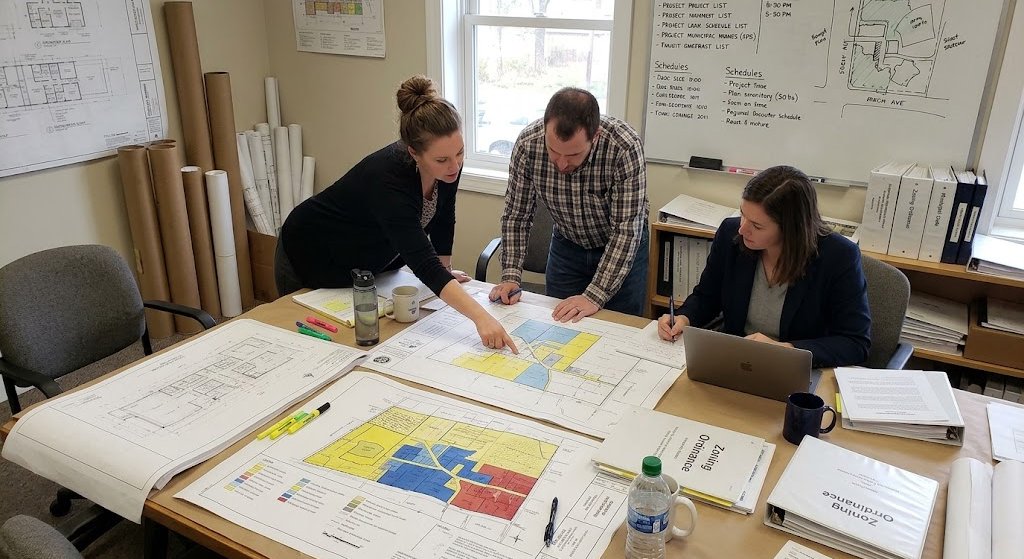
Every medical office project in Broward starts with one question: which of the county’s 31 municipalities governs the site, or does it fall inside the unincorporated Broward Municipal Services District (BMSD), where Broward County itself is the zoning and building authority. That single determination shapes every subsequent step, since each city runs its own planning, zoning, and building department with its own submittal process, review timeline, and political dynamics.
The general path looks like this:
- Pre-application and due diligence Confirm the zoning district and whether medical office is a permitted use outright. Small-scale medical offices under 5,000 square feet are typically allowed in a broader range of districts than larger specialty medical facilities, which draw more intensive review. This stage also confirms Future Land Use Map (FLUM) consistency and flags concurrency exposure for traffic, drainage, schools, parks, and water and sewer capacity.
- Entitlements, if required If the use is permitted by-right and FLUM-consistent, a project can move directly to site plan review. If not, expect rezoning, conditional use or special exception approval, a planned development designation, or a variance, most of which require public hearings before a planning board and city commission. Medical office frequently triggers Florida’s concurrency requirements, meaning the applicant must demonstrate adequate infrastructure capacity before approval is granted.
- Site plan and development review Submittals typically move from conceptual to final site plan, addressing building footprint, parking ratios, patient and ambulance access, landscaping, buffering, signage, lighting, and utilities. Medical uses draw particular scrutiny on patient parking counts, ADA compliance, and compatibility with adjacent residential or commercial uses.
- Engineering and utility approvals Drainage, stormwater, roadway access, and utility capacity are reviewed separately from the land-use approval, and Broward’s engineering standards on drainage and traffic apply even when a municipality controls the building permit itself.
- Building permit Once land-use approval is secured, the project moves to a uniform building permit application with signed and sealed plans, survey, zoning and development review approval, a notice of commencement for projects valued at $5,000 or more, and coordinated sub-permits for electrical, plumbing, and other trades. Permits are valid for 180 days, and extensions are discretionary rather than automatic, which makes sequencing critical.
- Inspections and Certificate of Occupancy Medical office inspections focus on life safety, ADA compliance, fire suppression, and, where applicable, medical gas systems. A Certificate of Occupancy is required before opening, and in BMSD that requirement is explicit for any change of commercial tenant or occupancy.
Why Jurisdiction Changes the Answer
The zoning distinction between a small-scale medical office and a specialty medical facility is not cosmetic. Offices under 5,000 square feet are often treated as standard professional office uses, sometimes without a required separation from residential zoning, though overnight treatment is generally prohibited and operating hours may be restricted near single-family neighborhoods. Facilities over 5,000 square feet, or those offering more intensive services, are more likely to require conditional use approval, greater buffering from residential uses, and stricter parking and traffic standards.
Professional office zoning districts, commonly labeled C-P in Broward’s municipal codes, explicitly allow medical and dental offices, clinics, laboratories, and pharmacies as principal uses, typically along major commercial corridors. Confirming which district applies, and how a given city interprets its own code, is the single most consequential early step in any Broward medical office project. Because each municipality writes and interprets these standards independently, the same building program can face a straightforward by-right approval in one city and a multi-hearing entitlement process a few miles away.
This is precisely where a locally fluent entitlement partner earns its fee. JDJ Consulting works with developers, architects, and investors to determine the correct jurisdiction and zoning path before a site is under contract, which is often the difference between a six-month approval and one that stretches well past a year. More on that approach is outlined on the firm’s Broward permit expediting and entitlement consulting page.
Where Medical Office Development Is Concentrated
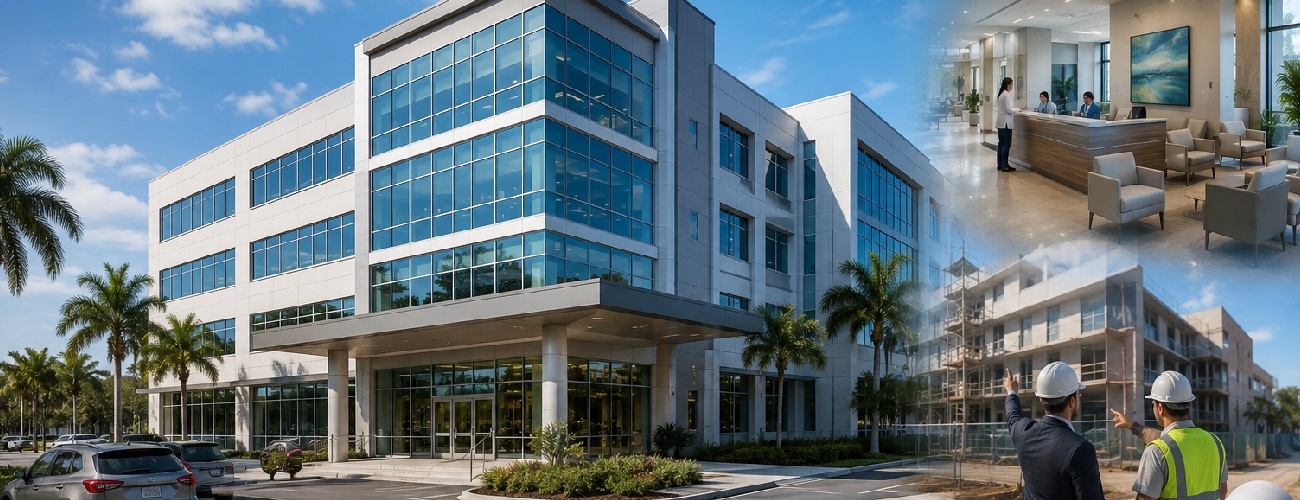
Activity is clustering around Broward’s flagship hospital campuses. Broward Health Medical Center in Fort Lauderdale and Broward Health North in Pompano Beach are anchoring significant expansion, including an eight-story, roughly 188,000-square-foot medical office building at the Fort Lauderdale campus and a 127,000-square-foot facility at Broward Health North. Coral Springs, Plantation, and Fort Lauderdale round out the most active central Broward submarkets, with developers targeting visible sites along major arterials near established healthcare clusters.
Class A projects such as the Baptist Health Medical Office Building and Atlantic Village Professional Center are moving forward with strong pre-leasing, reinforcing that new, well-designed facilities remain in demand despite broader market softening. The tradeoff in these corridors is straightforward: higher land basis, more competition for developable parcels, and heavier scrutiny over traffic impact and building massing during public hearings.
Where Opportunity Still Exists
Beyond the core hospital corridors, three types of sites are drawing renewed developer interest:
- Secondary commercial corridors with strong arterial access but comparatively lower land costs, often along older strip commercial nodes near activity centers.
- Infill and redevelopment parcels, including aging office buildings that can be repositioned for medical use, though these typically require a zoning transition, community engagement, and higher site work costs for utility and drainage upgrades.
- Western and northern Broward edges, where land is more available and less expensive, offset by longer commute times for patients and staff and, in some areas, infrastructure capacity limits.
Each of these opportunity zones carries its own version of the concurrency and community-risk equation. Traffic level of service, drainage capacity, and school or park capacity can all become gating items requiring mitigation or phased approval, and infill medical office proposed near residential neighborhoods frequently draws opposition over traffic, lighting, and extended hours of operation.
What Incentives Are Available for Medical Office Projects in Broward?
Florida offers no state income tax as a baseline advantage, and several targeted programs can materially improve a medical office pro forma when structured correctly.
State-level programs
- Qualified Target Industry (QTI) Tax Refund for job-creating projects in targeted industries, which can include healthcare and life sciences tenants.
- Capital Investment Tax Credit (CITC), offering up to 5 percent of eligible capital costs annually for up to 20 years on qualifying high-impact projects.
- Quick Response Training (QRT) grants that support workforce training costs for new or expanding healthcare employers.
Local and area-specific programs
- Enterprise Zones in Fort Lauderdale, Hollywood, and Pompano Beach, offering incentives tied to job creation and capital investment.
- Community Redevelopment Agency (CRA) and Tax Increment Financing (TIF) districts in cities including Coral Springs, Hallandale Beach, Margate, and Fort Lauderdale, which can fund public improvements and facade or job-creation grants within designated areas.
- Impact fee waivers of up to 100 percent for qualifying low-income certified projects, plus school impact fee waivers of up to $50,000 with School Board approval.
- Tax-exempt bond financing for hospital-affiliated projects, a tool Broward Health has used for its own medical office expansion.
The practical move is to map incentives against the tenant profile early, since QTI and CITC eligibility depends on the tenant’s industry classification and job creation commitments, not just the building’s use.
Common Hurdles by Project Stakeholder
Developers and investors are underwriting into a market where vacancy sits at 12.5 percent and older assets face real lease-up risk, while construction and capital costs remain elevated across South Florida.
Architects and engineers most often stall plan review over incomplete technical detail, code conflicts, or parking and traffic designs that do not meet medical-specific standards, including ADA compliance, ambulance access, medical gas systems, imaging shielding, and enhanced HVAC.
General contractors are managing a 180-day permit clock alongside sequenced sub-permits for electrical, plumbing, fire, and medical gas systems, any one of which can cascade into a broader delay if not tracked closely.
Lenders are underwriting medical office more conservatively than standard office product, since specialized build-outs and hospital affiliations complicate appraisal comps, and pre-leasing levels are scrutinized more closely given current vacancy trends.
Medical Office Development Checklist for Broward County
- Confirm jurisdiction (city versus BMSD) and zoning and FLUM consistency before locking a site under contract.
- Determine whether the project qualifies as a small-scale medical office (under 5,000 square feet) or a specialty medical facility, since the entitlement path differs significantly between the two.
- Run a concurrency screen covering traffic, drainage, water and sewer, schools, and parks before finalizing design.
- Design for patient experience from the outset: clear wayfinding, adequate patient parking, ADA compliance, and ambulance access where applicable.
- Map available incentives, including QTI, CITC, CRA and TIF programs, and tax-exempt financing, against the tenant profile and bake them into the pro forma.
- Build permit sequencing around the 180-day validity window, with medical gas, imaging, and HVAC sub-permits scoped early.
Frequently Asked Questions
Does medical office development in Broward County require rezoning?
Not always. If the proposed use is permitted by-right in the existing zoning district and consistent with the Future Land Use Map, a project can proceed directly to site plan review. Rezoning, conditional use approval, or a variance is only required when the use or intensity falls outside what the current zoning allows.
What is the difference between a small-scale medical office and a specialty medical facility in Broward?
Small-scale medical offices under 5,000 square feet are generally treated as standard professional office uses with fewer restrictions. Specialty medical facilities over 5,000 square feet typically require conditional use approval and face stricter parking, traffic, and residential buffering standards.
How long does a Broward building permit stay valid? Building permits in Broward are valid for 180 days.
Extensions are possible but not automatic, which makes coordinating design, engineering, and sub-permit sequencing essential to avoid re-permitting.
Which Broward submarkets have the most active medical office pipeline? Fort Lauderdale, Pompano Beach, Coral Springs, and Plantation are currently the most active, largely due to their proximity to major hospital campuses including Broward Health Medical Center and Broward Health North.
Every one of these steps changes depending on which of Broward’s 31 jurisdictions governs a site, and getting that determination wrong early is the most common reason medical office timelines slip. JDJ Consulting advises architects, developers, and investors through Broward’s entitlement and permitting process from initial zoning verification through Certificate of Occupancy. Learn more about how the firm supports medical office and commercial projects across Broward County on the services page, or visit jdj-consulting.com directly.