Table of Contents
How SB 79, SB 684, and a new generation of transit-tier zoning are rewriting the entitlement math for mixed-use redevelopment across Irvine, Santa Ana, Anaheim, Costa Mesa, and Tustin.
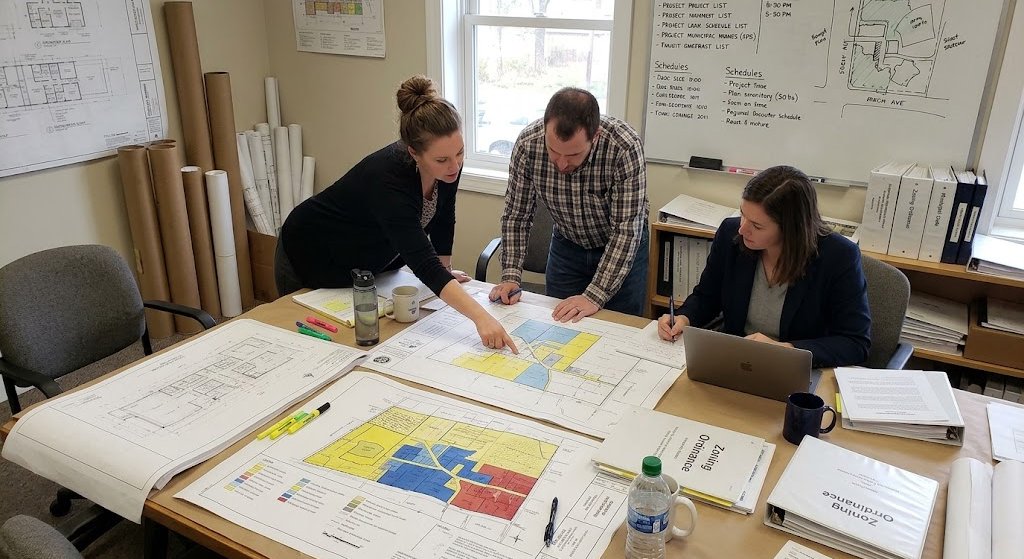
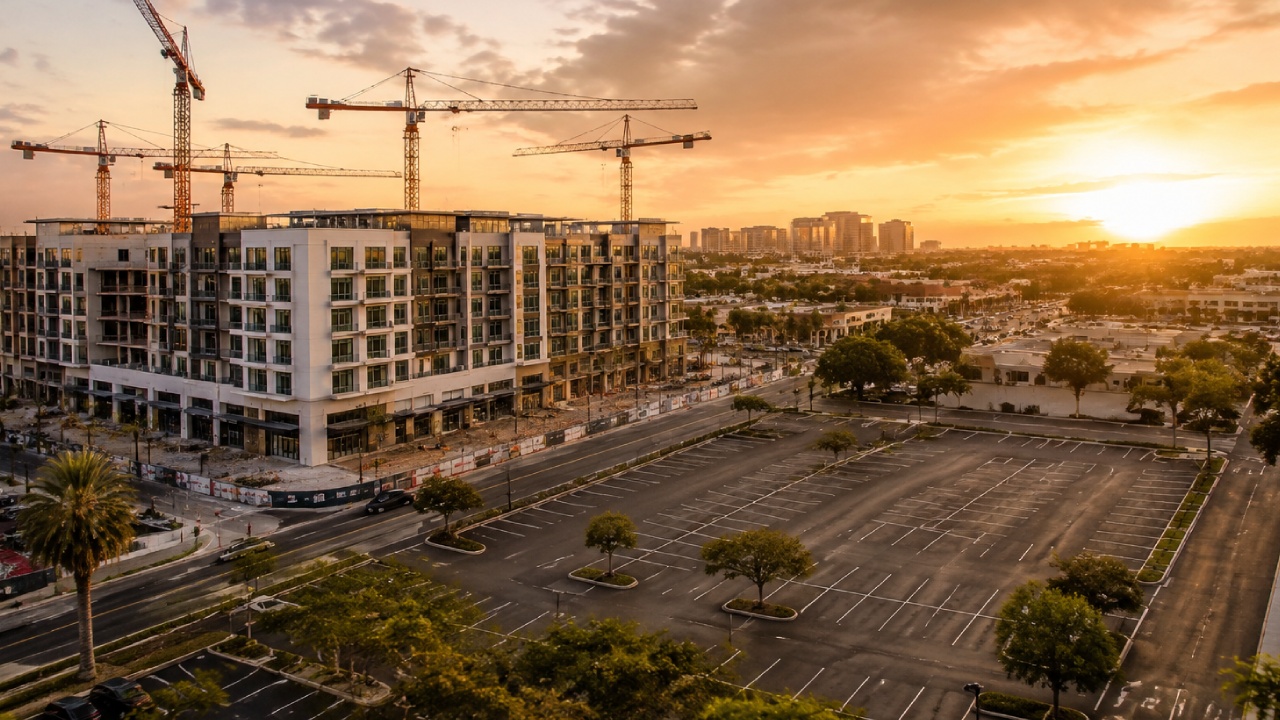
Drive down Bristol Street in Santa Ana on a Tuesday afternoon and you will pass three kinds of real estate: buildings that are full, buildings that are half full, and buildings that are waiting. The third category is the interesting one. It includes aging strip centers with cracked asphalt, 1980s office parks with vacancy signs that have not changed in two years, and surface parking lots so large they show up on satellite maps as gray rectangles. None of that land is idle because nobody wants it. It is idle because, until recently, the path from “vacant lot” to “occupied mixed-use building” in Orange County ran through eighteen to thirty-six months of discretionary review, a CEQA process built for a different era, and a zoning code that treated retail, office, and housing as three separate universes.
That path just got shorter for a meaningful share of sites. Senate Bill 79, the state’s transit-oriented development law, took effect July 1, 2026, and Orange County is one of only eight counties in California where it applies. Combined with the small-lot ministerial pathways created by SB 684 and SB 1123, and layered on top of city-led revitalization pushes in Santa Ana, Tustin, and Anaheim, the entitlement environment for mixed-use redevelopment has shifted meaningfully. Not for every parcel. Not without friction. But for developers who understand which pathway applies to which site, the math has changed.
This is the guide for reading that math correctly, before an architect draws a line or a lender underwrites a pro forma.
Why Mixed-Use Redevelopment Is Suddenly Everywhere in Orange County
Three forces are converging on the same submarkets at the same time. State housing law is pushing density toward transit corridors. Office demand has not recovered evenly, leaving older Class B and C buildings competing against newer product they cannot match on amenities. And cities that spent a decade writing specific plans for exactly this kind of redevelopment are now watching the market catch up to the zoning, rather than the other way around.
The result is a wave of adaptive reuse and ground-up mixed-use activity concentrated around Irvine Spectrum, South Coast Metro, downtown Santa Ana, and pockets of Anaheim and Tustin, each with a different entitlement calculus depending on zoning, transit proximity, and lot size.
What Pathway Applies to Your Site? Start Here
Every mixed-use redevelopment project in Orange County falls into one of five entitlement pathways. Getting this classification right at the due diligence stage is the single highest-leverage decision in the process, because it can compress or extend the timeline by more than a year.
By-Right Mixed-Use Zoning (MU, MX, TOD, C-R)
Most Orange County cities, including Irvine, Santa Ana, Anaheim, Costa Mesa, and Tustin, maintain mixed-use zoning districts where residential, retail, and office uses are permitted outright. Ground-floor retail paired with upper-floor residential is typically permitted by right in MU, MX, and TOD zones. Office-plus-residential-plus-retail combinations are generally allowed in C-R and MX districts. This is the fastest pathway available when the zoning already matches the intended use, and it is worth confirming before assuming a discretionary process is required.
SB 79 Transit-Oriented Development
SB 79, the Abundant and Affordable Homes Near Transit Act, took effect statewide on July 1, 2026, and Orange County qualifies as an urban transit county under the law, one of only eight in California. The law overrides local height and density limits on qualifying sites zoned residential, mixed-use, or commercial within one half mile of a major transit stop.
Eligibility hinges on tier and distance. Tier 1 stops, generally heavy rail and very high frequency commuter rail, unlock the most generous standards. Tier 2 stops, covering light rail, standard commuter rail, and bus rapid transit, unlock a somewhat lower but still significant density and height increase. The closer a site sits to the platform, the greater the entitlement benefit, with standards stepping down at the quarter-mile and half-mile bands.
- Minimum project size: at least five dwelling units, at a density of no less than 30 units per acre or the applicable local minimum, whichever is greater
- Affordability set-aside: roughly 7 percent extremely low income, 10 percent very low income, and 13 percent low income units, or the local inclusionary requirement if it is higher
- Height allowances: up to the mid-80-foot range for Tier 1 sites near a stop, scaling down with distance and tier
- Approval posture: SB 79 makes a qualifying project an allowed use and overrides conflicting local zoning and density limits, though it does not itself grant CEQA exemption or ministerial review. Projects that separately qualify under SB 35 or SB 423 can layer streamlined ministerial approval on top of SB 79’s density and height benefits.
One development to watch closely: the OC Streetcar, expected to open service in 2027, will activate SB 79 eligibility along its corridor in Santa Ana and surrounding areas, effectively creating a new entitlement pathway for sites that do not currently qualify. Developers assembling sites along that route today are positioning ahead of a zoning shift that has not yet fully landed.
SB 684 and SB 1123: The Small-Lot Ministerial Track
For smaller infill sites, SB 684 and SB 1123 offer something entitlement attorneys rarely get to say about California housing law: a genuinely fast, genuinely certain pathway. Lots zoned for multifamily or mixed use, up to five acres in size, can be subdivided into as many as ten parcels, each supporting up to ten residential units, with no discretionary hearing and no CEQA review, provided the average unit size does not exceed 1,750 square feet.
The approval window runs on a 60-day ministerial clock. For developers assembling smaller parcels for boutique mixed-use infill rather than a full city block, this is frequently the most efficient pathway on the table, and it is one that gets overlooked by teams defaulting to a conditional use permit out of habit.
Conditional Use Permit or Specific Plan
Large-scale mixed-use redevelopment that does not qualify for a ministerial pathway still moves through the traditional discretionary process: pre-application meeting, formal CUP or Specific Plan application with a full technical package, Planning Commission hearing, CEQA review, and, where rezoning or a Specific Plan amendment is involved, City Council approval. This remains the correct pathway for true megaprojects, and it remains the slowest, typically running eighteen to thirty-six months for entitlements alone before construction begins.
Office-to-Mixed-Use Conversion
Converting a vacant or underperforming office building into residential, retail, or a blend of the two triggers a different set of reviews: a change of use permit if the occupancy classification shifts, building permits for structural and MEP upgrades, environmental health plan check if residential kitchens or bathrooms are being added, fire department review for egress and sprinklers, and accessibility compliance under the California Building Code. Conversion projects typically run twelve to twenty-four months from due diligence through entitlement, faster than a ground-up megaproject but slower than either ministerial pathway.
The Typical Permit Sequence, Step by Step
Regardless of which pathway applies, most mixed-use redevelopment projects in Orange County move through a recognizable sequence. The table below maps the stages and realistic timelines.
Step | What Happens | Typical Timeline |
|---|---|---|
1. Site due diligence | Confirm zoning designation, SB 79 and SB 684 eligibility, parking and traffic constraints | 2–4 weeks |
2. Pre-application meeting | City planning staff confirms which pathway applies | 1–2 weeks |
3. Application submittal | Site plan, architectural drawings, traffic and parking studies, environmental documentation | Varies by pathway |
4. CEQA review, if applicable | Exempt under SB 684 and SB 1123; addressed separately under CUP or Specific Plan review | 0–12 months |
5. Discretionary review, if applicable | Planning Commission hearing for CUP or Specific Plan, with public notice | 3–6 months |
6. City Council approval, if applicable | Legislative action for rezoning or a Specific Plan | 2–4 months |
7. Entitlement approval | CUP, Specific Plan, or SB 79 and SB 684 ministerial clearance issued | — |
8. Building permit | Construction drawings, plan check, fees, structural and MEP permits | 2–4 months |
9. Construction and occupancy | Build-out, inspections, Certificate of Occupancy | 18–36 months |
Where the Friction Actually Lives: A Stakeholder View
Every party at the table experiences the same entitlement process differently, and misreading a counterpart’s real pressure point is one of the more expensive mistakes on a mixed-use deal. Understanding the friction points below is often what separates a project that stays on schedule from one that stalls in month fourteen.
Stakeholder | Where the Friction Shows Up |
|---|---|
Developers | Layering multiple capital stacks for residential and commercial components; construction costs running $400 to $600 per square foot; parking requirements that conflict with transit-oriented density goals |
Architects | Balancing genuinely different spatial programs under one roof; coordinating MEP systems across use types; meeting SB 79 height and density standards without sacrificing design quality; integrating structured parking without it dominating the massing |
General contractors | Sequencing phased construction, often retail first and residential second; coordinating overlapping tenant improvement schedules; staging on tight urban infill sites |
Investors | Property classification conflicts between residential and commercial underwriting; cap rates running 5.5 to 6.5 percent on mixed-use product; longer lease-up timelines on the retail and office components |
Retail and office tenants | Tenant improvement costs of $100 to $200 per square foot for retail and $50 to $100 per square foot for office; limited available space in high-demand submarkets like Irvine Spectrum and South Coast Metro |
Lenders | Construction cost overruns; mixed-use collateral that is harder to liquidate than a single-use asset; rollover risk on the commercial components |
Where Orange County’s Mixed-Use Market Actually Stands Right Now
Submarkets Carrying Elevated Vacancy
Irvine Spectrum has one of the county’s highest concentrations of mixed-use product, and retail vacancy there sits in the 8 to 10 percent range, with e-commerce continuing to pressure rents at older centers. Newport Beach carries some of the county’s highest asking rents, in the $3.50 to $4.50 per square foot NNN range for retail, alongside elevated availability in its older shopping centers even as new supply stays limited. The Greater Airport Area around Santa Ana is carrying meaningfully elevated office vacancy, as older Class B and C buildings struggle to compete against newer mixed-use product.
Where the Opportunity Is Actually Concentrated
Santa Ana, and South Coast Metro specifically, stands out as the county’s clearest opportunity zone. SB 79 eligibility will expand meaningfully once the OC Streetcar opens in 2027, and the city is actively courting mixed-use transit-oriented development, with multiple large projects already in the pipeline. Anaheim’s west-of-I-5 corridor is drawing interest for its proximity to the Disneyland Resort and convention center, paired with a city posture that is reducing parking requirements for mixed-use projects. Costa Mesa is seeing older office stock convert toward mixed-use, aided by proximity to UC Irvine and UCI Health. Tustin’s Campo on 17th project, transforming an aging shopping center into roughly 100 townhomes plus retail, is a useful template for what a mid-scale mixed-use conversion can look like when the city is a willing partner rather than an obstacle. And in Laguna Niguel, a $260 million mixed-use redevelopment on the 25-acre former South County Justice Center site is slated to break ground in summer 2026, a signal of how large public-to-private conversions are moving through the pipeline.
Market conditions shift quickly in submarkets this active. Vacancy figures and pipeline data cited here should be verified against current brokerage reporting before being used in an investment memo or underwriting package.
Incentive Programs That Can Change the Deal
Entitlement speed is only half of the value equation. Several overlapping incentive programs can materially improve project economics for teams who structure their application to capture them from the outset, rather than discovering them after the fact.
- SB 79 transit-oriented development: overrides local density limits near qualifying transit stops and can be layered with SB 35 or SB 423 ministerial review where those separate eligibility criteria are also met
- SB 684 and SB 1123: 60-day ministerial approval, no public hearing, no CEQA review, for qualifying small-lot subdivisions up to ten units
- State Density Bonus Law under Government Code Section 65915: up to a 50 percent density bonus for projects with 10 to 100 percent affordable units, plus one to four concessions or waivers covering setbacks, height, parking ratios, or lot consolidation
- New Markets Tax Credit: a federal credit worth roughly 39 percent of qualified equity investment over seven years, available for projects in qualifying low-income census tracts, including parts of Santa Ana and Anaheim
- Low-Income Housing Tax Credit: 4 percent or 9 percent credits for the affordable residential component of a mixed-use project, often paired with tax-exempt bond financing
- Local city incentives: deferred impact fees in cities like Anaheim and Santa Ana, and parking reductions for mixed-use projects near transit, including Anaheim’s reduction from six to four spaces per 1,000 square feet for office components
- Tax-exempt bond financing: available through the Orange County Industrial Development Authority and the California Statewide Communities Development Authority for the affordable residential portion of qualifying projects
The Constraints Nobody’s Marketing Deck Mentions
None of this makes mixed-use redevelopment in Orange County simple. Financing remains genuinely harder than single-use development, because lenders are underwriting two different asset classes inside one capital stack, and elevated cap rates in the 5.5 to 6.5 percent range reflect that complexity. Construction costs running $400 to $600 per square foot are driven up by specialized systems: structured parking, MEP infrastructure serving three or four different use types under one roof, and phased build sequencing that adds coordination overhead most single-use projects never encounter.
Parking remains a genuine tension point. Some cities still require ratios as high as six spaces per 1,000 square feet for office and two spaces per unit for residential, standards that sit uneasily next to a state mandate explicitly designed to reduce car dependence near transit. And for large-scale megaprojects still routed through a CUP or Specific Plan, eighteen to thirty-six months of entitlement time remains the reality, regardless of how favorable the underlying zoning looks on paper.
SB 79 implementation itself carries a wrinkle worth watching. Cities have latitude to adopt implementing ordinances, and some are using that latitude to exclude parcels or slow-walk local application of the law. Developers assembling sites near future OC Streetcar stops, or any Tier 1 or Tier 2 transit stop, should track local ordinance activity closely rather than assuming state law alone guarantees the entitlement outcome.
Frequently Asked Questions
How long does mixed-use redevelopment entitlement take in Orange County?
It depends entirely on pathway. A qualifying SB 684 or SB 1123 small-lot project can clear ministerial approval in 60 days. A site that qualifies for SB 79’s density and height overlay, combined with SB 35 or SB 423 streamlining, can move considerably faster than the traditional track. A large-scale project routed through a Conditional Use Permit or Specific Plan should be budgeted at eighteen to thirty-six months for entitlements alone, with total project delivery, including construction, running twenty-four to forty-eight months.
Does SB 79 apply to my Orange County site?
Only if the parcel sits within one half mile of a qualifying major transit stop and is zoned residential, mixed-use, or commercial. Eligibility narrows by tier and distance band, with Tier 1 heavy-rail stops unlocking the most generous standards. Confirming eligibility requires checking the site against the transit stop tier maps that regional planning agencies are required to maintain, since local ordinance activity can also modify which parcels qualify.
What is the fastest legal pathway to entitle a small mixed-use infill project?
For qualifying lots under five acres zoned multifamily or mixed-use, SB 684 and SB 1123 offer the fastest route available: a 60-day ministerial approval with no discretionary hearing and no CEQA review, for subdivisions of up to ten parcels with up to ten units each.
Why are office buildings converting to mixed-use in Orange County right now?
Uneven office demand recovery has left older Class B and C buildings, particularly in submarkets like the Greater Airport Area, unable to compete with newer product on amenities. Converting to residential, retail, or a blended program lets owners capture value from underperforming assets, though conversions still require a change of use permit, building permit upgrades, and full accessibility compliance.
What incentive programs most improve mixed-use project economics in Orange County?
State Density Bonus Law, offering up to a 50 percent density increase for affordable unit inclusion, tends to have the largest single impact on unit count and yield. New Markets Tax Credits and Low-Income Housing Tax Credits can materially improve the capital stack for projects in qualifying census tracts, and local parking reductions and fee deferrals in cities like Anaheim and Santa Ana can meaningfully reduce both hard costs and site plan friction.
Where This Leaves Developers, Architects, and Investors
The entitlement environment for mixed-use redevelopment in Orange County has not become simple. It has become legible, for the first time in years, to teams who know how to read it. The pathway a site qualifies for, by-right, SB 79, SB 684, CUP, or conversion, determines almost everything downstream: financing structure, design constraints, timeline, and ultimately whether the deal pencils at all.
That classification decision is exactly where experienced entitlement guidance earns its fee. JDJ Consulting’s permit expediting and entitlement team in Orange County works directly with city planning staff across Irvine, Santa Ana, Anaheim, Costa Mesa, and the surrounding submarkets to identify which pathway actually applies to a given site, structure the application to capture available incentives, and keep discretionary projects moving through hearings without the delays that quietly erode a pro forma.
For a specific site, the first move is always the same: verify the zoning designation and SB 79 or SB 684 eligibility before a single design decision gets made. Teams who bring that clarity to their architect and their lender on day one are the ones who move from vacant lot to occupied building on the timeline they originally underwrote. To scope entitlement strategy for a mixed-use site in Orange County, connect with JDJ Consulting’s Orange County team.