Table of Contents
Why the next wave of government and quasi-public buildings in the capital will be decided less by budgets than by entitlement strategy
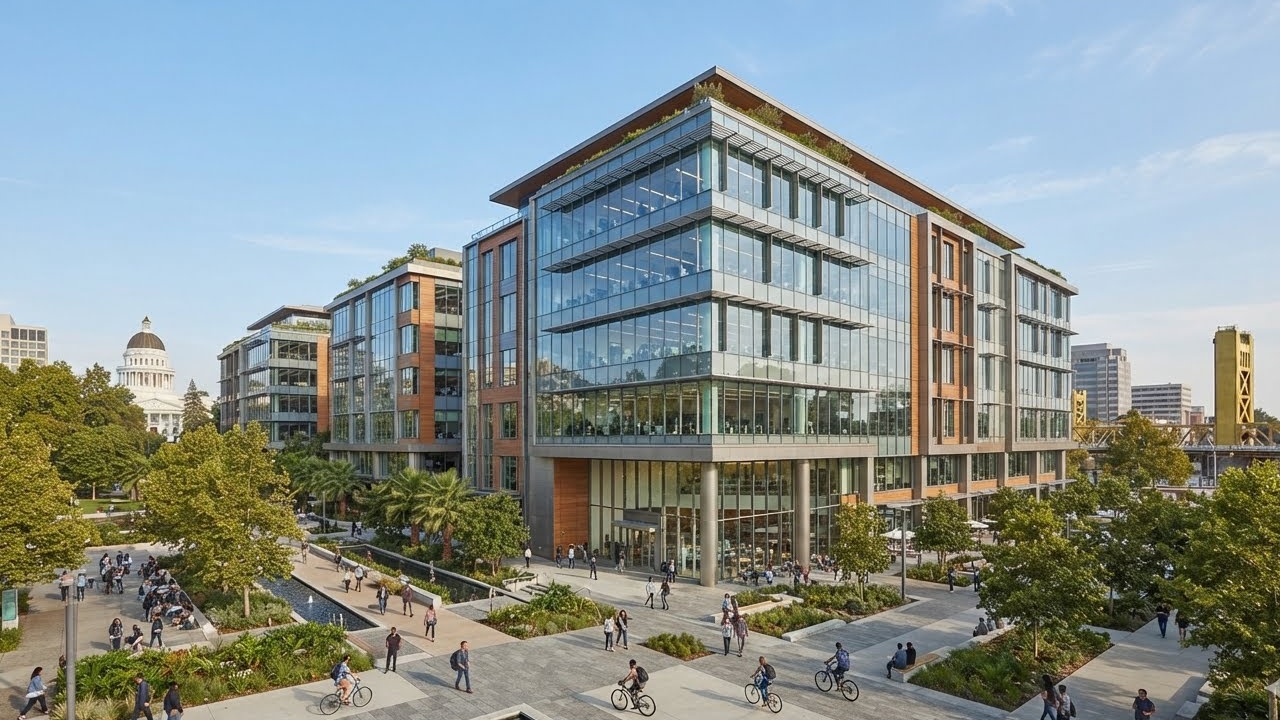
A state agency does not choose a building the way a private tenant does. It chooses a jurisdiction, a funding cycle, and a political moment, and only then does it choose a site. That sequencing is the entire story of public-sector office development in Sacramento right now. Meta’s $50 million catalyst gift toward the Capitol Mall redevelopment for Sacramento State did not simply fund a building. It signaled that the state’s most contested corridor still has room for one more deal, provided someone can move it through entitlements before the political window closes.
That window is the subject of this article. Sacramento is entering 2026 with a rewritten CEQA statute, a City Hall that has spent two years trying to shorten its own review cycles, and a public office pipeline that is unevenly distributed across the region. Downtown and Capitol Mall are crowded and getting more expensive to build in. The suburban ring, from Citrus Heights to Rancho Cordova, is comparatively open. Developers, architects, and general contractors who understand which lever to pull, and when, are the ones who deliver on schedule. Everyone else discovers the cost of assuming a government building permits like a private one.
How Does the Entitlement Process Work for Public-Sector Office Projects in Sacramento?
Public-sector office development covers state agency buildings, county administrative offices, courthouses, DMV-style service centers, workforce hubs, and public health clinics. What separates these projects from private office from the first day is ownership and funding structure, not just use. A state-owned building routes through the Department of General Services and the State Public Works Board. A county or city project needs board or council approval of funding and lease terms before entitlements even begin. Many recent deals, Capitol Mall among them, are delivered through public-private partnership or lease-leaseback structures that layer a private developer’s execution speed onto a public funding source.
That layering changes the sequence architects and GCs are used to. Interagency agreements and catalyst funding commitments often precede formal entitlements rather than follow them, which means the political and financial deal can be locked well before a site plan exists.
Pre-Application: Where the Real Decisions Get Made
Zoning for public office uses in Sacramento typically falls into C-3 Central Business District, C-2 General Commercial, P Public, or a specific plan district. Some public uses are allowed by-right in P zones, but design review and CEQA compliance still apply. The pre-application meeting is where a project’s actual entitlement path gets defined: ministerial versus discretionary, the scope of traffic and utility study required, and whether the site carries environmental exposure serious enough to trigger an EIR.
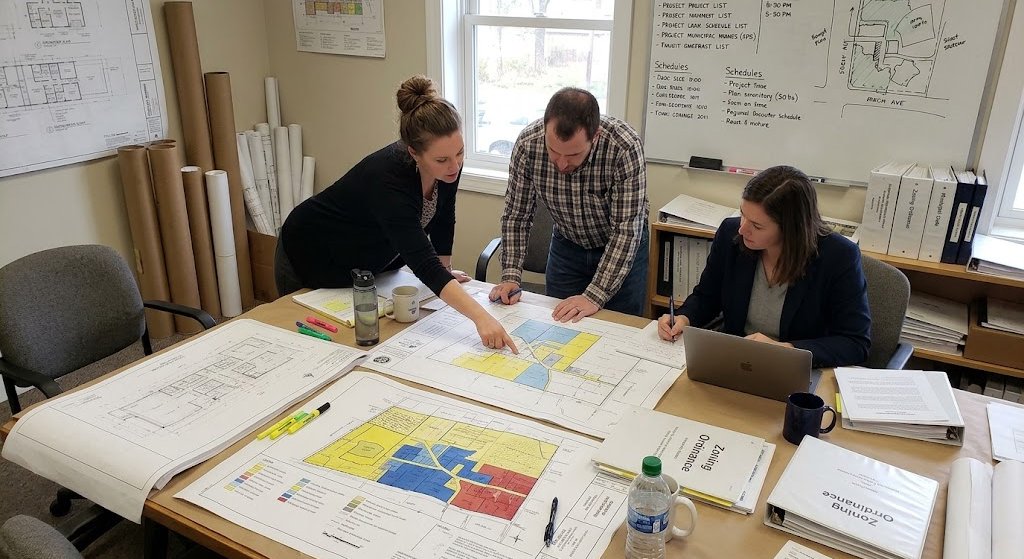
This is the point in the process where jurisdictional complexity compounds fastest, three levels of government, a funding agency, and a design review board all with independent timelines. Firms that bring a permit expediting partner in at this stage, rather than after the first round of comments, are the ones who keep a multi-agency schedule from drifting.
JDJ Consulting works this exact seam in the Sacramento market, coordinating DGS, county, and city review tracks so a public office project’s funding timeline and its entitlement timeline stay in sync rather than working against each other. More on that approach is outlined at JDJ’s Sacramento permit expediting and entitlement consulting page.
Ministerial vs. Discretionary Approval
Smaller public office projects that meet objective standards in P or C zones can sometimes proceed through administrative permits, a path the City of Sacramento generally clears in two to three months at the staff level. Most larger public office buildings do not get that option. They require conditional use permits or planned development approval, full site plan and design review covering massing, materials, landscaping and security, a traffic impact analysis, and environmental clearance. Staff-level design review on these larger projects typically runs two to three months; anything requiring Planning and Design Commission review stretches to six or seven. Projects that trigger a full Environmental Impact Report should be budgeted at twelve to twenty-four months or longer, particularly where litigation risk is elevated.
What Changed in CEQA for 2026, and Does It Help Public Office Projects?
The honest answer is: partially, and unevenly. Assembly Bill 130 and Senate Bill 131 took effect January 1, 2026, and represent the most significant CEQA streamlining package in years. AB 130 created a new statutory CEQA exemption for qualifying development projects of 20 acres or less that meet specific criteria, while SB 131 addresses “near miss” projects that fail to qualify for exemption due to a single disqualifying condition, limiting review in those cases to only the effects tied to that condition.
The catch for public-sector office development is that most of this reform architecture was built around housing, infill, and transit-oriented projects. Health centers, child care facilities, and certain public infrastructure categories picked up expanded exemptions in the same package, but a standalone government administrative building or courthouse does not automatically inherit housing-focused streamlining. Sacramento’s own CEQA guidelines still treat traffic and parking impact, historic resource impact, and community character as central issues for discretionary public office review, and large projects in or near historic districts, much of downtown and Capitol Mall qualifies, still face the heaviest scrutiny.
Seismic and liquefaction hazard mapping adds a technical layer specific to this region. Current hazard zones designate large sections of downtown, the Railyards, and Natomas as Zones of Required Investigation for liquefaction, which affects foundation design, cost, and in some cases the CEQA analysis itself. Any public office project budgeting a downtown or Railyards-adjacent site should treat a geotechnical scope as a pre-application task, not a design-phase afterthought.
What This Means for Scheduling
- Confirm early whether your project category benefits from AB 130/SB 131 exemptions, most standalone office uses will not qualify outright, but hybrid public office plus community-serving components sometimes do.
- Budget for a Mitigated Negative Declaration timeline (several months) as the realistic middle case, reserving full EIR timelines for sites with known historic, traffic, or seismic complexity.
- Treat CEQA litigation exposure as a scheduling risk, not just a legal one. Sacramento has seen CEQA used as leverage by residents, environmental groups, and occasionally labor interests on larger public projects.
What Happens After Entitlements Are Approved?
Once entitlements and CEQA clearance are complete, the project moves into building permit submittal, architectural, structural, MEP, fire and life safety, accessibility, and Title 24 energy compliance. All new permit and plan-review applications submitted in Sacramento from January 1, 2026 forward must comply with the 2025 California Building Standards Code and the city’s local amendments, which affects everything from energy systems to structural detailing on projects still in design.
Coordination at this stage runs across Public Works for frontage and street improvements, utilities for will-serve letters and capacity fees, Fire for access and suppression systems, and, for state-owned buildings, DGS and the State Public Works Board directly. State law now imposes firmer timelines on responsible agencies for post-entitlement permit action, generally requiring a decision within a set window after a complete application, which is a meaningful improvement over the open-ended waits public projects faced a decade ago. Conditions of approval commonly attached to public office buildings include frontage improvement timing, landscape and tree mitigation, traffic mitigation such as signal or turn-lane work, sustainability requirements like solar and EV charging infrastructure, and completion bonds where off-site work is involved.
Where Each Stakeholder Feels the Friction
Public-sector office projects distribute risk differently than private development, and the friction points are specific enough that they are worth mapping by role.
| Stakeholder | Primary Friction Point | Schedule Impact |
| Developers / Delivery Partners | High upfront fees, CEQA litigation exposure, and public budget-cycle uncertainty that can delay or cancel funded projects | High |
| Architects / Designers | Design review standards for massing and materials, plus heightened security and sustainability requirements unique to government buildings | Moderate |
| General Contractors | Phased infrastructure in edge/infill sites, permit timing tied to utility will-serve letters, rising specialty-systems cost | Moderate to High |
| Investors / Lenders | Lease rates tied to government budget cycles, submarket perception risk, environmental and seismic exposure affecting exit assumptions | Variable |
| Community Stakeholders | Traffic and parking concerns, historic character preservation, displacement risk in disadvantaged communities | High in contested sites |
Which Sacramento Submarkets Are Already Saturated?
Downtown Sacramento and the Capitol Mall corridor remain the region’s dominant public office hub, home to EDD, DGS, and a dense concentration of state and federal agencies. Recent state catalyst investment, the Meta-backed Capitol Mall project among them, confirms continued public-sector commitment to the corridor, but it also confirms how constrained the land supply has become. New entrants face intense competition for remaining parcels and correspondingly heavier environmental review.
Midtown and the Railyards carry some public and quasi-public use but are increasingly dominated by private office, residential, and retail development. Liquefaction risk is a defining constraint for this submarket specifically, and any public office project here should assume geotechnical findings will shape both design and CEQA scope. The Natomas and airport-adjacent area has pockets of public and quasi-public use but is dominated by industrial and residential growth, and large-scale public office proposals there tend to run into significant infrastructure and CEQA hurdles.
Where Is There Still Room for Public Office Development?
The more interesting story for developers right now is not downtown, it is the ring around it. Aging commercial and office sites along major arterials in Citrus Heights, North Highlands, Orangevale, and unincorporated county pockets carry public or commercial zoning already, along with existing utility capacity, which meaningfully de-risks redevelopment into modern public office facilities.
- Infill sites in established public corridors, typically 2 to 10 acres, can support 50,000 to 200,000 square foot public office buildings with minimal off-site improvement work.
- Unincorporated county pockets near Elk Grove, Rancho Cordova, and Citrus Heights are under pressure to meet service delivery goals and are often more receptive to public office proposals than incorporated cities managing tighter growth caps.
- Transit-adjacent sites near light rail stations and high-frequency bus routes are increasingly favored for public office use, both to reduce parking demand and to align with state sustainability goals, a trend reinforced by SB 79’s transit-oriented development framework taking effect July 1, 2026 across Sacramento and seven other counties.
None of these opportunities are turnkey. Some corridors still need sewer, water, or street capacity upgrades before they can absorb meaningful public office square footage, and lenders sometimes price suburban Sacramento public deals as riskier than downtown ones without a pre-leasing commitment in hand. Fragmented parcel ownership along arterial corridors can also slow site assembly considerably. The advantage goes to teams who map infrastructure capacity and ownership status before, not after, committing to a site.
What Incentive Programs Are Available for Public Office Development?
State-owned projects may qualify for State Public Works Board funding covering land acquisition, design, and construction, the funding mechanism behind several recent Capitol Mall-area moves. Energy efficiency and renewable energy rebate programs can offset the cost of solar and EV charging infrastructure, which is increasingly a design requirement rather than an option for public buildings. Seismic retrofit and safety grant programs are directly relevant for any project sited in Sacramento’s liquefaction hazard zones.
At the local level, cities and the county offer fee deferrals, expedited permit processing, and infrastructure improvement support for job-creating public office projects, with West Sacramento, Rancho Cordova, and Elk Grove among the suburban jurisdictions running the more targeted programs. Workforce development agencies can also offset hiring and training costs tied to job creation requirements attached to some incentive packages.
The practical move is to map a project against zoning, transit proximity, and utility capacity before finalizing site selection, then use the pre-application meeting to lock in which development standards can be waived or reduced. Confirming ministerial eligibility in writing at this stage, rather than assuming it, is what protects a project if the classification gets challenged later.
Frequently Asked Questions
How long does entitlement take for a public office project in Sacramento?
It depends heavily on the review path. Ministerial or staff-level design review can close in two to three months. Discretionary approval requiring Planning and Design Commission review typically runs six to seven months. Projects triggering a full Environmental Impact Report should budget twelve to twenty-four months or more, especially where CEQA litigation risk is present.
Does the 2026 CEQA reform (AB 130/SB 131) apply to government office buildings?
Partially. The reform package primarily targets housing, infill, and transit-oriented development, along with specific categories like health centers and child care facilities. A standalone administrative office building or courthouse does not automatically qualify for the new exemptions, though hybrid public projects with a qualifying component sometimes do. Each project needs individual evaluation against the statutory criteria.
Which Sacramento submarkets have the most room for new public office development?
Suburban and unincorporated corridors, Citrus Heights, North Highlands, Orangevale, and pockets near Rancho Cordova and Elk Grove, generally offer more available, appropriately zoned land than downtown Sacramento or Capitol Mall, where sites are scarce and competition is high.
What triggers a full Environmental Impact Report for a public office project?
Common triggers include significant traffic and parking impacts, proximity to historic resources or districts, seismic and liquefaction hazard exposure, and community concerns over displacement or neighborhood character. Downtown and Railyards-area sites are more likely to face full EIR review than suburban infill sites.
Can a private developer deliver a public-sector office project in Sacramento?
Yes. Many public office projects use public-private partnership or lease-leaseback structures, allowing a private developer to execute design and construction while the public agency retains ownership or long-term lease control. These structures often mean funding and interagency agreements are finalized before formal entitlements begin.
Building the Right Sequence, Not Just the Right Site
Public-sector office development in Sacramento rewards teams that treat entitlement strategy as a parallel track to design, not a formality that follows it. The corridor is bifurcated: downtown and Capitol Mall carry prestige and public-sector permanence but shrinking, contested land supply, while the suburban ring offers real capacity if the infrastructure and ownership questions get resolved early. The 2026 CEQA reforms narrow some review timelines but do not eliminate the jurisdictional complexity, DGS, county, city, design review boards, that defines this asset class.
Getting a public office project from funding commitment to certificate of occupancy in this environment takes a team that already knows which agency owns which decision, and when. That is the work JDJ Consulting does for developers, architects, and public agencies across the Sacramento region, translating a multi-agency approval sequence into a schedule that actually holds. Learn more about our Sacramento entitlement and permit expediting practice at jdj-consulting.com/sacramento-permit-expeditors-entitlement-consultants.