
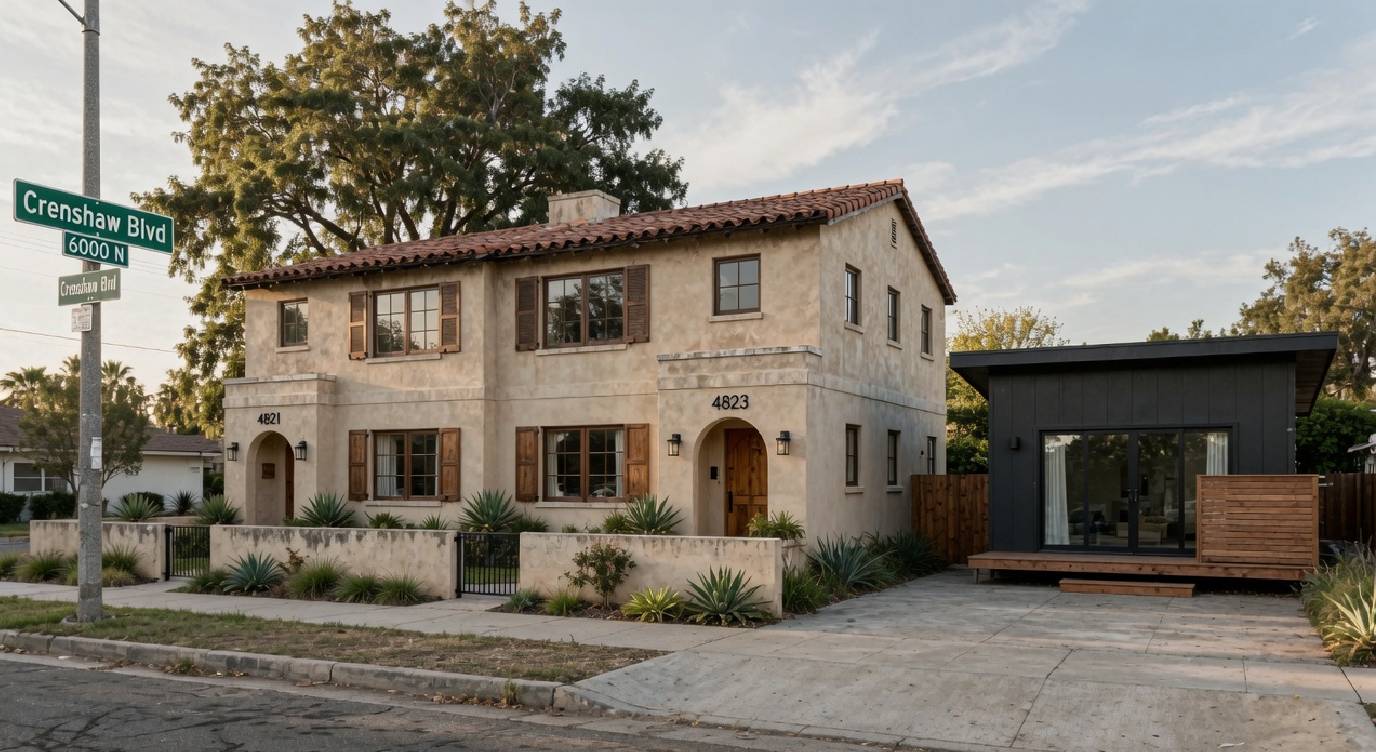
On a tree-lined stretch of Crenshaw Boulevard, a handsome 1920s Spanish Colonial has taken on a new identity. What was once a single family residence now holds two distinct addresses, 4821 and 4823, and just behind it sits a sleek, dark-paneled accessory dwelling unit that feels entirely of this era. The pairing of old and new on one lot is becoming a familiar sight across Los Angeles, and it tells a bigger story about how the city is quietly reshaping its housing stock, one parcel at a time.
Projects like this one rarely happen by accident. Converting a single family residence into a duplex, then adding a standalone ADU on top of that, requires threading together several layers of municipal code that were not necessarily written with each other in mind. In this case, the path ran through ZA Memo 143, the zoning administrator guidance that clarified how accessory dwelling units interact with lots that are also undergoing a change in occupancy type. Without that clarity, a property owner could easily find themselves caught between two sets of rules that seem to contradict one another, one governing the duplex conversion and another governing the ADU addition.
Why This Kind of Project Is Harder Than It Looks
From the street, the result looks effortless. A restored facade, thoughtful landscaping, a modern rear structure that respects the scale of its historic neighbor. But behind that final image is a process that tests the patience of even experienced property owners.
Converting a single family home into a duplex changes its legal use, which triggers a review of setbacks, parking, and unit separation requirements that did not apply under the original single family designation. Layer an ADU on top of that conversion, and the city needs to confirm that the combined density still fits within what the lot and the zone can support. Each department, from Building and Safety to Planning, tends to interpret these overlapping requirements slightly differently, and a plan set that satisfies one reviewer can come back with corrections from another.
Then there is the matter of timing. Entitlement review in Los Angeles rarely moves in a straight line. Plans get routed, comments come back weeks later, revisions get resubmitted, and the cycle repeats until every department signs off. For a project involving both a use change and a new unit, that cycle can happen more than once, and each round adds weeks to a timeline that owners often expected to be much shorter.
Finding the Right Reading of the Code
What makes ZA Memo 143 valuable is that it gives property owners and their teams a clearer interpretation of how ADU provisions apply when a lot is also changing from one residential use to another. It does not eliminate the review process, but it does provide a more defensible foundation for the plans being submitted, which tends to reduce the back and forth that so often stalls projects like this one.
This is where having a team that understands the nuance of local code becomes less of a convenience and more of a necessity. JDJ Consulting worked through the entitlement sequencing on this Crenshaw Boulevard property, aligning the duplex conversion with the ADU addition so that both moved through review as a coordinated package rather than two competing applications. That kind of sequencing, knowing which approval needs to happen before another can be submitted, is often the difference between a project that stalls for months and one that keeps moving.
A Model Worth Watching
The finished property now offers three separate living spaces on a lot that once held one. For the owner, that means additional rental income and long term flexibility. For the neighborhood, it means more housing without a dramatic change to the streetscape, since the original home retains its historic character while the ADU sits quietly toward the rear of the lot.
As more Los Angeles property owners look at similar opportunities, projects like this one on Crenshaw Boulevard offer a useful reference point. They show that combining a duplex conversion with an ADU is achievable, provided the entitlement path is understood clearly from the start and the right guidance is in place to keep the layers of code working together instead of against each other.