Table of Contents
What a 2026 hotel-market study reveals about the room types, meeting space, and sites the Township is missing, and what it takes to entitle them.
Somewhere between a corporate site-selection call that never got returned and a wedding planner who quietly crossed The Woodlands off her shortlist, roughly $175 million in hotel and convention business slipped out of Montgomery County over the last decade. Not because travelers stopped wanting to come. Because the rooms they needed were not there.
That is the uncomfortable headline buried inside a 2026 hotel-market study commissioned to answer a deceptively simple question: does The Woodlands need more hotels? The answer, it turns out, is not a blanket yes. It is a precise, almost surgical yes, pointed at two very specific gaps in an otherwise mature and well-served market.
For developers, architects, and institutional investors scanning Houston’s northern suburbs for the next defensible hospitality play, that precision matters more than the topline number. The Woodlands is not an underbuilt market looking for volume. It is a sophisticated, occupancy-conscious market that lost specific categories of business it should have kept, and the study’s authors were unusually clear about which ones.
The Real Story Isn’t a Room Shortage. It’s a Format Mismatch.
The Woodlands currently carries approximately 2,254 hotel rooms, with roughly 1,300 classified as full-service inventory carrying restaurants and dedicated meeting or event space. On paper, that looks like a market with plenty of beds. The study’s contribution was showing that bed count was never the constraint.
The constraint was format. Over the 2021 to 2030 window, the market lost an estimated $175 million in potential hotel and convention business, tied to 651 identifiable leads that went elsewhere because no available property matched the requested room block, meeting-space configuration, or brand tier. That is not lost demand. That is demand that showed up, asked for something specific, and left.
The study concluded the Township could absorb an additional 180 to 360 rooms without meaningfully cannibalizing the existing base, structured around two distinct products: a 175 to 225-room upper-upscale full-service hotel and a 125 to 175-room upscale branded select-service hotel. Each targets a different piece of the leakage the market has been experiencing for years.
Where the Money Actually Is
Tourism is not a side benefit in The Woodlands. It is a measurable economic engine. Visit The Woodlands reports more than $555 million in direct visitor spending, close to 4,300 travel and tourism jobs, and $10.3 million in 2025 hotel-occupancy-tax collections. The Township levies a 9 percent hotel-occupancy tax on top of the state’s 6 percent, for a combined 15 percent rate that ties hotel performance directly to public revenue.
That fiscal relationship is precisely why public bodies pay close attention to what gets built and where. A hotel that adds net-new room nights, pulls in convention business the market has been losing, and generates incremental occupancy-tax revenue is a fundamentally different conversation for local officials than a hotel that simply redistributes existing demand across one more property.
Five Product Types, Five Very Different Bets
Hospitality is not a single asset class in The Woodlands. It is five distinct plays, each with its own capital structure, operating model, and entitlement complexity.
Full-Service Upper-Upscale Hotel
This is the product the 2026 study most directly supports. Think 175 to 225 rooms, 10,000 to 20,000 square feet of meeting space, a real restaurant and lobby lounge, executive-level accommodations, and structured or valet parking. It is built to capture corporate travel, group and convention business, medical visitors, life-science companies, weddings, and upscale leisure guests who currently drive to Memorial City or into Houston proper because The Woodlands could not hold their room block.
Upscale Branded Select-Service Hotel
Smaller, leaner, and generally easier to finance: 125 to 175 rooms with 4,000 to 6,000 square feet of meeting space, limited food service, and a tighter staffing model. The strategic challenge here is positioning. This format only works if it avoids going head-to-head with the market’s existing Hyatt, Hilton, and Marriott inventory rather than simply adding another indistinguishable option.
Boutique or Lifestyle Hotel
A smaller bet, 75 to 150 rooms, built around architectural identity rather than brand-standard uniformity. The Waterway and Market Street corridor rewards this format because it already has the pedestrian infrastructure, dining density, and event programming that a lifestyle concept depends on. Higher room rates offset the smaller footprint, but the entire proposition rests on design distinctiveness, which raises the design-review stakes considerably.
Extended-Stay and Corporate Housing
This category answers a question the glossy convention-hotel narrative tends to skip: where do traveling clinicians, life-science contractors, and relocating corporate employees actually sleep for six weeks at a time? Extended-stay product is less dependent on convention cycles but competes directly with furnished apartments and single-family rentals, which changes the underwriting math considerably.
Resort and Destination Hospitality
The Woodlands Resort already operates 55 meeting rooms and more than 75,000 square feet of event space, which sets a high bar for any new resort concept. A second resort-scale property would need a sharply differentiated proposition, built around wellness, golf, culinary programming, or corporate retreat positioning, rather than attempting to out-scale an incumbent with a decade of relationship equity.
The Entitlement Path Nobody Budgets Enough Time For
Here is where hospitality development in The Woodlands diverges sharply from a straightforward Texas ground-up build. Because much of the Township operates under private covenants and commercial design standards layered on top of standard county and municipal permitting, a hotel project runs two entitlement tracks simultaneously, not one.
The Township is explicit that its commercial standards govern building design, signage, landscaping, lighting, parking, and related exterior improvements, and that all of it requires approval before construction begins. A national hotel brand’s standard prototype, the repetitive facade, the oversized porte-cochere, the surface parking field, was designed for a market with no comparable design-review layer. In The Woodlands, that prototype typically needs substantial rework before it clears review, and finding that out late in the schedule is an expensive way to learn it.
This is precisely the kind of jurisdictional and procedural complexity where a firm that works Township approvals daily earns its fee. Firms navigating this dual-track process, private covenant review layered on public entitlement, often bring in a local specialist before land is even under contract. JDJ Consulting’s Woodlands permit expediting and entitlement consulting practice is built specifically around that intersection of Township commercial standards and county or municipal permitting, catching design-review friction before it becomes a costly redesign.
The Ten-Step Sequence
At a program level, the path from site control to certificate of occupancy runs through ten distinct stages:
- Confirm jurisdiction (Montgomery vs. Harris County, municipal boundaries, Township covenant applicability)
- Define the hospitality program in full detail, room count, meeting space, F&B, alcohol service, event capacity
- Commission market and feasibility diligence beyond the Township-wide study
- Confirm land-use entitlement, zoning, specific-use permits, PD amendments, plat approvals
- Hold pre-application meetings with Township design staff, county planning, fire marshal, and utility providers
- Complete Township commercial design review
- Secure civil, traffic, and infrastructure approvals
- Submit building, accessibility, and fire-protection plans
- Obtain health and food-service permits for kitchens, bars, and banquet operations
- Move through construction, brand inspection, and certificate of occupancy
Texas hotels and restaurants are also public accommodations subject to Texas Accessibility Standards review through TDLR, and any project with a commercial kitchen, catering operation, or banquet service will need Montgomery County Environmental Health sign-off under the state’s Food Establishments Rules. Neither of these is optional, and both are frequently underscheduled.
| Approval Track | Typical Trigger | Lead Agency / Reviewer |
| Jurisdiction Confirmation | Site control / due diligence | Township Covenant Administration |
| Commercial Design Review | Concept and schematic design | Township Development Standards Committee |
| Land-Use Entitlement | Zoning, PD amendment, or SUP | Montgomery/Harris County or municipal planning |
| Civil & Traffic Approvals | Site plan through construction docs | County Engineering, TxDOT if applicable |
| Building & Fire Plans | Permit submittal | Building official, Fire Marshal, TDLR (TAS) |
| Food & Health Permits | Kitchen and F&B buildout | Montgomery County Environmental Health |
| Certificate of Occupancy | Pre-opening | Local building department, brand QA |
Approval tracks generally run in parallel with private Township design review, not after it.
Where the Friction Actually Lands
Every stakeholder in a Woodlands hotel deal is managing a different risk. Investors are watching cannibalization against 2,254 existing rooms. Architects are reconciling brand prototypes against design-review expectations. Contractors are sequencing guestrooms, kitchens, and ballrooms toward a single brand-inspection deadline. Operators are building a sales organization capable of generating group business, not just leisure walk-ins. And public agencies are deciding whether a project’s occupancy-tax and job-creation profile justifies a negotiated incentive.
| Stakeholder | Primary Friction Point | Where It Surfaces |
| Developers & Investors | Cannibalization risk against 2,254 existing rooms | Feasibility and lender underwriting |
| Architects | National brand prototypes clash with Township design standards | Commercial design review |
| General Contractors | Convergence of guestrooms, kitchens, ballrooms, and brand inspection | Final 90 days before opening |
| Hotel Operators | Group and convention demand generation beyond leisure travel | Sales ramp-up and stabilization |
| Public Agencies | Hotel-occupancy-tax structuring and abatement eligibility | Chapter 380 and incentive negotiation |
A simplified friction matrix. Each stakeholder’s exposure peaks at a different point in the timeline.
The Incentive Landscape Is Real, But It Isn’t Automatic
The Township’s combined 15 percent hotel-occupancy tax creates a genuine public-finance incentive to support projects that generate new room nights rather than redistribute existing ones. Visit The Woodlands operates a Tourism Development Fund evaluated on hotel room nights, sales tax, and event-admission impact, though it functions more as tourism-programming support than a construction subsidy.
Tax abatements are available in principle, but Montgomery County’s policy generally excludes housing and hotel accommodations from standard eligible-property categories, which means a hotel project typically needs a more customized negotiated argument than a manufacturing or office deal would. Chapter 380 economic-development agreements and potential hotel-occupancy-tax participation structures exist under Texas law, but eligibility, term, and structure require review with local-government counsel on a project-specific basis. None of this is a rebate a developer can simply assume into a pro forma. It is a negotiation that has to be built, documented, and defended.
Reading the Map: Where Each Product Actually Fits
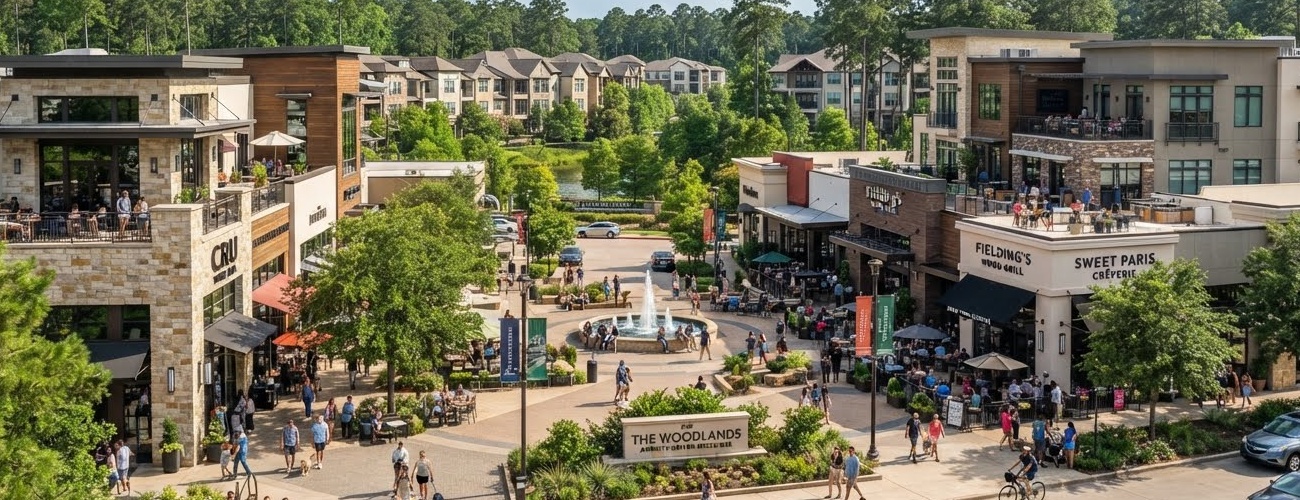
Town Center and The Waterway remain the strongest submarket for a full-service or boutique lifestyle hotel, but land is scarce and design expectations are high. Hughes Landing offers lakefront identity but already carries Embassy Suites and comparable competition. Research Forest and the employment corridors look increasingly like the best-positioned location for medical and life-science hospitality, weekday-driven, less reliant on leisure programming, and directly adjacent to the demand generators. The SH 242 and I-45 corridors remain the default for highway-oriented select-service and extended-stay product, though that comes with pricing pressure from Spring, Shenandoah, and Conroe.
The weakest bet in the entire market is the one that looks safest on paper: another generic limited-service hotel with no meeting space and no defensible demand anchor. The study’s own numbers suggest that segment is already adequately served. The opportunity the data actually supports is narrower, and more specific, than that.
The Bottom Line for Developers and Architects
The Woodlands hotel market is not asking for more rooms in the abstract. It is asking for the 175 to 225-room upper-upscale hotel with real meeting space, the 125 to 175-room upscale branded property positioned to avoid cannibalizing existing brands, and increasingly, a hospitality product built around the medical and life-science demand the Township has been cultivating for years.
Getting any of those built means clearing two entitlement tracks at once, Township commercial design review and standard county or municipal permitting, on a schedule where the two rarely align by accident. That is the piece of this opportunity that tends to surprise out-of-market developers, and it is the piece where local process knowledge converts directly into schedule and cost savings.
For teams evaluating a Woodlands hospitality site, a jurisdiction and covenant review before land is under contract is usually the highest-leverage hour spent on the deal. That is the starting point for JDJ Consulting’s permit expediting and entitlement work in The Woodlands, and it is where most of the projects that stayed on schedule actually began.
Frequently Asked Questions
How many additional hotel rooms can The Woodlands support?
A 2026 hotel-market study concluded the Township could support approximately 180 to 360 additional rooms without materially disrupting the existing hotel base, split primarily between a 175 to 225-room upper-upscale full-service hotel and a 125 to 175-room upscale branded hotel.
Why did The Woodlands lose hotel and convention business if it already has over 2,200 rooms?
The market’s existing inventory did not match the specific room blocks, meeting-space configurations, or brand tiers that corporate and convention groups requested. The study attributed roughly $175 million in lost business between 2021 and 2030 to 651 leads that went unfilled for exactly that reason, a format mismatch rather than a true shortage.
What is the Township’s hotel-occupancy tax rate?
The Woodlands Township collects a 9 percent hotel-occupancy tax in addition to the state’s 6 percent hotel tax, for a combined 15 percent rate applied within the Township.
Do hotel projects in The Woodlands go through a separate design review beyond standard permitting?
Yes. The Township’s commercial design standards govern building design, signage, landscaping, lighting, and parking, and require approval before construction, in addition to standard county or municipal permitting. This dual-track process is one of the most commonly underestimated parts of hotel development timelines in the Township.
Are tax abatements available for hotel development in The Woodlands?
Abatements are possible but not automatic. Montgomery County’s policy generally excludes hotel and housing uses from its standard eligible-property categories, so a hotel project typically requires a more customized negotiated structure, often involving Chapter 380 agreements or occupancy-tax participation reviewed with local-government counsel.