Table of Contents
Inside the market gaps, permitting maze and design tension shaping The Woodlands’ next generation of retail projects.
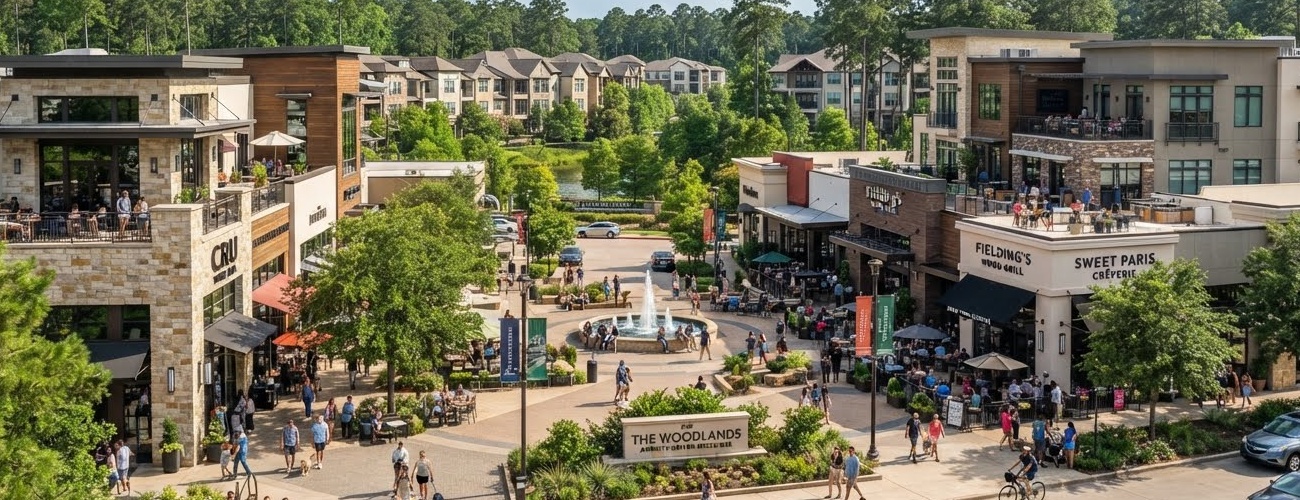
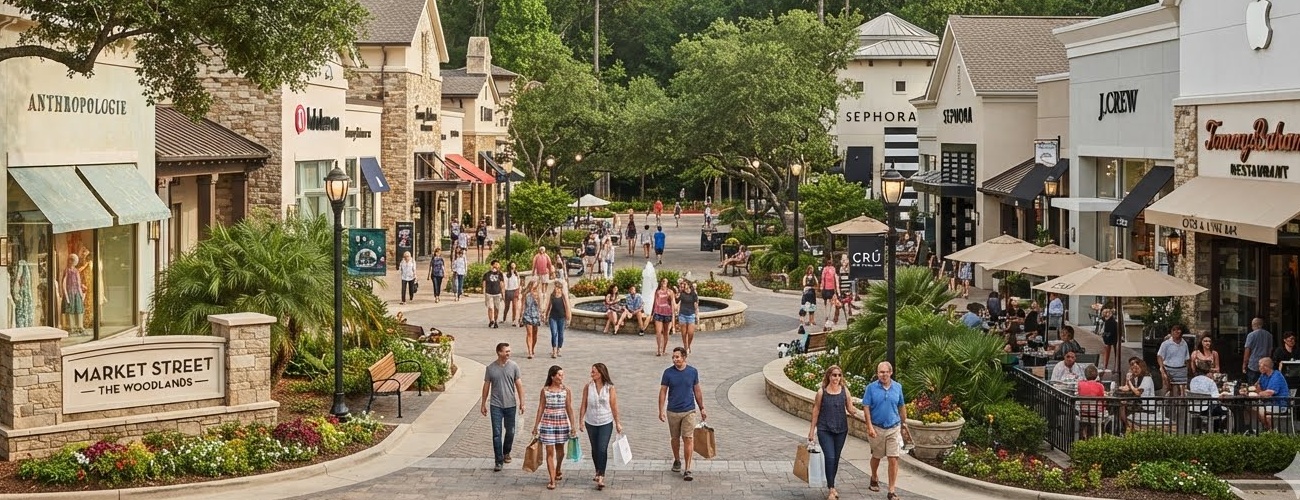
Drive through Town Center on a Saturday afternoon and you would be forgiven for thinking The Woodlands has all the retail it will ever need. The Woodlands Mall is crowded. Market Street’s patios are full. Hughes Landing’s lakefront restaurants have a wait. By every visible measure, this is a market that has already won.
That impression is exactly what trips up the next wave of developers.
The visible saturation at the center of The Woodlands masks a much narrower, much more interesting truth: this is a market with enormous purchasing power and almost no appetite for more of what it already has. The households are here. The income is here, averaging well over $225,000 within a mile of some of the market’s strongest centers. What is missing is not another lifestyle center chasing the same discretionary dollar as Market Street. It is a short, specific list of retail formats the market has quietly been asking for, delivered in the right location, anchored the right way, and built by a team that understands why a national retail prototype does not simply drop into a Montgomery County parcel.
This is a market where the entitlement path matters as much as the site selection, and where getting either one wrong can turn a promising retail pad into a stalled asset.
A Retail Market That Looks Full but Isn’t
The Woodlands’ retail inventory breaks into four distinct tiers, and understanding which tier a site competes in is the first discipline of any feasibility study here.
The Regional Destinations Already Own Discretionary Spending
The Woodlands Mall anchors the region’s conventional retail with more than 160 stores and restaurants, department-store anchors and a full calendar of seasonal programming. Market Street operates as the luxury and lifestyle counterpart, with roughly 375,000 square feet of street-level retail, fifteen restaurants, Class A office space and the Hyatt Centric hotel woven into a tenant mix that runs about two-thirds retail, one-fifth office and the balance hospitality. Both properties continue to add tenants. Market Street recently welcomed seven new luxury and lifestyle retailers spanning jewelry, fragrance, apparel and children’s brands, a signal that demand for high-quality specialty retail in that specific node has not slowed.
For a new project, this tier is largely closed. A developer entering this space is not filling a gap. They are competing head-on with an established, well-capitalized asset for the same customer, and that is a much harder underwriting case than most pro formas admit.
Grocery-Anchored Neighborhood Retail Is the Market’s Quiet Performer
Creekside Park Village Green tells a more useful story. The 74,615-square-foot center sits at 98% leased, shadow-anchored by H-E-B, serving a trade area with average household income near $227,125 within one mile. Its second-story medical and retail space has benefited directly from a neighboring Houston Methodist facility, a pairing of daily-needs grocery traffic with healthcare demand that keeps the center productive well outside typical retail hours.
This is the format institutional buyers still want to underwrite. It combines grocery frequency, daily-needs convenience, food and beverage, and medical or professional services in a single trip pattern, which is precisely the kind of resilience that discretionary-only retail cannot match.
Village Centers Are the Market’s Unfinished Business
Grogan’s Mill, Panther Creek, Alden Bridge, Sterling Ridge, Indian Springs and Creekside all carry the bones of daily-needs retail, but many are aging. Layouts built decades ago do not always accommodate today’s parking, drive-through or outdoor-dining expectations, and ownership is often fragmented enough to complicate a coordinated redevelopment. That gap between what these centers were built for and what today’s tenant mix requires is exactly where a well-capitalized, entitlement-savvy developer can move first.
Employment-Linked Retail Is Still Catching Up to the Jobs
Research Forest and the broader employment and life-science corridors have added office, medical and lab space faster than the restaurants, coffee concepts and daytime-convenience retail needed to serve that workforce. Retail here lives and dies on whether residential or hospitality density arrives to extend activity past 6 p.m. Get that sequencing right and a small-format retail pad becomes one of the more defensible plays in the market.
What’s Already Full, and What’s Genuinely Open
Trade-area leakage analysis, tenant interviews and current lease-up data point to a fairly consistent pattern across the market.
Categories Facing Real Competitive Pressure
- Generic fast-casual restaurants without a distinct location advantage
- Coffee concepts entering saturated intersections
- Boutique apparel competing directly with Town Center
- Conventional fitness centers in already-dense corridors
- Small retail strips built without a credible anchor tenant
- Standard medical and dental office conversions in established corridors
Categories With Real, Underwritable Demand
- Specialty grocery and international food concepts
- Fresh food and prepared-meal formats
- Neighborhood-scale grocery in expansion corridors
- Children’s enrichment and family-service retail
- Senior-oriented retail and wellness services
- Medical retail, rehabilitation and outpatient services
- Pet care and veterinary services
- Food halls and curated local-maker retail
- Daytime food and beverage near research and office clusters
- Retail integrated directly into multifamily and senior housing
None of this should be taken on faith. Every one of these categories still needs to be tested against actual leakage data, trade-area capture modeling and tenant conversations before a site is optioned, not after.
Where the Next 700 Acres Will Actually Get Built
Howard Hughes has identified roughly 700 acres of future commercial land across The Woodlands, concentrated in and around Town Center and the major corridors of I-45, FM 1488, FM 2978 and Kuykendahl Road. That figure represents only about 2.5% of the community’s total acreage, which tells you how selective the remaining commercial pipeline really is. Every acre in that pool will be evaluated against the existing destination and village retail already in place, and the sites that succeed will be the ones with a genuine functional gap to fill rather than a duplicate concept.
A critical distinction the market rewards: plat approval on any of this land is not project approval. The Woodlands’ own future-commercial guidance is explicit that a recorded plat is an early subdivision step, not a green light for a specific retail concept. Site planning, traffic analysis, stormwater design, tree removal and commercial design review all remain to be negotiated separately, and each carries its own timeline risk.
Why Entitlement Is the Real Development Risk Here
The Woodlands’ regulatory layering is unusually dense for a suburban Houston submarket, and it is where most retail timelines actually break.
Jurisdiction Is Not a Formality
A single retail parcel may sit in Montgomery County, Harris County or an incorporated city, and may also be subject to The Woodlands Township’s commercial design standards layered on top of whichever base jurisdiction applies. Those Township standards govern building design, signage, landscaping, lighting and parking, and exterior improvements require approval before construction begins. A developer who assumes county zoning is the only hurdle typically discovers the Township covenant review much later than they should have, and that discovery almost always costs schedule.
National Prototypes Rarely Survive First Contact With Local Design Standards
This is one of the most consistent friction points in the market. A national retailer’s standard prototype, drive-through lane geometry, parking-lot layout, monument sign package, all of it, was not designed with The Woodlands’ architectural and landscape expectations in mind. Materials get revised. Sign packages get resized. Drive-through queuing gets rerouted around fire lanes and pedestrian paths. None of this is unusual, but all of it needs to be anticipated in the pro forma before the retailer’s real estate team walks away from a site that looks right everywhere else in the country but doesn’t fit here.
Traffic and Drainage Approvals Move on Their Own Clock
Montgomery County’s development regulations require coordination with the applicable Commissioner’s Office before the earliest construction-plan or drainage-report submittal for any development exceeding five acres, including a project description, construction-traffic routing plan and adjacent development context. A retail project of any real scale should be modeling weekday and weekend peaks, holiday traffic, restaurant peak periods, drive-through stacking and shared access with neighboring centers well before that submittal, not as a reaction to it.
The Approval Stack, in Practice
A typical retail entitlement runs through, in some combination depending on jurisdiction and use: zoning or planned-development review, conditional or specific-use approval, site-plan approval, preliminary and final plat, shared-access and shared-parking agreements, drainage and detention approval, tree-removal review, sign approval, and food, alcohol or entertainment-specific permits where applicable. Each layer has its own review body, its own timeline, and its own capacity to stall a project if the sequencing is wrong.
This is precisely the terrain where a permit expediting and entitlement consulting team earns its fee. Sequencing jurisdictional review, Township covenant approval, county drainage and traffic requirements and commercial design review in the wrong order can add months to a schedule that a correctly sequenced application would not lose. JDJ Consulting’s entitlement and permit expediting work in The Woodlands is built around exactly this kind of jurisdictional layering, coordinating Township, county and utility review from pre-application through certificate of occupancy so a retail project’s schedule risk sits with the entitlement team, not with the developer’s capital.
Six Development Plays That Actually Pencil
Not every opportunity in this market carries the same risk profile. The table below breaks down the strongest current plays, where they fit, and the one variable most likely to determine whether they work.
Development Play | Program | Best Locations | Primary Risk |
|---|---|---|---|
Grocery-anchored neighborhood center | 40,000–100,000 SF; grocer, pharmacy, restaurants, fitness, medical | Northern/western growth corridors, Creekside expansion, FM 1488/2978 | No anchor means a slow drift into low-productivity service tenants |
Medical and wellness retail | Urgent care, PT, imaging, dental, pharmacy, vision, orthopedics | Research Forest, SH 242, village centers near senior housing | Direct competition with hospital-campus retail; specialized TI costs |
Life-science and corporate services retail | Restaurants, coffee, fitness, business services, corporate dining | Innovation District, Research Forest, employment centers | Over-reliance on weekday daytime population |
Experience-oriented village retail | Food hall, local restaurants, indoor recreation, cultural uses | Village centers, mixed-use nodes, Town Center edges | Requires active programming and ongoing management, not passive leasing |
Retail-integrated multifamily or senior housing | Ground-floor restaurant, pharmacy, clinic, café, market, fitness | Research Forest, Town Center fringe, Hughes Landing, senior campuses | Retail scaled beyond resident and worker demand weakens the whole project |
Adaptive reuse | Fitness, medical retail, food hall, specialty grocery, childcare | Underperforming centers, vacant anchor boxes, older office | Parking, structural and utility limitations; deed restrictions |
Where Each Stakeholder Actually Gets Stuck
Retail development friction in The Woodlands rarely shows up as a single bottleneck. It shows up differently depending on which side of the project you sit on.
Stakeholder | Where the Friction Shows Up |
|---|---|
Developers & Investors | Anchor dependence, tenant cannibalization from existing centers, high land basis, long lease-up periods and financing that favors grocery-anchored or highly stabilized assets over speculative retail. |
Architects & Site Planners | National prototype conflicts with Township design standards, drive-through stacking against fire lanes, parking-field design that undercuts tree preservation, and residential-compatibility constraints on lighting and noise. |
General Contractors | Multi-tenant sequencing between shell and TI work, long-lead restaurant equipment, grease interceptor and kitchen exhaust coordination, and phased openings around ongoing public-realm work. |
Retail Tenants & Operators | High occupancy costs relative to sales productivity, shared-parking competition at peak hours, and seasonal dependence for lifestyle and entertainment concepts. |
The Incentive Landscape Is Narrower Than It Looks
Retail incentive eligibility in this market should never be assumed. Montgomery County’s standard tax-abatement policy is generally built around qualifying economic-development facilities, and housing and hotel accommodations are excluded outright. A retail project is more likely to find support through Chapter 380 performance agreements where the jurisdiction allows it, public-improvement or management-district financing tied to infrastructure the corridor genuinely needs, or Tourism Development Fund support where the project drives measurable room nights, event-admission tax or sales-tax growth.
The pattern across all of these tools is consistent: incentives are defensible when they unlock a genuinely difficult site or produce measurable public infrastructure benefit, not when they simply pad the returns on a conventional shopping center.
The Strategy That Actually Works Here
- Avoid direct duplication of Town Center, Market Street, Hughes Landing and The Woodlands Mall
- Identify category-specific leakage by village and trade area before optioning land
- Prioritize grocery-anchored, medical, wellness, service and experience-oriented formats
- Tie the retail program to adjacent residential, senior, medical, life-science, hotel or employment growth
- Secure a credible anchor tenant before closing on a large site
- Design for shared parking across uses with different peak periods
- Preserve trees and integrate detention into the public realm rather than fighting it
- Screen loading, dumpsters, drive-through lanes and mechanical equipment from day one
- Build a flexible tenant-bay and utility strategy that survives tenant turnover
- Pursue infrastructure and public-realm assistance ahead of relying on direct tax incentives
Frequently Asked Questions
Is there still room for new retail development in The Woodlands, TX?
Yes, but not for undifferentiated retail. The Woodlands Mall, Market Street and Hughes Landing already capture most discretionary and destination spending. The genuine openings are in grocery-anchored neighborhood centers, medical and wellness retail, and retail tied directly to residential, senior housing or employment growth along corridors such as FM 1488, FM 2978 and Kuykendahl Road.
What makes retail permitting in The Woodlands more complex than other Houston-area submarkets?
Retail parcels can fall under Montgomery County, Harris County, or an incorporated city, and are frequently subject to The Woodlands Township’s commercial design standards on top of that base jurisdiction. Exterior improvements need Township approval before construction begins, which adds a review layer most national retailers do not encounter elsewhere.
Does an approved plat mean a retail project is ready to build?
No. The Woodlands’ own future-commercial guidance is explicit that plat approval is an early subdivision step, not project approval. Site planning, traffic analysis, stormwater design, tree removal and commercial design review still have to be secured separately.
What retail categories are most saturated in The Woodlands right now?
Generic fast-casual restaurants, undifferentiated coffee concepts, boutique apparel competing with Town Center, conventional fitness centers, and small retail strips without a credible anchor tenant all face significant existing competition.
How much future commercial land remains in The Woodlands?
Howard Hughes has identified roughly 700 acres of future commercial land, concentrated around Town Center and the I-45, FM 1488, FM 2978 and Kuykendahl corridors, representing about 2.5% of the community’s total acreage.
The Bottom Line
The Woodlands has never lacked purchasing power. What it lacks is patience for retail that duplicates what already works two miles away. The developers who win here are not the ones with the most capital. They are the ones who can identify the narrow, real gap, a grocery anchor still missing from a growth corridor, a medical retail cluster underserved near a hospital campus, a village center overdue for reinvestment, and then move through a genuinely layered entitlement process without losing a year to a jurisdictional question that should have been answered in week one.
That second part, the entitlement path, is where most retail timelines in this market actually get decided. JDJ Consulting has worked permit expediting and entitlement strategy across The Woodlands, coordinating Township covenant review, county drainage and traffic requirements, and commercial design approval into a single sequenced path from pre-application through certificate of occupancy. For developers, architects and general contractors evaluating a retail site in this market, that coordination is often the difference between a project that opens on schedule and one that spends a year explaining delays to its capital partners.