

Austin is now one of the most ADU-friendly cities in the country. Rising home prices, strong rental demand, and major zoning changes have made accessory dwelling units (ADUs) a popular option for homeowners and investors. But building an ADU involves more than construction. You must follow Austin’s permit and zoning requirements before work can begin. This guide explains Austin’s ADU rules, permit requirements, costs, timelines, and the most common issues that delay projects. Many Austin ADU permit delays occur because applicants submit plans before confirming lot restrictions, utility requirements, and setback compliance.
Table of Contents
What Changed and Why It Matters
Austin’s HOME (Home Options for Mobility and Equity) Initiative, first approved in late 2023 and expanded in 2024, changed what property owners can build on residential lots. The rules in 2026 are much more flexible than they were a few years ago.
Some of the biggest changes include:
The minimum lot size dropped to 2,500 square feet.
Property owners can now build up to two ADUs on the same lot as a primary home.
Owner-occupancy requirements were removed.
New ADUs no longer require dedicated off-street parking.
These changes opened the door for many properties in East Austin, South Austin, and Central Austin that were not eligible before. For many homeowners and investors, these updates created new opportunities to add living space and rental income on existing properties.
ADU Size, Height, and Setback Requirements
Austin’s new rules expanded ADU opportunities, but development standards still apply. Understanding these requirements before you start design work can save time and money.
- Size Limits
An ADU can be up to 1,100 square feet or 15% of the lot area, whichever is smaller. If the ADU has a second story, the upper floor cannot exceed 550 square feet.
- Height Limits
A detached ADU cannot be taller than 30 feet.
- Parking Requirements
Austin no longer requires off-street parking for ADUs, regardless of location.
- Setback Requirements
Detached ADUs must meet rear, side, and street-facing setback requirements.
These requirements vary based on lot layout, zoning, and overlay rules. Setbacks often create problems during the planning stage. They affect where an ADU can be built, how large it can be, and whether a design will work on a specific property. Many owners discover setback issues after they have already paid for plans and design work.
- Short-Term Rental Rules
If your ADU received a certificate of occupancy after October 1, 2015, it can only operate as a short-term rental for up to 30 days per year. Long-term rentals of 30 days or more are not restricted.
Starting July 1, 2026, all short-term rental listings must display a valid City of Austin license. Booking platforms are removing listings that do not meet this requirement.
The Issue That Stops Many ADU Projects
City approval is only part of the process. Private deed restrictions and HOA rules can still prevent an ADU project. Many neighborhoods have CC&Rs (Covenants, Conditions, and Restrictions). These rules may limit secondary structures, rental activity, or the number of homes allowed on a lot.
Even if your property meets Austin’s zoning requirements, private restrictions may still block the project. Before spending money on design or permits, have a title company or real estate attorney review your deed restrictions. Finding problems early can save thousands of dollars.
Permit Requirements and What to Expect
Most ADU projects require permits. In Austin, a permit is required unless the structure is under 200 square feet and has no plumbing. Most ADUs exceed those limits.
A typical project requires:
A residential building permit
Electrical permits
Mechanical permits
Plumbing permits
Each permit has its own review process and fees. If the project includes solar panels, Austin Energy handles a separate review process.
Quick ADU Eligibility Checklist
- Property zoning verified
- Setback requirements reviewed
- Utility access confirmed
- Tree regulations reviewed
- Site constraints identified
- Permit strategy established
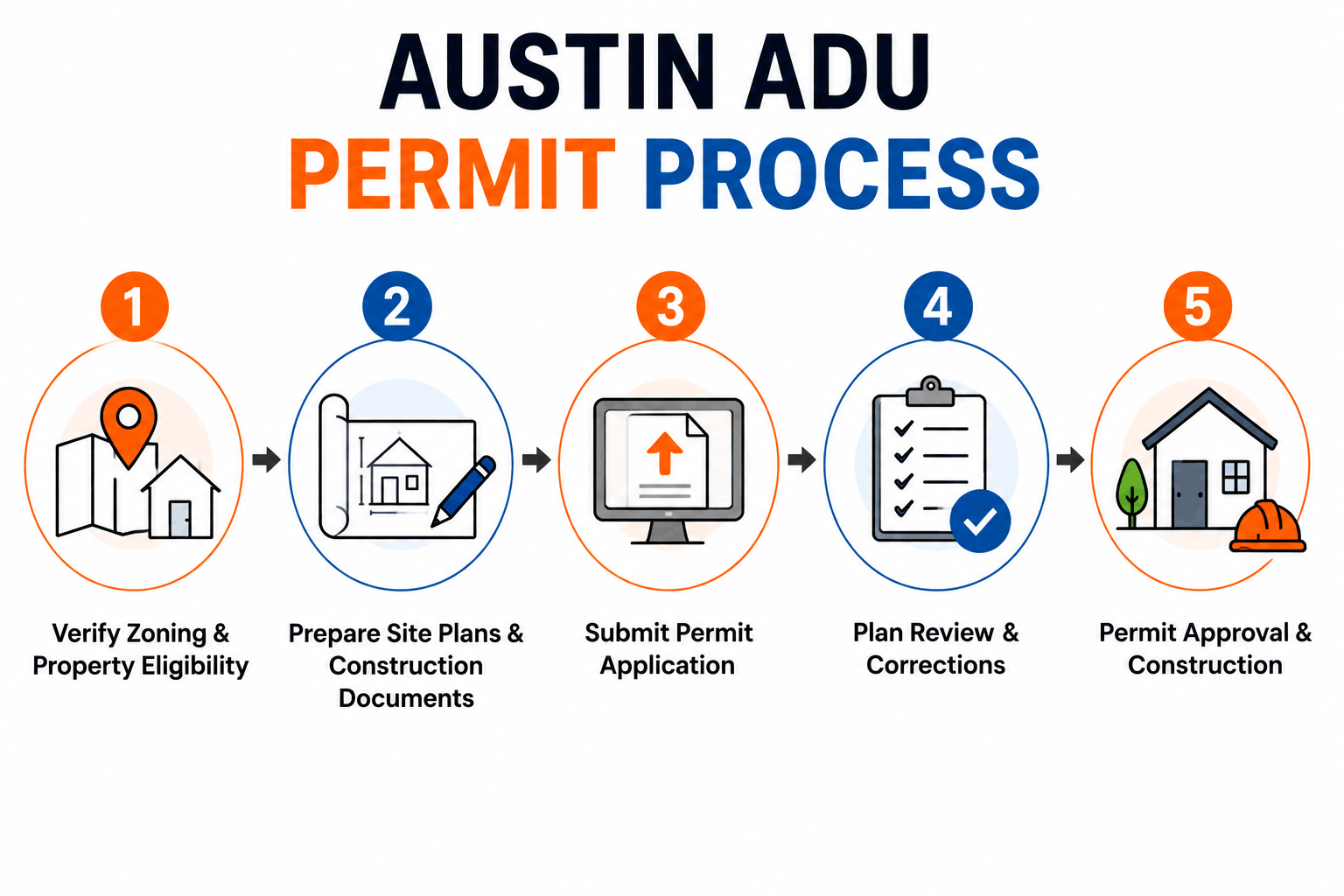
Application Process
Applications are submitted through the AB+C portal. Applicants should submit all required documents at the beginning of the process, including:
Site plans
Architectural drawings
Impervious cover calculations
Utility coordination documents
Incomplete applications often face delays.
Review Timeline
Most ADU permits take between 8 and 14 weeks from submission to approval. Projects involving heritage trees, floodplains, variances, or historic districts usually take longer. Review times can change, so owners should build extra time into project schedules.
Permit Costs
Permit costs typically range from $6,000 to $16,000. The final amount depends on project size, valuation, and required trade permits. These fees do not include construction costs, design fees, engineering work, or utility connections.
Austin ADU Costs in 2026
Construction costs vary by project type.
Typical ranges include:
Garage conversion: $80,000 to $150,000
Prefab or modular ADU: $120,000 to $250,000
Detached site-built ADU: $175,000 to $400,000
Rental income also varies by location. Many one-bedroom ADUs in Central Austin and East Austin rent for $1,600 to $2,200 per month. Properties in higher-demand areas can generate rents of up to $3,000 per month. ADUs can provide strong returns, but only when projects stay on budget and on schedule. Permit delays, redesigns, and unexpected site conditions are common causes of cost overruns.
Common Problems That Delay ADU Projects
Even experienced builders run into challenges. The most common issues include:
- Heritage Trees
Austin has strict tree protection rules. Building within the critical root zone of a protected tree often requires arborist review and may force design changes.
- Impervious Cover Limits
ADUs increase the amount of impervious cover on a property. Lots that are already near the maximum limit may have fewer design options.
- Deed Restrictions
Many projects run into problems when deed restrictions are discovered late in the process. Reviewing these documents early can prevent delays and unexpected costs.
- Incomplete Applications
Submitting partial documents does not save time. Reviewers usually flag incomplete applications immediately.
- Slow Responses to Comments
When reviewers request changes, quick responses are important.
Delays can push projects further back in the review queue.
Getting It Right the First Time
Austin’s ADU process is manageable, but preparation matters. For homeowners, investors, and contractors, delays often cost much more than the permit fees themselves.
An experienced permit consultant can help identify issues before they slow down the project. This includes setback requirements, impervious cover limits, tree protection rules, and other common review concerns.
If you are considering an ADU project, a property review can help you understand what your lot allows, what permits you need, and how long approval may take. Our team offers free initial project assessments to help property owners make informed decisions before investing in design or construction.
Information reflects City of Austin requirements and Development Services Department procedures as of June 2026. Permit fees, timelines, and regulations may change. Always verify current requirements with the City of Austin or consult a qualified permit professional for project-specific guidance.