
If you’re planning to add square footage to your Austin home — whether it’s a new bedroom, a sunroom, a garage conversion, or a full second-story addition — the first question you’re probably asking is: do I actually need a permit for this? The short answer is almost certainly yes. But the fuller answer is more nuanced, and understanding it before you break ground can save you thousands of dollars and weeks of headaches.
Table of Contents
Why Home Additions Virtually Always Require a Permit
Austin’s Development Services Department (DSD) requires permits for any work that affects the structure, utility systems, or safety systems of a home. A home addition, by definition, touches all three.
When you expand your home’s footprint or envelope, you’re dealing with:
Structural changes — new foundations, load-bearing walls, framing, and roof connections
Electrical work — new circuits, outlets, lighting, and panel capacity
Plumbing — if the addition includes a bathroom, laundry, or wet bar
Mechanical systems — extending or adding HVAC to condition new square footage
Each of these triggers its own permit requirement in Austin. A standard home addition doesn’t just require a single building permit — it typically requires a building permit plus separate trade permits for electrical, mechanical, and often plumbing work.
Does Your Home Addition Require a Permit?
Most home additions in Austin require permits, zoning review, and inspections. Use this quick guide to understand where your project may fall.
Room Additions
Add bedrooms, living rooms, offices, and enclosed spaces generally require permits.
Second Stories
Adding square footage vertically typically requires zoning and structural review.
Structural Changes
Removing walls or modifying framing usually requires permits and inspections.
What Happens If You Skip the Permit?
It’s tempting to avoid the permitting process — it costs money, takes time, and adds complexity to an already involved project. But unpermitted additions carry serious long-term risks.
- Stop-work orders and fines. If a neighbor reports the work or an inspector spots it during an unrelated site visit, you can receive a stop-work order immediately. Fines in Austin are not trivial.
- You may be required to tear it out. If the city determines unpermitted work doesn’t meet code, they can require you to demolish the addition entirely — regardless of how much you spent building it.
- It complicates your sale. When you go to sell, your title company and the buyer’s lender will look for permits on any improvement. Unpermitted additions delay closings, reduce appraised value, and can kill deals outright.
- Insurance issues. If something goes wrong in an unpermitted addition — a fire, a structural failure — your homeowner’s insurance may deny the claim. The cost of doing it right is almost always less than the cost of doing it wrong.
What the Permit Process Involves for a Home Addition
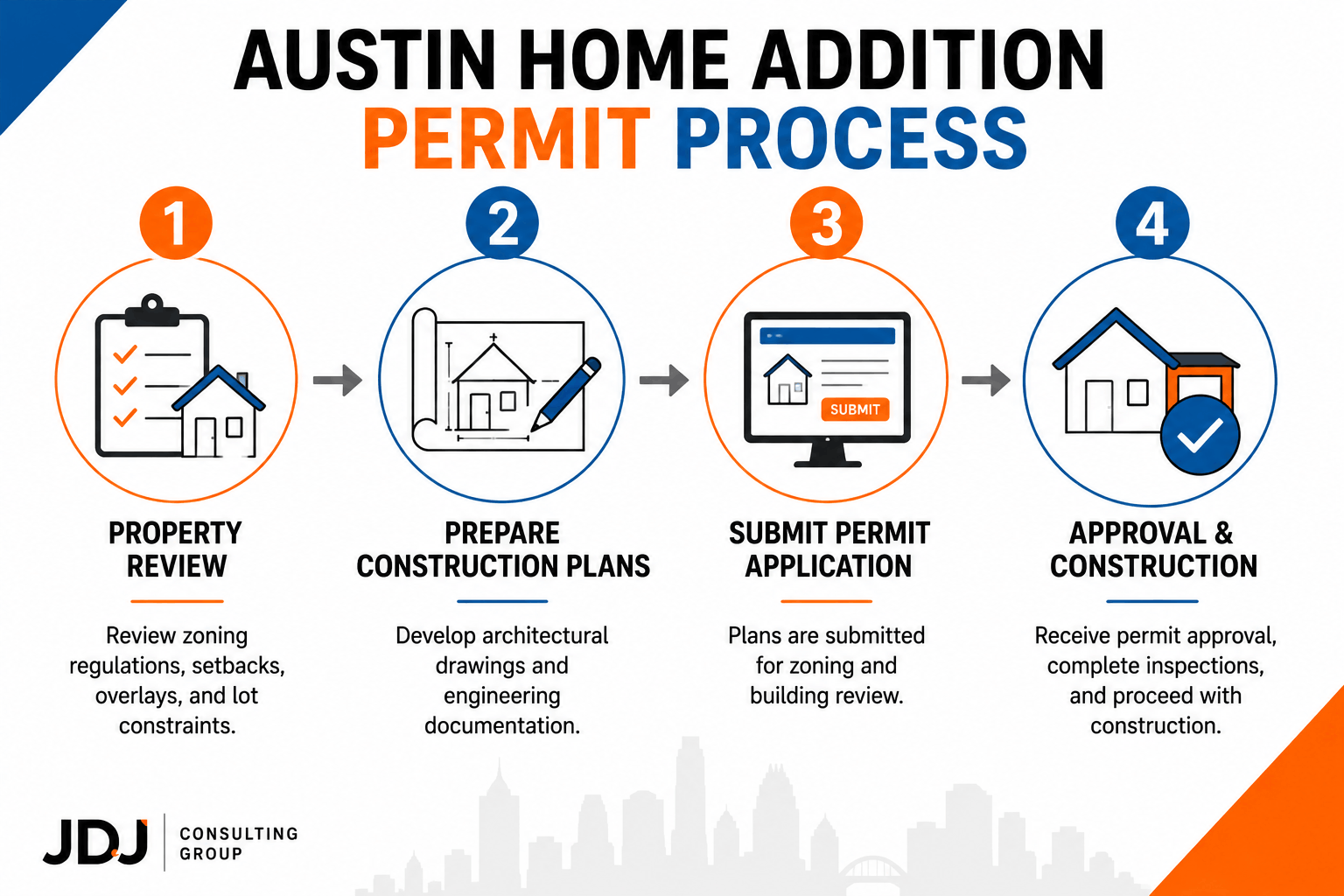
Austin’s permitting process for residential additions runs through the AB+C portal (Austin Build + Connect) and involves multiple reviewing departments — building, zoning, electrical, mechanical, and plumbing — all reviewing your submission simultaneously.
Here’s what you’re navigating:
- Zoning compliance. Before a permit can be issued, your addition has to comply with Austin’s zoning rules for your property. This includes setback requirements (how close you can build to property lines), maximum lot coverage, impervious cover limits, and Floor-to-Area Ratio (FAR) caps. These vary by zoning district — and Austin has more than 30 base zoning categories, plus overlay districts that can modify the rules further.
- Plan review. Residential plan review in Austin typically takes 10 to 21 business days for an initial review cycle. If your plans have issues — missing dimensions, zoning violations, conflicts between drawings — you’ll receive reviewer comments and need to respond with revised plans. Each revision cycle adds time.
- Trade permits. Your electrical, mechanical, and plumbing work each requires its own separate permit, fee, and review.
- Inspections. Once the permit is issued and work begins, inspections are required at multiple stages of construction. Work that gets covered before inspection — framing before drywall goes up, for example — can require walls to be opened back up for verification.
The Variables That Affect Your Permitting Path
Not all home additions have the same permitting experience. Several factors can simplify or significantly complicate the process:
- Location on your lot. Additions near property lines, protected trees, or within floodplain or hillside overlay zones face additional review layers. Austin’s heritage tree protections are particularly strict — any addition near a tree with a trunk diameter of 19 inches or more triggers an arborist review.
- What you’re adding. A bedroom addition is simpler than a full suite with a bathroom. A garage conversion has a different permitting path than a second-story addition. Accessory Dwelling Units (ADUs) — increasingly popular in Austin — have their own specific requirements and review process.
- Your property’s zoning. SF-2, the most common residential zoning designation in Austin, has specific setbacks and coverage limits. But if your property sits in a historic district, a neighborhood conservation district, or another overlay zone, additional reviews and design standards may apply.
- The completeness of your plans. This one is entirely within your control — and it’s one of the biggest factors in how fast your project moves through review. Incomplete or inconsistent plan sets are the leading cause of delays in Austin’s residential plan review queue.
Common Reasons Home Addition Permits Get Delayed
Incorrect Setback Calculations
Property boundaries and setback requirements must be verified before submission.
Incomplete Site Plans
Missing information can trigger review comments and revisions.
Tree Protection Requirements
Protected trees often require additional review and coordination.
Structural Documentation Issues
Engineering details must align with local code requirements.
A New Tool That Can Help: AI Pre-Check
In early 2026, Austin’s DSD launched an AI Pre-Check beta — powered by Archistar — that provides automated pre-review of residential plans before formal submission. The tool flags potential issues before your application enters the official review queue, giving you a chance to correct problems before they trigger a revision cycle.
It’s not available for every project type, but for qualifying residential submissions, it’s worth looking into. Catching a setback issue or an impervious cover exceedance before submission is far less costly than discovering it mid-review.
What Good Preparation Looks Like
The difference between a home addition permit that moves efficiently and one that gets stuck in revision loops almost always comes down to preparation:
Confirm your property’s zoning, overlay district status, and any applicable deed restrictions before you hire a designer
Understand your setback and coverage limits before your design gets too far along
Submit complete, coordinated plan sets — architectural, structural, and MEP drawings that are consistent with each other
Respond to reviewer comments promptly; applications stall when responses are slow
When It Makes Sense to Work With a Permit Professional
For a straightforward bedroom addition with no unusual site conditions, a patient homeowner and a good contractor can often navigate Austin’s permitting process on their own. But the process rewards people who know it — and penalizes those who don’t.
If your addition is more complex, if you’re on a timeline that matters, or if your property has any of the complicating factors described above, working with an experienced Austin permit expediter is often worth every dollar. An expediter who knows the DSD process can identify issues before you spend money on design, prepare clean submissions that reduce revision cycles, and monitor your application through each stage of review.
Our team specializes in Austin residential and commercial permit expediting. If you’re planning a home addition and want to understand exactly what your project needs — and how long it’s likely to take — reach out for a free project assessment. We’ll give you a straight answer before you commit to anything.
This article reflects Austin DSD requirements and procedures as of June 2026. Permit fees, review timelines, and code requirements are subject to change. Always verify current requirements with the City of Austin Development Services Department or consult a qualified permit professional for your specific project.
Planning a Home Addition in Austin?
Before investing in design and construction, verify zoning requirements, setback restrictions, permit obligations, and development constraints that could impact your project.