Table of Contents
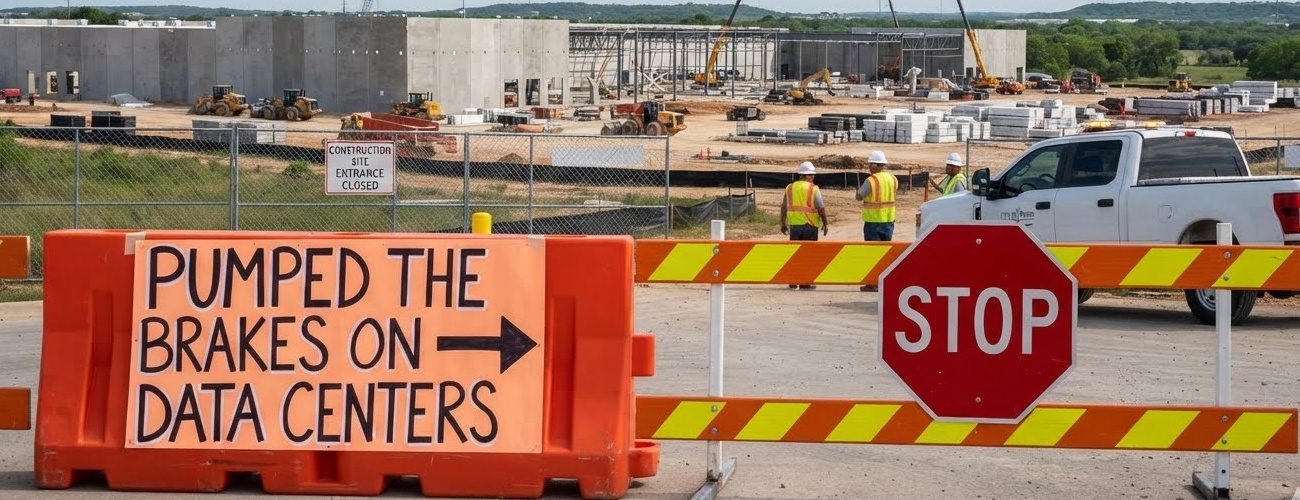
On August 11, 2026, the Fort Worth City Council voted unanimously to start the legal process for a 90-day moratorium on new data center applications. A new Data Center and Infrastructure Commission was created in the same session. A new filing requirement now sits between developers and the permit counter. None of it stops data centers from getting built in Fort Worth. It changes, permanently, what it takes to get one approved.
For two years, Fort Worth has been one of the most active data center markets in North Texas, anchored by Alliance and its deep bench of transmission capacity, fiber, and hyperscale precedent. That momentum did not stall because demand disappeared. It stalled because the city, its residents, and its grid operator all arrived at the same conclusion at roughly the same time: a data center is not an industrial building. It is a power project, a water project, and a noise-generating neighbor wearing an industrial building’s zoning classification.
The moratorium is not yet in effect. It requires additional public hearings and a supermajority vote before it becomes binding, and a proposed zoning ordinance already failed a 7 to 4 vote at the Zoning Commission in July before being sent back to City Council. But the direction of travel is unmistakable, and developers who treat the current industrial standards as a safe harbor are underwriting yesterday’s rulebook.
What Triggered Fort Worth’s Data Center Moratorium?
The moratorium follows a pattern familiar to fast-growing power-constrained markets: rapid facility growth, a state grid operator under strain, and residential neighborhoods increasingly adjacent to industrial land that was zoned decades before anyone contemplated a 500-megawatt campus next door. Fort Worth already counts four existing data center developments across ten buildings and more than three million square feet, with one more under construction and four additional projects proposed within city limits. Those projects span Council Districts 3, 5, 6, 7, 8, and 10, which tells you the issue is citywide rather than confined to one industrial corridor.
On the same day the council initiated the moratorium process, it also approved a new requirement: any data center application submitted after that date must include evidence that ERCOT or the Public Utility Commission of Texas has approved the project’s grid interconnection before the city will move the application forward, with limited exceptions tied to ETJ and municipal water situations. That single procedural change reorders the entire development sequence. State grid approval, once a parallel workstream, now sits in front of local entitlement.
What Kind of Data Center Are You Actually Building?
“Data center” is not one use. It is a category that spans hyperscale cloud campuses, AI and high-performance computing facilities, colocation buildings, enterprise data centers, edge or micro facilities, disaster-recovery sites, crypto-mining operations, powered shells, and equipment-manufacturing support buildings. A 20-megawatt enterprise facility and a 500-megawatt hyperscale campus should never be entitled, financed, or reviewed as though they were the same project, and Fort Worth’s regulators are increasingly making that distinction explicit.
Before a site is under contract, the sponsor should have defined the initial and ultimate IT load, gross building area, number of buildings, power density, cooling technology, water demand, generator type and fuel, operating hours, battery and energy storage systems, use of behind-the-meter generation, fiber requirements, and expansion schedule. Every one of those variables changes the entitlement path.
What Does Fort Worth’s Zoning Actually Allow Today, and What’s About to Change?
Fort Worth has no mature, stand-alone data center zoning ordinance yet. Current projects generally proceed under ordinary industrial-development standards, which were written for warehouses and manufacturing, not substations, generator yards, and cooling plants. Under that framework, industrial districts are exempt from the city’s maximum sound-level limits, a detail that matters enormously once a data center’s chillers and generators become a residential neighbor’s problem.
Current Industrial Standard | Proposed Data Center Standard |
|---|---|
No residential setback specific to data centers | 250-foot building setback from residential districts and uses |
Generators sited per standard industrial rules | Standby generators at least 300 feet from homes, fully screened |
Height up to 55 ft (Light Industrial) or 120 ft (Medium/Heavy) | Rooftop cooling equipment behind acoustic barrier 1 to 1.5x equipment height |
Standard landscaping requirements | 50-foot landscape buffer plus evergreen screening on residential edges |
Industrial exemption from sound-level limits | 72-hour ambient noise study; max 5 dBA above baseline within 250 ft of homes |
Cooling technology unrestricted | Closed-loop cooling required; wastewater pretreatment as Non-Significant Industrial User |
Crypto-mining permitted as an industrial use | Crypto-mining prohibited outright |
The practical implication: a site that is technically compliant today may face a materially different review environment before zoning, site plan, or building permit approval is complete. Sponsors who lock financing or land assemblage against the current standard alone are carrying regulatory risk that a permit expediter should be pricing into the schedule from day one.
This is precisely where jurisdictional fluency earns its keep. A project moving through Fort Worth’s data center review today has to be built to satisfy both the current industrial code and the standard the city is visibly moving toward, a moving target that rewards teams who track council agendas and Zoning Commission dockets as closely as they track construction schedules. JDJ Consulting’s Fort Worth permit expediting and entitlement team works this exact terrain day to day, translating council-level policy shifts into site-specific submittal strategy before they become costly surprises at plan review.
What Does the Fort Worth Data Center Entitlement Process Actually Look Like?
A hyperscale or large enterprise data center in Fort Worth moves through roughly twelve overlapping workstreams, most of which have to be sequenced correctly rather than tackled in isolation. The table below compresses the process into the order that avoids the most common scheduling collisions.
Phase | What Happens and Why It’s Sequenced Here |
|---|---|
1. Power fatal-flaw screen | Confirm serving utility, substation capacity, ERCOT queue position, and firm versus interruptible service before land is committed. |
2. Fiber and connectivity | Verify diverse, physically separate fiber routes; a site with strong power but one fiber path is not hyperscale-ready. |
3. Water and cooling strategy | Closed-loop versus evaporative cooling drives water demand, wastewater permitting, and community narrative. |
4. Zoning review | Confirm use classification, setback exposure, and whether a rezoning or planned-development approval is required. |
5. Platting and campus subdivision | Reserve parcels for substations, fiber easements, generator yards, and future phases before the first plat records. |
6. Site plan and civil engineering | Show the full external-equipment environment, not just the building shell, to preempt neighborhood opposition. |
7. Stormwater and floodplain | Large impervious areas trigger city flood-risk review beyond FEMA floodplain, including 2026 compensatory-storage rules. |
8. Water-loading and wastewater | Meter sizing, off-site extensions, and NSIU pretreatment permitting are budget items, not afterthoughts. |
9. Air permits and generators | TCEQ authorization for generators and fuel storage runs parallel to, not after, local site plan review. |
10. Noise and compatibility | Design to the proposed 5 dBA standard now, before an ordinance forces a retrofit of acoustic enclosures. |
11. Building, fire, electrical permits | Battery rooms, UPS systems, and clean-agent suppression drive fire marshal review timelines. |
12. Construction and CO | Certificate of occupancy covers the building; it does not substitute for interconnection, TCEQ, or wastewater sign-off. |
Who Actually Carries the Risk on a Fort Worth Data Center Project?
Every participant in a data center deal is exposed to a different failure mode, and understanding where each party’s risk concentrates is the fastest way to build a submittal strategy that survives contact with staff review.
Participant | Primary Exposure |
|---|---|
Developer | Power availability, ERCOT/PUCT approval timing, moratorium risk, noise-driven opposition, and long utility lead times. |
Architect | Integrating electrical, mechanical, generator, battery, and acoustic systems into a code-compliant, screenable campus. |
Civil engineer | Impervious area, floodplain, substations, utility corridors, and phased expansion within one platted site. |
General contractor | Long-lead transformers and switchgear, utility coordination, and high-security construction logistics. |
Investor / lender | Power-delivery risk, tenant concentration, regulatory change mid-entitlement, and stranded-asset exposure. |
City and residents | Balancing tax base and investment against water use, noise, grid strain, and visual and traffic impact. |
Where in Fort Worth Should a Data Center Developer Actually Be Looking?
Alliance and North Fort Worth: the deepest infrastructure, the most scrutiny
Alliance remains Fort Worth’s strongest data center location on pure infrastructure depth. The corridor offers 400 acres of master-planned data center land, multiple 345-kV and 138-kV transmission lines, service from both Oncor and Brazos Electric, and a fiber ecosystem mature enough to support Meta’s roughly 2.5 million square foot, 150-acre hyperscale campus. It is also, precisely because of that track record, the submarket most likely to draw the next round of policy scrutiny and community pushback.
West Fort Worth, Veale Ranch, and the I-20 corridor: land and separation
Large greenfield tracts near I-20 offer something Alliance increasingly cannot: distance from existing homes and room to build substations, generator yards, and future phases without redesigning around a residential buffer. The tradeoff is that power and water infrastructure often has to be created rather than simply tapped, and TIF-supported public infrastructure at Walsh Ranch does not fund the private substation or cooling plant a developer still has to build.
South and East Fort Worth: the enterprise and edge play
South Fort Worth suits enterprise data centers, smaller colocation campuses, and disaster-recovery facilities better than hyperscale, given more site-specific power capacity and encroaching residential growth. East Fort Worth and Trinity Lakes offer redevelopment potential for edge computing and carrier facilities, but older utility infrastructure and parcel fragmentation limit the ceiling for anything approaching campus scale.
What Incentives Are Actually Available for Fort Worth Data Centers?
Fort Worth’s ordinary tax abatement program can reach up to ten years and 100 percent of the increase in appraised value on qualifying improvements, but data center-specific incentives are considerably more restrictive. The city’s data center policy materials point to a threshold near $500 million in initial investment, an identified end user, demonstrated progress in the ERCOT interconnection process, and abatements capped at roughly 50 percent of tax revenue. A speculative powered shell with no committed operator is, in practice, a weaker incentive candidate than a hyperscale project with a signed tenant.
- Chapter 380 grants, evaluated on capital investment, new taxable value, jobs, and ERCOT/Oncor approval status
- Tax increment financing (TIF) for roads, drainage, water, and sewer infrastructure in zones like Walsh Ranch and Trinity Lakes
- Enterprise Zone, Opportunity Zone, and brownfield tools, generally stronger fits for infill or redevelopment sites than greenfield campuses
- Stormwater credits for qualifying best-management practices, which reduce drainage cost exposure without solving the core water question
- Renewable energy and behind-the-meter structuring, which can improve both project economics and the community narrative
What Are the Costliest Mistakes Developers Make in This Market?
- Buying land before power is actually deliverable, rather than merely proximate to a transmission line.
- Treating a utility’s preliminary interest letter as equivalent to a binding service commitment.
- Choosing evaporative cooling without pricing in Fort Worth’s likely closed-loop requirement.
- Siting generators near residential property, even where current zoning technically allows it.
- Designing the building first and treating substations, fuel tanks, and fiber routing as afterthoughts.
- Assuming existing industrial zoning is a permanent safe harbor while the city actively rewrites the rulebook.
- Starting local permitting before securing state and ERCOT grid approval, now a front-end filing requirement.
- Underpricing water and wastewater costs, from meter sizing to pretreatment certification.
- Building speculative capacity ahead of confirmed power delivery, fiber activation, or tenant lease-up.
- Ignoring the possibility that a project submitted before a new ordinance takes effect may still be reviewed under it.
The Bottom Line for Fort Worth Data Center Development
Fort Worth still has industrial land, transmission capacity, and fiber depth that few Texas markets can match. What it no longer has is a stable, predictable rulebook that a sponsor can underwrite once and forget. Between now and whatever the City Council ultimately adopts, every application is effectively being built to satisfy two standards at once: the code on the books and the code that is visibly coming.
The sponsors who move fastest through this window will be the ones who define their power, water, and noise profile before land closes, who treat ERCOT and PUCT approval as a scheduling gate rather than a parallel workstream, and who design generator and cooling placement to the proposed residential-adjacency standards regardless of whether they are legally required yet.
That is the work of a permit expediting and entitlement team that tracks Fort Worth’s council agendas, Zoning Commission dockets, and Development Services requirements as closely as it tracks a project’s own construction milestones. JDJ Consulting’s Fort Worth entitlement services are built for exactly this kind of moving regulatory target, and the firm’s broader permit expediting and consulting services extend the same approach across Texas and Florida markets navigating similarly complex entitlement environments.
Frequently Asked Questions
Is Fort Worth’s data center moratorium already in effect?
No. As of August 2026, the City Council has only initiated the legal process for a possible 90-day moratorium. It still requires additional public hearings and a supermajority council vote before it becomes binding, and the timeline for that vote has not been finalized.
Can I still submit a data center application in Fort Worth right now?
Yes. Applications are still being accepted and reviewed under the city’s current industrial-development standards. New applications submitted after August 11, 2026 must also include evidence of ERCOT or PUCT approval for the project’s grid interconnection.
Does Fort Worth allow cryptocurrency mining facilities?
Crypto-mining is currently processed as an industrial use, but the city’s proposed data center ordinance would prohibit it outright. Developers pursuing mining operations should treat this as a near-term regulatory risk rather than a settled question.
What cooling technology does Fort Worth prefer for new data centers?
The city’s proposed water policy would require closed-loop cooling for new data centers and wastewater pretreatment permits under the Non-Significant Industrial User framework. Evaporative cooling systems, which can use several times more water on a normalized basis, face the most regulatory uncertainty.
Which Fort Worth submarket is best for a hyperscale data center campus?
Alliance and North Fort Worth offer the deepest existing transmission, fiber, and hyperscale precedent, including Meta’s campus. West Fort Worth, Veale Ranch, and the I-20 corridor offer larger greenfield tracts with more separation from residential neighborhoods, at the cost of infrastructure that has to be built rather than simply connected to.