Table of Contents
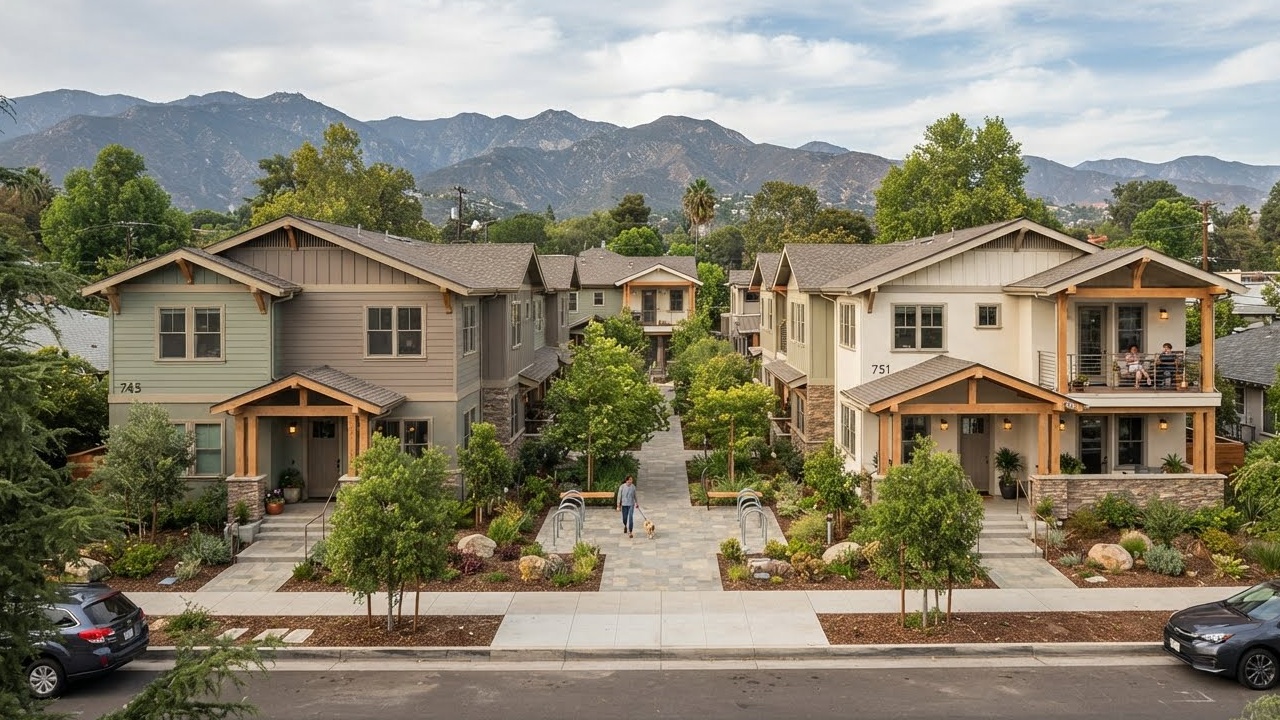
Altadena is being rebuilt one lot at a time, and the shape of that rebuild is no longer a foregone conclusion. For decades, this unincorporated pocket of Los Angeles County read as a single-family enclave nestled beneath the San Gabriel foothills. Today, in the aftermath of the Eaton Fire, a different kind of project is quietly reshaping the conversation: the 2 to 10 unit building. Not a high-rise. Not a subdivision of tract homes. Something in between, built on a single parcel, made possible by a handful of state housing laws that most homeowners have never heard of and most developers are still learning to navigate.
For architects, developers, and investors weighing whether Altadena belongs in their pipeline, the opportunity is real. So is the friction. Understanding both is the difference between a project that clears plan check in sixteen weeks and one that stalls in a political standoff.
What “Small Multifamily” Actually Means Here
In Altadena, small multifamily generally describes projects of 2 to 10 units, built either on parcels already zoned for multifamily use or on vacant single-family lots unlocked through state-mandated ministerial pathways. Two laws dominate this landscape.
SB 684 streamlines approvals for projects of up to 10 units on small lots already zoned for multifamily residential use in unincorporated areas. If a project meets objective design standards, the county must process it ministerially, meaning no discretionary hearing, no public comment period, no CEQA review.
SB 1123 extends that same logic to vacant single-family-zoned lots. Up to 10 residential units become possible on a qualifying R1 parcel, provided the site is vacant, sits under 1.5 acres, and is substantially surrounded by urban development.
Traditional R2 and R3 zoned parcels remain a third pathway. These lots, concentrated along corridors like Lake Avenue and Foothill Boulevard, can pursue small multifamily through standard ministerial review without relying on the newer state statutes at all.
All three routes share a defining feature: when a project meets objective standards, Los Angeles County Regional Planning cannot say no on discretionary grounds. That is a meaningful shift in a state where entitlement delay has historically been the biggest cost driver on small infill projects.
The Five-Step Path From Lot to Certificate of Occupancy
Step 1: Feasibility and pre-application. Before drawing a single unit, confirm zoning, lot size, and any hillside or fire hazard overlays that could affect height, setbacks, or Wildland-Urban Interface requirements. The Altadena One-Stop Permit Center at 464 W Woodbury Rd offers property-specific packets and can confirm SB 684 or SB 1123 eligibility on the spot. Eligibility hinges on specifics: multifamily-zoned lots must sit under 5 acres and be substantially surrounded by urban uses, while single-family lots must be vacant, under 1.5 acres, and clear of hazardous waste sites, flood zones, and earthquake fault zones.
Step 2: Zoning clearance. The applicant submits a site plan, floor plans, and elevations detailing unit count, size, height, setbacks, and parking. Under state law, the county must act on a complete application within 60 days. Projects using SB 684 or SB 1123 are processed administratively when they meet objective standards, bypassing the hearing process altogether.
Step 3: Building permit and fire plan check. This is where the technical rigor lives. Structural calculations, Title 24 energy compliance, and multi-discipline plan sets go to LA County Public Works Building & Safety, while the Fire Department reviews for Wildland-Urban Interface compliance. Additional clearances, such as a water agency will-serve letter or Public Health sign-off for septic systems, may apply depending on the site.
Step 4: Permit issuance and construction. Fees are paid, permits are issued, and inspections proceed through foundation, framing, mechanical-electrical-plumbing, and final sign-off.
Step 5: Certificate of occupancy. The final gate before units can be leased or occupied.
For a project that meets objective standards from the outset, zoning and building review combined can run 10 to 16 weeks. Hillside sites, septic-dependent lots, and larger unit counts extend that timeline considerably.
Where the Friction Actually Lives
The ministerial promise of SB 684 and SB 1123 is real, but it is not the whole story. Several forces are complicating small multifamily development in Altadena right now, and each hits a different stakeholder differently.
For developers and investors, the dominant issue is policy uncertainty. SB 1090, known locally as the “Keep Altadena Lands in Altadena Hands Act,” proposes a five-year moratorium on SB 9 and SB 1123 ministerial approvals within Altadena’s 91001 and 91003 ZIP codes, covering applications submitted between January 2025 and January 2030, with exceptions for vested property rights. Whatever its ultimate fate, its mere presence in the discourse is enough to make pro formas and lenders nervous. Layer onto that a wave of community opposition at town halls, where residents have voiced real concern about gentrification and the loss of neighborhood character in the burn zone, and the entitlement path starts to look less purely ministerial and more politically contingent than the statute text suggests.
For architects and designers, the constraints are more technical but no less binding. Every project in a Very High Fire Hazard Severity Zone must satisfy Chapter 7A: ember-resistant vents, ignition-resistant materials, tempered or multi-pane glazing, Class A roofing, and in some configurations, interior fire sprinklers. Objective standards such as 4-foot side and rear setbacks and a 16-foot height limit for smaller units keep a project inside the ministerial lane; exceed them and the project risks discretionary review. Unit size caps matter too. SB 1123 and SB 684 require an average unit size of 1,750 square feet or less on multifamily-zoned land, and 1,200 square feet or less on single-family-zoned land, which pushes design teams toward efficient, market-tested unit plans rather than sprawling floor plates.
For general contractors, utility coordination and cost volatility are the recurring headaches. Multi-unit buildings often require separate metering and a distinct address for fire and emergency access, even where utilities are shared. Permit fees alone can run $8,000 to $16,000 in unincorporated areas before a shovel touches dirt. And on fire-impacted lots, some owners are sequencing a small multifamily structure first, using it as interim housing while the primary residence is rebuilt, which demands careful permit sequencing across two related but distinct projects.
For investors and lenders, affordability strings attached to public financing can complicate the math. Grant programs such as the county’s ADU support initiative for fire-impacted areas often require ten or more years of affordability, which reshapes rental income projections. Combined with the SB 1090 overhang and the reality that rebuild costs frequently exceed insurance proceeds, underwriting a small multifamily deal in Altadena right now requires more scenario planning than it would have eighteen months ago.
For a closer look at how these dynamics are playing out specifically on fire-impacted parcels, see our analysis of the Altadena and Palisades wildfire rebuild landscape, which walks through the entitlement realities facing owners and developers rebuilding after the Eaton and Palisades fires.
Where Activity Is Concentrated, and Where It Could Grow
Small multifamily activity today is clustered on two types of sites: fire-impacted lots where owners and investors are using SB 684 and SB 1123 to pursue 2 to 10 unit projects, and vacant R1 parcels well suited to the same statutes. County data shows well over 200 SB 9 applications and more than 20 SB 1123 applications filed in Altadena, a meaningful signal of pent-up demand even amid policy uncertainty. Existing R2 and R3 parcels near Lake Avenue and Foothill Boulevard are also seeing steady proposal activity, largely because these corridors already carry the zoning and infrastructure to support additional density without a legislative workaround.
The next wave of opportunity sits at the intersection of three conditions: a lot that already meets objective design standards, proximity to a service-rich corridor, and existing utility infrastructure that avoids costly extensions. Sites checking all three boxes tend to move fastest through entitlement and carry the lowest development cost per unit.
The constraints on that opportunity are just as specific. Hillside overlays limit height and footprint on a meaningful share of Altadena’s terrain. Septic-dependent parcels face feasibility limits that sewer-connected lots do not. And critically, SB 1123 and SB 684 projects cannot be sited in Very High Fire Hazard Severity Zones absent specific exemptions, which removes some burned lots from eligibility entirely, even as those same lots sit at the center of the rebuild conversation.
The Incentives Worth Knowing About
Several programs are actively reducing the cost and risk of small multifamily development in fire-affected Altadena. The county’s ADU grant program, backed by $3.8 million and implemented alongside SGV Habitat for Humanity, is expected to help 35 to 50 households, though it carries a ten-year-plus affordability requirement. Permit fee waivers and refunds are available for many owner-occupants rebuilding after the fires, and pre-approved plan sets from the county can meaningfully shorten design and plan-check time.
Process accelerators matter just as much as direct subsidy. The 60-day statutory approval clock forces county action on complete applications. Small multifamily projects are exempt from CEQA review entirely, removing what is often the single largest source of delay and litigation risk on infill housing elsewhere in California. And homeowners pursuing a standalone-unit-first strategy can occupy that unit before the primary home is rebuilt, with occupancy permitted through 2030.
On the financing side, SoCalGas offers enhanced rebates through its Residential Energy Efficient Fire Rebuild Program for multifamily projects, provided the application is submitted before construction begins. LADWP’s HOME LA pilot program supports all-electric multifamily rebuilds with incentives ranging from $5,000 to $10,000 for whole-home electrification, plus standalone rebates for heat pumps and water heaters. And the county’s Emergency Rent Relief Program can provide up to $18,000 to landlords or tenants affected by the Eaton or Palisades fires, offering a measure of income stability during construction.
The Bottom Line for Developers and Investors
Altadena’s small multifamily opportunity is genuinely unusual in California’s housing landscape. Ministerial approval pathways, a CEQA exemption, and a 60-day approval clock have compressed what used to be a multi-year entitlement gauntlet into a process that, on a clean site, can move from application to permit in a matter of months. But the same rebuild that created this opportunity has also created its central risk: a community weighing its future in real time, with legislation like SB 1090 capable of reshaping the rules mid-pipeline.
The developers who succeed here will be the ones who treat entitlement strategy and community engagement as inseparable, who understand exactly which lots qualify under SB 684 versus SB 1123, and who build in contingency for a policy environment that is still being written. Navigating that combination of statutory opportunity and local complexity is precisely where experienced land use counsel earns its keep, and it is the kind of due diligence JDJ Consulting works through with clients evaluating sites across the Altadena rebuild corridor.
Frequently Asked Questions
What counts as small multifamily housing in Altadena? Generally, projects of 2 to 10 units built on parcels zoned for multifamily use or on qualifying vacant single-family lots, processed through ministerial pathways like SB 684 and SB 1123.
How long does entitlement take for a small multifamily project in Altadena? For projects meeting objective standards, zoning and building review combined typically take 10 to 16 weeks, though hillside sites, septic systems, or larger unit counts can extend that timeline.
Does SB 1123 apply to burned lots in Altadena? It can, provided the lot is vacant (no permanent habitable structure), under 1.5 acres, substantially surrounded by urban uses, and not located in a Very High Fire Hazard Severity Zone without an applicable exemption.
What is SB 1090 and how does it affect small multifamily development? SB 1090, the “Keep Altadena Lands in Altadena Hands Act,” proposes a five-year moratorium on SB 9 and SB 1123 ministerial approvals in Altadena’s 91001 and 91003 ZIP codes for applications submitted between January 2025 and January 2030, with exceptions for vested property rights. It remains a significant source of uncertainty for pipelines in the area.