Table of Contents
Altadena has always occupied a peculiar place on the map: a community with its own identity, its own commercial corridors, and its own housing pressures, but no city hall to call its own. It is unincorporated Los Angeles County, which means every affordable housing project here answers to LA County Regional Planning for zoning, LA County Public Works for building permits, and the Fire Department for plan check and inspections. That structure was already complex before the Eaton Fire. Now, with entire blocks needing to be rebuilt, understanding this pathway has become essential for anyone with a stake in Altadena’s future, whether they are drawing plans, underwriting a loan, or breaking ground.
For architects, developers, and investors weighing whether to bring affordable housing to Altadena, the opportunity is real. So are the hurdles. This article lays out what “affordable” actually means under LA County’s rules, walks through the entitlement and permit process step by step, and identifies where the county’s incentive programs can meaningfully change a project’s math.
What Counts as Affordable Housing in Altadena
Affordable housing in LA County is defined by income-restricted units tied to Area Median Income, or AMI. The tiers matter because they determine which incentive programs a project qualifies for and how deep the affordability commitment needs to run.
Extremely Low Income households earn no more than 30% of AMI. Very Low Income sits at or below 50% AMI. Low Income tops out at 80% AMI. Moderate Income, which applies only to for-sale projects, extends up to 120% AMI.
Developers generally pursue one of three structures. Inclusionary zoning requires projects with ten or more units to set aside a percentage as affordable, commonly 5% Extremely Low Income plus 6% Very Low Income, or alternatively 11% Very Low Income or 20% Low Income for rental projects, with different thresholds for for-sale developments. A second path is the 100% affordable project, where every unit except a manager’s unit is restricted to lower or very-low-income households. The third is the density bonus project, where a developer trades affordable units for additional density and regulatory concessions, a mechanism that has become increasingly attractive as post-fire land values and construction costs squeeze traditional pro formas.
The Entitlement and Permit Pathway, Step by Step
Step 1: Feasibility and Pre-Application
Before any plans are drawn, a project team needs to confirm zoning, lot size, and whether hillside or fire hazard overlays will affect height, setbacks, or Wildland-Urban Interface, or WUI, requirements. Altadena’s One-Stop Permit Center at 464 W Woodbury Rd, Suite 210, has become the practical starting point for this work, offering a property-specific packet and guidance on which affordable housing options and state funding programs, including HCD’s disaster-focused multifamily financing, a project might qualify for.
Step 2: Zoning Clearance Through Regional Planning
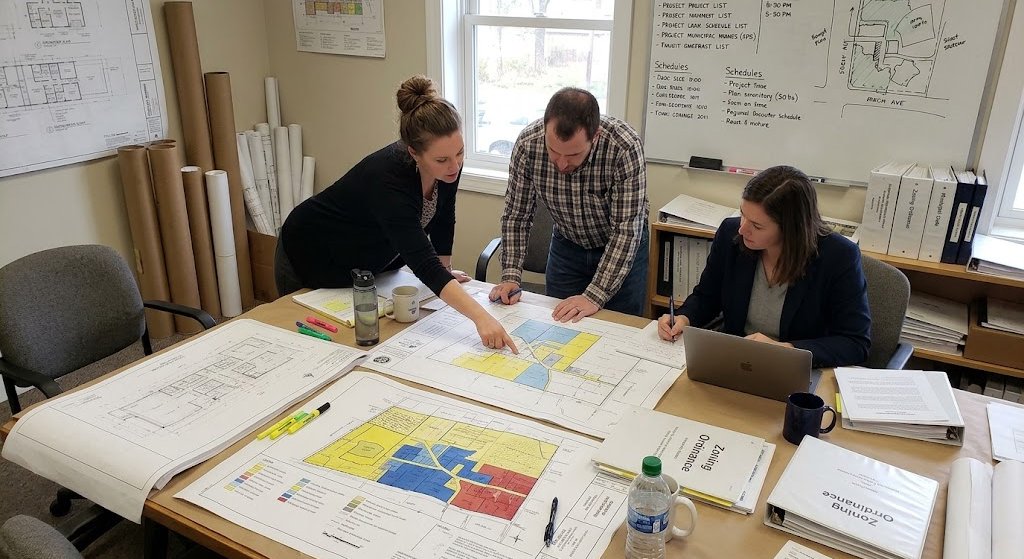
The applicant submits a site plan, floor plans, and elevations documenting unit count, size, height, setbacks, parking, and affordability restrictions. For projects that meet objective standards, state law obligates the county to act within 60 days, and many affordable housing applications move through an administrative track rather than a discretionary one. Projects that require a Conditional Use Permit face a longer road, including a public hearing before the Planning Commission.
Step 3: Building Permit and Fire Plan Check
Once zoning clears, the project moves to Building & Safety for structural plans and calculations, Title 24 energy compliance, and coordination across disciplines. The Fire Department’s review is where WUI compliance becomes concrete: ember-resistant vents, ignition-resistant materials, and occupancy-specific requirements such as sprinklers and exiting. Depending on the site, additional clearances from the water agency or Public Health may also be required.
Step 4: Permit Issuance and Construction
Fees are paid, permits are issued, and construction begins under a standard inspection schedule covering foundation, framing, mechanical, electrical, plumbing, and final sign-off.
Step 5: Certificate of Occupancy
No unit can be occupied until this final approval is granted.
For a standard affordable housing project meeting objective standards, zoning and building review together typically run 10 to 16 weeks in unincorporated LA County. Hillside sites, projects requiring a Conditional Use Permit, or larger developments should expect a longer timeline.
Where the Friction Actually Shows Up
The entitlement steps are procedural. The real challenges tend to surface in the gaps between them, and they look different depending on where a professional sits in the development stack.
For developers and investors, the central tension is financing. Affordable housing rarely pencils on a single capital source; it requires layered financing that stacks state grants, low-interest loans, tax credits, and operating subsidies to close the gap between development cost and restricted rents. Community response adds another variable. Town halls in Altadena have shown resistance to specific proposals perceived as changing neighborhood character or adding traffic, even as state law increasingly favors approval. And for fire-affected parcels specifically, acquisition and entitlement risk is tangled up with insurance settlements, financing timelines, and uncertain market demand. Long-term affordability covenants, which run 55 years or more for state-funded projects and 30 years or more for density bonus projects, also shape exit strategy and return profile in ways that require underwriting well beyond a standard construction loan.
For architects, the discipline is code compliance layered onto design intent. Chapter 7A requirements apply throughout Very High Fire Hazard Severity Zones, meaning ember-resistant vents, ignition-resistant materials, tempered or multi-pane glazing, and Class A roofing are not optional details, and larger or higher-occupancy projects may also need interior fire sprinklers. Staying within objective standards, such as four-foot side and rear setbacks and zone-specific height limits, keeps a project on the faster administrative track; exceeding them invites discretionary review and a longer clock. Complete documentation, including Title 24 energy compliance, is what keeps the statutory 60-day window intact.
For general contractors, utility coordination and cost volatility dominate. Separate metering, utility extensions, and addressing for fire and emergency access all need to be resolved early. Permit fees alone can run $8,000 to $16,000 in unincorporated areas before construction costs are even considered, and on fire-impacted lots, sequencing with debris removal, geotechnical and soils reports, and temporary utilities adds real time to the schedule.
For lenders, the long affordability horizon and layered capital stack are the defining underwriting challenges, compounded by genuine uncertainty about post-fire housing demand in the corridors hit hardest by the Eaton Fire.
Where Development Is Concentrated, and Where the Room Still Exists
Four corridors are carrying most of the current affordable housing activity in Altadena. Lake Avenue, zoned C3, is the primary commercial spine, with several fire-affected parcels being actively marketed for mixed-use and affordable redevelopment. Fair Oaks Avenue, under C2 and C3 zoning, hosts a similar mix of retail and services with real potential for affordable mixed-use infill. Lincoln Avenue, a semi-blighted corridor on the west end, is a candidate for upzoning that could pair new housing with retail. Foothill Boulevard, zoned C2 and C4, offers regional retail frontage with potential for affordable housing positioned near transit.
Beyond these corridors, the sites with the most upside share a few traits: existing infrastructure that can absorb new density without major utility work, vacant or fire-damaged lots that offer a genuine blank canvas, and mixed-use zoning that lets residential and commercial uses reinforce each other.
That said, the constraints are real. Hillside overlays cap height and footprint in parts of Altadena. Small lots can struggle to meet parking requirements. Community opposition, while not a legal barrier given state housing law, remains a practical one that shapes timelines and design choices. And parcels within Very High Fire Hazard Severity Zones carry WUI obligations that add cost and complexity regardless of where they sit on a corridor map.
The Incentive Landscape: Where the Numbers Improve
Several programs exist specifically to make affordable housing feasible in a post-fire Altadena, and understanding which ones stack is often the difference between a project that gets financed and one that doesn’t.
At the state level, HCD’s Multifamily Finance Super NOFA for the LA Disaster allocates $101 million specifically to post-fire affordable rental housing in LA County, combining resilience-focused infrastructure grants, low-interest loans, and operating subsidy reserves, in exchange for a 55-year affordability commitment. Section 811 Project Rental Assistance can layer on top for projects serving residents with disabilities, and Low-Income Housing Tax Credits remain the workhorse federal tool for combining with state funding.
At the county level, the LA County Density Bonus Ordinance goes further than the state minimum, offering greater density bonuses and encouraging units affordable to households earning no more than 15% of AMI, a tier known as Acutely Low Income. Local philanthropy has also mobilized: the Altadena Builds Back Foundation is committed to the community’s long-term housing recovery, SGV Habitat for Humanity is rebuilding affordable modular homes and received $1 million through the LA Rises initiative, and Greenline Housing Foundation is supporting faith-based affordable housing efforts with a similar allocation.
Process accelerators matter just as much as funding. The statutory 60-day approval clock, CEQA exemptions available to many affordable housing projects, and the co-located review at Altadena’s One-Stop Permit Center all compress a timeline that could otherwise stretch far longer. On the financing side, interest-free gap loans from some nonprofits, SoCalGas’s Residential Energy Efficient Fire Rebuild Program for multifamily rebuilds, and LADWP’s HOME LA Pilot Program, which offers $5,000 to $10,000 in electrification incentives for all-electric multifamily rebuilds, round out a genuinely deep incentive stack for developers willing to navigate it.
Navigating the Path Forward
The entitlement process for affordable housing in Altadena is not simple, but it is navigable, and the incentive structure currently in place, much of it built specifically in response to the Eaton Fire, makes this a moment when patient, well-advised projects can move faster and pencil better than they would have two years ago. The difference between a project that stalls in review and one that reaches Certificate of Occupancy in under four months usually comes down to how well the feasibility work was done before the first application was filed: confirming overlays, aligning design with objective standards, and identifying which funding programs actually stack for the specific site.
For a deeper look at how fire-rebuild dynamics are shaping entitlement strategy across Altadena and the Palisades, see JDJ Consulting’s analysis on wildfire rebuild and the entitlement landscape.
Every affordable housing path in Altadena looks a little different depending on whether it is 100% affordable, inclusionary, density bonus, senior, or supportive housing, and whether it’s structured for rental or for-sale. Land use consultants who work these entitlements daily, including the team at JDJ Consulting, can help developers, architects, and investors map the specific checklist, likely fees, and realistic timeline for their site, and identify which incentives are worth pursuing before capital and design time are committed.