
Table of Contents
Drive west out of San Antonio toward Medina County right now and you’ll pass land that, three years ago, was mostly mesquite and ranch fence. Today it’s home to one of the densest clusters of Microsoft data centers in the country. That’s not a coincidence. That’s a market arriving all at once, and San Antonio’s city government is scrambling to keep up with it.
The Express-News has been chronicling the buildout in real time, and the numbers behind the headlines are genuinely startling. More than 20 data centers are already running in and around the city. Several more, bigger than anything that came before them, are either under construction or freshly approved just beyond the city limits. San Antonio wasn’t supposed to be a national data center hub. It’s becoming one anyway.
This isn’t really a tech story. It’s a land use story wearing a tech story’s clothes, and the people sorting out the difference are sitting on the City Council right now.
The land grab is real, and the numbers back it up
Texas has turned into the country’s most talked-about data center market, full stop. AI infrastructure demand has outgrown the old guard of Northern Virginia and Silicon Valley, and the search for the next site has landed squarely on the Lone Star State. Dallas got there first. Austin, Houston, and San Antonio are now racing to catch up, and San Antonio has quietly built a stronger hand than most people outside the industry realize.
Here’s what’s actually on the ground:
Microsoft has planted a flag in Medina County, just west of the city, with its seventh project in that county alone landing in the small town of Castroville at a price tag of $400 million. Vantage Data Centers picked up land from the University of Texas System and is now building a $276.9 million, 432,800-square-foot facility on it. H5 Data Centers expanded its downtown colocation site, adding room for hundreds more cabinets in a market that clearly isn’t slowing down. And just outside the metro, straddling Guadalupe and Hays counties, a single approved project, CloudBurst’s 706-acre campus, represents a planned $14.5 billion investment at 1.2 gigawatts of capacity. The first phase has already broken ground.
Add it up and you get a market that didn’t creep into existence. It showed up overnight, fully formed, and very well capitalized.
The part nobody put in the press release: water, power, and patience
None of this growth is free, and San Antonio’s elected officials aren’t pretending otherwise.
In March 2026, CPS Energy and the San Antonio Water System sat down with City Council to lay out, in plain terms, what continued growth would actually cost the city in resources. The conversation didn’t happen in a vacuum. Council District 6, home to the city’s heaviest concentration of existing facilities, has been hearing about it from residents directly, and Councilman Ric Galvan turned that pressure into a formal policy review.
The tension is simple to state and hard to solve: AI-grade data centers are thirsty and power-hungry, full stop. SAWS calls the water risk manageable, leaning on a shift toward liquid cooling, which uses meaningfully less water than the evaporative systems of a decade ago, plus a continued push toward recycled water over potable supply. CPS Energy says it can handle the demand curve for the next several years, and it’s piloting a program that lets data centers build their own on-site generation in exchange for paying a tariff on that power.
Read between the lines and the message is consistent: nobody on the utility side is panicking. But nobody’s treating this as background noise either, and that’s worth sitting with if you’re planning anything in this market.
Zoning hasn’t caught up, and that’s the real story
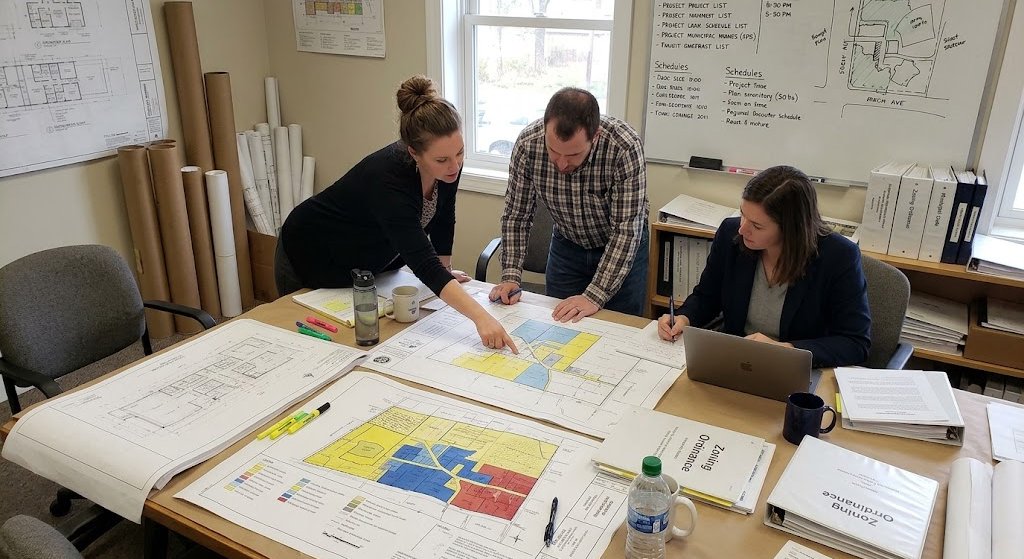
Here’s the detail that should actually change how you think about this market: San Antonio doesn’t have a zoning category for data centers. Not one. Today, these facilities slide in under “office data processing and management,” a catch-all designation that fits comfortably in most nonresidential zones without anyone blinking.
That’s about to stop being true.
City staff have already floated a package of changes that would carve out standalone zoning rules built specifically for data centers, shrinking the list of districts where they’re allowed by right and adding a 1,000-foot buffer from homes, parks, and hospitals. Under San Antonio’s normal rhythm, the Unified Development Code only gets touched once every five years, and the next scheduled rewrite isn’t due until January 2027. Mayor Gina Ortiz Jones isn’t interested in waiting that long, and neither are several council members pushing to fast-track the review starting mid-2026.
San Antonio isn’t alone in feeling this pressure, either. San Marcos, just up I-35, didn’t bother with a buffer compromise. It voted to ban data centers citywide, full stop, a far blunter move than anything San Antonio appears to have on the table. That contrast says everything about how unsettled this regulatory moment still is across Central and South Texas.
If you’ve got a site under contract or a facility on the drawing board, sit with this for a second: the rulebook you’re designing against today is very likely not the rulebook you’ll be permitting against by the time you break ground. That’s not a hypothetical risk. That’s a near-certainty, and it’s far cheaper to plan around now than to discover it mid-application.
What this actually means if you’re the one holding the site plan
Strip away the policy theater and a few practical truths fall out:
Where your parcel sits relative to the proposed buffer zones could be the whole ballgame. A site that clears zoning today might not clear it in twelve months, depending entirely on geography you can check right now.
CPS Energy and SAWS are no longer background utilities. They’re stakeholders at the table. Anyone sizing a large facility needs those conversations early, not as a formality after design is locked.
The Edwards Aquifer recharge zone question isn’t going away. City staff have explicitly flagged the need to confirm whether existing and proposed sites sit over it, and that’s a question with both environmental and political teeth.
The map is not one rulebook. A site in unincorporated Bexar County plays by different rules than one inside city limits, which plays by different rules than one in Guadalupe or Hays County, which plays by entirely different rules than San Marcos, where the answer is now just no.
None of this is a reason to walk away from San Antonio. It’s a reason to walk in with your eyes open, because the ground is genuinely still moving under this market.
A market worth watching, closely
San Antonio wants this growth. Most of its leadership says so plainly. But “we want this” and “we haven’t figured out how to manage this yet” are both true in the same breath right now, and that’s exactly the moment when good land use guidance stops being a nice-to-have and starts being the difference between a project that sails through and one that gets caught flat-footed by a rule change nobody saw coming.
We keep a close eye on zoning, entitlement, and permitting shifts across our active Texas markets, and a regulatory rewrite like the one taking shape in San Antonio is exactly the kind of thing worth a conversation before it’s locked in, not after. If you’re sizing up a site or a project anywhere in Texas and want a straight read on how the local rules might move under you, reach out for a free project assessment. We’ll tell you what you’re actually working with before you spend a dollar on design.
Information in this article reflects reporting and public meeting records available as of June 2026. San Antonio’s zoning policy on data centers is under active review and subject to change. Always verify current requirements with the City of San Antonio Development Services Department, CPS Energy, or the San Antonio Water System, or consult a qualified land use professional for your specific project.