

Table of Contents
Construction delays do not always begin on the jobsite. In many projects, they start months earlier with an unplanned permit process.
A missing approval, incomplete application, poorly coordinated consultant, or unexpected plan check correction can interrupt an otherwise ready-to-build project. For developers, property owners, architects, and contractors, the solution is not simply to submit permits faster. The better approach is to create a permit sequencing strategy before applications are submitted.
A well-planned permit strategy identifies which approvals are needed, determines which applications should be submitted first, and coordinates reviews that can happen at the same time. This approach can reduce unnecessary waiting and help move a project toward permit issuance more efficiently.
What Is a Permit Sequencing Strategy?
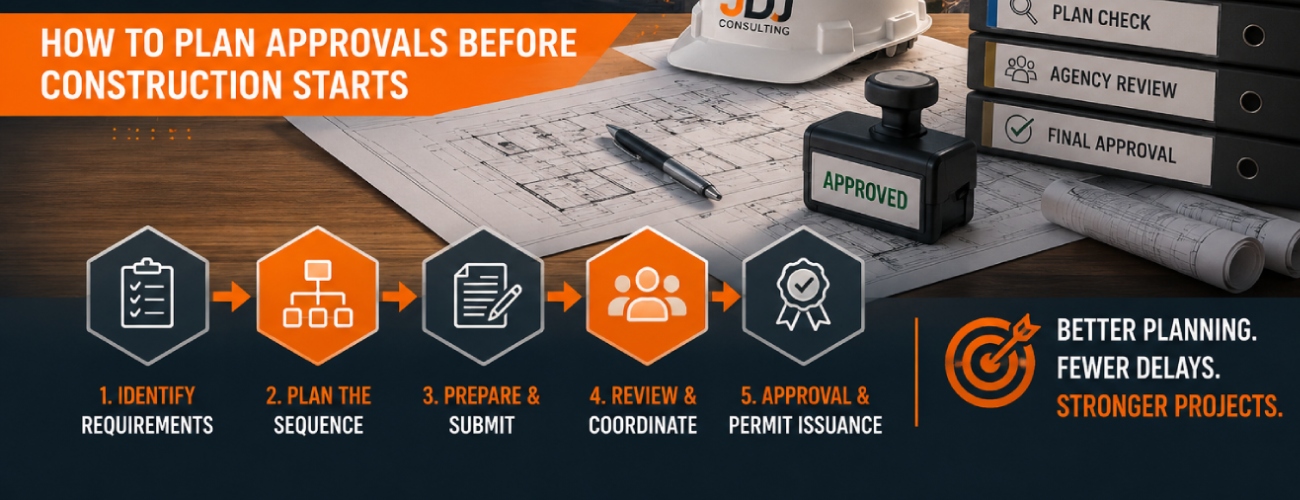
A permit sequencing strategy is a planned order for preparing, submitting, reviewing, and obtaining the approvals required for a construction or development project.
Instead of treating every permit as a separate task, the project team maps the entire approval process.
Depending on the project, this may include:
- Zoning and land-use approvals
- Building permits
- Planning approvals
- Site and grading permits
- Demolition permits
- Mechanical permits
- Electrical permits
- Plumbing permits
- Fire department approvals
- Utility clearances
- Environmental or agency approvals
- Special inspections and final approvals
The objective is simple: identify dependencies before they become delays.
Why Permit Sequencing Matters
Permitting is rarely a single-step process.
Most projects move through application preparation, submission, plan review, corrections, resubmission, agency coordination, approval, and final permit issuance. JDJ Consulting describes its own process as moving from feasibility and zoning analysis through application, plan check responses, and final approval.
Without a clear sequence, project teams can encounter:
1. Unnecessary Waiting
One application may sit idle while another approval is being completed, even though both could potentially have progressed at the same time.
2. Repeated Plan Changes
If zoning, code, or agency requirements are not confirmed early, design changes can trigger additional plan checks and resubmittals.
3. Coordination Problems
Architects, engineers, contractors, owners, and permitting agencies may all work on different timelines. Without one coordinated schedule, important tasks can fall through the cracks.
4. Construction Delays
A contractor may be ready to mobilize while the required permit is still waiting for approval.
5. Increased Project Costs
Every additional review cycle can consume design, consulting, administrative, and project-management resources.
Step 1: Identify Every Required Approval
The first step is creating a complete approval checklist.
Do not begin with only the building permit. Start by asking what the project is actually changing.
For example, a commercial renovation may require building, electrical, mechanical, plumbing, fire, accessibility, and planning-related approvals.
A residential development may involve zoning review, demolition, grading, building permits, ADU approvals, utility coordination, or other jurisdiction-specific requirements.
The exact requirements depend on the location, property, project scope, and applicable regulations.
Step 2: Determine Which Approvals Are Dependencies
Once the approval list is created, identify which applications depend on other decisions.
For example:
Zoning Review → Design Confirmation → Building Permit → Plan Check → Corrections → Resubmittal → Approval → Permit Issuance
However, not every project follows this exact sequence.
Some applications may be prepared concurrently. Others may require a previous approval before they can move forward.
This is why permit sequencing should be customized to the actual project instead of relying on a generic checklist.
Step 3: Review the Project Before Submission
A strong permit strategy starts before the application reaches the building department.
Review the project for:
- Zoning requirements
- Building code considerations
- Required drawings
- Consultant documents
- Application requirements
- Agency clearances
- Potential correction items
- Jurisdiction-specific procedures
- Existing violations or unresolved issues
- Required fees and documentation
This early review can help identify problems before they enter the formal plan check process.
For projects where the development potential or approval pathway is uncertain, a feasibility study can help establish zoning, development options, and entitlement risks before significant capital is committed.
Step 4: Coordinate Consultants Before Filing
Permit delays often involve more than the building department.
Architects, structural engineers, civil engineers, MEP consultants, surveyors, landscape professionals, and other specialists may contribute documents to the application.
If one consultant’s information conflicts with another’s, corrections can delay the entire submission.
Before filing, confirm that:
- Drawing sets are coordinated.
- Required signatures and stamps are included.
- Consultant information is consistent.
- Project descriptions match across applications.
- Required calculations are complete.
- Supporting documents are ready.
- Application information is accurate.
A coordinated submission gives reviewers fewer reasons to return the application for corrections.
Step 5: Decide What Can Move in Parallel
One of the most important parts of permit sequencing is identifying opportunities for parallel processing.
Instead of:
Approval A → Approval B → Approval C → Approval D
the project may allow:
Approval A
Approval B + Approval C
Approval D after A and B
The exact sequence depends on the jurisdiction and project.
The goal is not to submit everything at once. The goal is to understand which processes are dependent on each other and which can progress simultaneously.
Step 6: Build a Correction-Response Process
Plan check corrections are a normal part of many construction projects.
The problem occurs when corrections are handled without a clear system.
When comments are received, the team should:
- Review every correction.
- Assign each item to the appropriate consultant.
- Establish response deadlines.
- Coordinate revisions.
- Verify that corrections are fully addressed.
- Prepare the resubmittal.
- Track the next review stage.
This creates accountability and reduces the chance that one unresolved comment delays the entire application.
JDJ Consulting’s permit-expediting services include permit submittal, plan check coordination, correction management, agency communication, and approval tracking.
Step 7: Track the Permit Through Approval
Submitting the application is not the end of the process.
A permit strategy should continue through:
Submission → Review → Corrections → Resubmission → Approval → Issuance
The project team should know:
- Who is responsible for communication.
- Which department currently has the application.
- What comments remain open.
- When responses are due.
- Which approvals are still outstanding.
- What is required before permit issuance.
A dedicated permit coordinator or expediter can serve as the central point of communication between the project team and agencies.
Common Permit Sequencing Mistakes
Even experienced project teams can encounter avoidable permitting problems.
Starting Construction Planning Too Early
If the permit pathway has not been established, construction schedules may be based on unrealistic approval assumptions.
Treating Every Jurisdiction the Same
Permit procedures vary by city, county, project type, and agency. A process that works in one jurisdiction may not work in another.
Filing Incomplete Documents
Incomplete applications can create additional review cycles and unnecessary administrative work.
Ignoring Existing Conditions
Existing structures, violations, zoning conditions, or previous permits can affect the current application.
Failing to Coordinate Consultants
Conflicting drawings or incomplete consultant documents can create correction cycles.
Waiting Until the End to Track Approvals
Permit tracking should begin when the strategy is developed, not after a problem occurs.
Permit Strategy vs. Permit Expediting
These concepts are closely related, but they are not identical.
Permit strategy focuses on deciding how the approval process should be structured.
Permit expediting focuses on managing and advancing that process.
A strong project may need both.
The strategy determines the path. Expediting helps keep the project moving along that path.
JDJ Consulting provides permit expediting services that include application coordination, plan check management, agency communication, and approval support.
When Should You Develop a Permit Strategy?
The best time is before permit submission.
Ideally, permit planning should begin during pre-construction and feasibility analysis.
Early planning gives the project team an opportunity to identify:
- Required permits
- Approval dependencies
- Potential entitlement issues
- Design requirements
- Agency coordination needs
- Possible review risks
- Expected project milestones
This is especially important for projects involving multiple agencies or complex development approvals.
JDJ Consulting combines feasibility, zoning, entitlement, and permit services as part of its broader pre-construction approach.
A Simple Permit Sequencing Checklist
Before submitting a major construction project, ask:
☐ Have all required permits been identified?
☐ Have zoning and entitlement requirements been confirmed?
☐ Are approval dependencies documented?
☐ Can any applications move in parallel?
☐ Are all consultant drawings coordinated?
☐ Are application forms complete?
☐ Have potential correction issues been reviewed?
☐ Is someone responsible for agency communication?
☐ Is there a correction-response process?
☐ Is every approval being tracked through issuance?
If several boxes remain unchecked, the project may not be ready for an efficient permit submission.
Build the Approval Path Before the Construction Schedule
A construction schedule is only as reliable as the approvals behind it.
That is why a permit sequencing strategy should be treated as a project-planning tool rather than an administrative task. By identifying dependencies, coordinating consultants, preparing complete submissions, and actively managing plan checks, developers and property owners can reduce avoidable permitting friction.
The goal is not simply to obtain a permit.
The goal is to create a clear, defensible path from project concept to approval to construction.
For complex projects, working with a team experienced in zoning, feasibility, agency coordination, and permit expediting can help identify the right approval path before delays become expensive.
Ready to evaluate your project’s permit path? Talk to JDJ Consulting about your project, jurisdiction, and approval strategy.
Ready to Know What Your Site Can Do?

Your next development opportunity starts with an address.
Know your SITE in seconds.
Address IN, Feasibility OUT.
Try AIEntitle
JDJ Consulting can help evaluate zoning, development potential, entitlement pathways, and permitting considerations so you can move forward with greater clarity.