Table of Contents
Zoning incentive programs can create valuable opportunities for property owners, real estate developers, and investors looking to maximize a property’s development potential. Depending on the location and project type, these programs may allow additional building density, reduced parking requirements, greater development flexibility, or financial benefits for projects that meet specific public objectives.
However, identifying an incentive is only the first step. Developers must understand the zoning regulations, eligibility requirements, application procedures, and long-term obligations associated with each program.
A property that appears limited under its existing zoning designation may support a different development strategy when applicable incentives are considered. Therefore, evaluating these opportunities early can help developers make more informed acquisition, design, and investment decisions.
In this guide, JDJ Consulting explains how zoning incentive programs work, which opportunities developers should investigate, and how to incorporate incentive analysis into the development planning process.
What Are Zoning Incentive Programs?
Zoning incentive programs are regulatory or development-related benefits designed to encourage specific types of investment, housing production, redevelopment, or community improvements.
Unlike traditional zoning regulations, which establish the standard requirements for land use and building development, incentive programs may provide qualifying projects with additional flexibility or development opportunities.
Depending on the jurisdiction, these benefits may include:
- Increased residential density or additional housing units.
- Reduced parking requirements.
- Additional building height or floor area.
- Development concessions or waivers.
- Expedited or coordinated review procedures.
- Affordable housing development opportunities.
- Financial incentives, grants, or tax-related benefits under separate programs.
Not every incentive is available in every jurisdiction. Some are established through state legislation, while others are administered by cities, counties, or specialized public agencies.
Developers should review the applicable regulations and official program guidelines before incorporating any potential benefit into a project proposal.
1. Density Bonus Programs
Density bonus programs are among the most relevant zoning incentives for multifamily and affordable housing developers.
These programs may allow qualifying developments to exceed the residential density otherwise permitted under base zoning. In exchange, projects typically provide certain public benefits, such as income-restricted affordable housing units.
For developers, additional density can create opportunities to increase the number of residential units on a property. However, the economic benefit must be evaluated alongside construction costs, affordability requirements, and other project obligations.
Before pursuing a density bonus, review:
- Existing zoning and permitted residential density.
- Applicable affordability requirements.
- Maximum allowable density under the program.
- Available concessions, incentives, or waivers.
- Height, setback, and parking requirements.
- Required approvals and supporting documentation.
A density bonus should be evaluated as part of a complete development feasibility analysis rather than treated as an automatic increase in project value.
2. Parking Reduction Incentives
Parking requirements can significantly affect the design, cost, and development capacity of a property.
In certain jurisdictions, qualifying projects may receive parking reductions based on factors such as transit accessibility, affordable housing commitments, location, or specific land-use policies.
Reducing required parking may help developers allocate more site area to residential units, commercial space, landscaping, or other project components.
However, parking reductions are subject to local regulations and eligibility conditions. Developers should verify whether the property qualifies before designing around a reduced parking count.
Important considerations include:
- Distance from qualifying public transportation.
- Existing parking requirements under local zoning.
- Affordable housing or mixed-use project status.
- Accessible parking requirements.
- Bicycle parking and transportation demand management.
- Site access, circulation, and fire department requirements.
A parking incentive may improve site efficiency, but the development team must still demonstrate compliance with applicable planning and building standards.
3. Transit-Oriented Development Incentives
Transit-oriented development (TOD) programs encourage housing, commercial uses, and mixed-use projects near public transportation.
Cities may use zoning incentives to support higher-density development in designated transit areas. Depending on the program, eligible projects may benefit from additional residential capacity, reduced parking requirements, or other development flexibility.
Before pursuing a transit-oriented development strategy, developers should investigate:
- Whether the property falls within an eligible transit area.
- The distance to qualifying transit stations or routes.
- Applicable zoning and land-use designations.
- Permitted residential and commercial uses.
- Available density or parking incentives.
- Infrastructure and transportation requirements.
Transit proximity alone does not guarantee eligibility. Developers must confirm the specific geographic boundaries and qualifying conditions established by the applicable jurisdiction.
For projects involving multiple uses or complex site conditions, an early zoning and entitlement review can help identify potential constraints before architectural plans are finalized.
4. Affordable Housing Development Incentives
Affordable housing programs are designed to encourage the construction and preservation of housing for households that meet specified income requirements.
Depending on the jurisdiction, qualifying projects may receive density bonuses, parking reductions, development concessions, fee-related benefits, or access to separate financing and funding programs.
However, these opportunities often come with additional responsibilities.
Developers may need to consider:
- Required affordable unit percentages.
- Applicable household income limits.
- Rent restrictions and affordability periods.
- Recorded regulatory agreements or covenants.
- Tenant eligibility and compliance procedures.
- Reporting and monitoring requirements.
These conditions can influence project revenue, financing, operations, and future property transactions.
Consequently, affordable housing incentives should be evaluated alongside the project’s financial model and long-term operating strategy.
5. Adaptive Reuse and Redevelopment Incentives
Some municipalities use development incentives to encourage the rehabilitation of existing buildings, reuse of underutilized properties, and revitalization of established commercial districts.
Depending on local policy, eligible projects may qualify for alternative development standards, streamlined review procedures, financial assistance, or other redevelopment-related benefits.
Adaptive reuse can be particularly relevant for older office buildings, commercial properties, and structures that may be suitable for residential or mixed-use conversion.
Before proceeding, developers should evaluate:
- Existing building conditions and permitted uses.
- Current zoning and proposed occupancy.
- Building and fire code requirements.
- Structural and accessibility considerations.
- Parking and loading requirements.
- Historic preservation restrictions, where applicable.
- Available redevelopment or rehabilitation incentives.
A potential incentive does not eliminate the need for building code compliance or the required approvals for a change of use.
6. Green Building and Sustainability Incentives
Some jurisdictions encourage sustainable development through incentives connected to energy efficiency, water conservation, renewable energy, and environmentally responsible construction.
Depending on the program, qualifying projects may have access to grants, rebates, tax benefits, or development-related incentives.
These programs can support projects that incorporate measures such as:
- Energy-efficient building systems.
- Solar energy installations.
- Water-efficient landscaping and fixtures.
- Green roofs and stormwater management.
- Sustainable building materials.
- Electric vehicle charging infrastructure.
Developers should distinguish between zoning-related incentives and separate energy or environmental funding programs. Each has its own eligibility rules, application process, and documentation requirements.
Early coordination with the design team can help determine whether sustainability measures align with the project’s budget and applicable incentive criteria.
 How to Determine Whether a Property Qualifies for Zoning Incentives
 How to Determine Whether a Property Qualifies for Zoning Incentives
Not every property qualifies for every incentive. Eligibility often depends on the property’s location, zoning designation, proposed use, project characteristics, and compliance with local regulations.
Before purchasing land or committing to a development concept, consider the following steps.
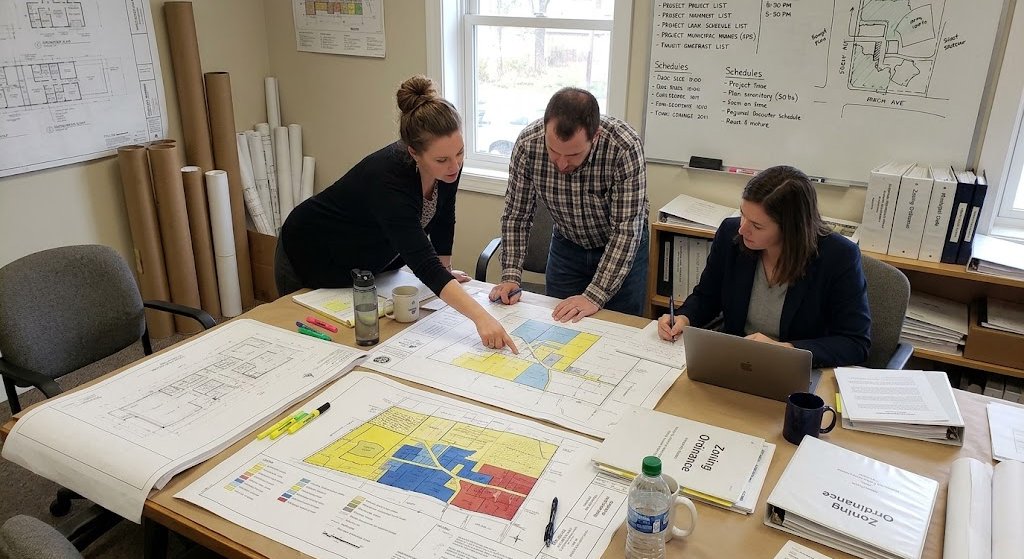
Step 1: Review the Existing Zoning Designation
Start by identifying the property’s current zoning classification and applicable development standards.
Review permitted uses, density, height limits, floor area ratio (FAR), setbacks, parking, and other restrictions.
This establishes the property’s baseline development potential before incentives are considered.
Step 2: Identify Applicable Incentive Programs
Research city, county, and state programs that may apply to the property.
Review official program boundaries, eligibility criteria, qualifying uses, and application requirements.
Do not assume that a program applies simply because another property in the same city has received an incentive.
Step 3: Compare Base Zoning With Incentive Scenarios
Evaluate what can be developed under existing zoning and compare it with the potential development standards available through qualifying incentives.
For example, consider this hypothetical multifamily development:
| Development factor | Base zoning | Incentive scenario |
|---|---|---|
| Residential units | 40 | 50 |
| Building height | 4 stories | 5 stories |
| Parking spaces | 60 | 45 |
| Affordable units | 0 | 10 |
These figures are illustrative only. They do not represent an actual jurisdiction’s incentive program or guaranteed development approval.
The comparison demonstrates how an applicable incentive could change a project’s development assumptions. The team must still verify whether the proposed density, height, parking, and affordability conditions are permitted.
Step 4: Evaluate Financial and Operational Implications
Additional development capacity does not automatically mean greater profitability.
Developers should compare potential revenue against construction costs, financing expenses, affordability commitments, infrastructure improvements, and ongoing compliance responsibilities.
A feasibility analysis should consider both the potential benefits and the additional costs associated with the incentive.
Step 5: Confirm the Entitlement and Approval Process
Determine whether the project requires administrative review, a density bonus application, conditional use permit, site plan approval, public hearing, or other entitlement.
Identify the responsible agencies, required submissions, review periods, and project milestones.
This step is important because an incentive may require formal approval before construction or other qualifying activities begin.
Common Mistakes Developers Should Avoid
Even when an incentive appears attractive, overlooking its requirements can create delays, additional costs, or eligibility problems.
Assuming every property qualifies. Incentive eligibility depends on specific location, zoning, and project requirements. Always verify the official criteria.
Designing before reviewing incentives. Waiting until architectural plans are complete may result in unnecessary redesigns or missed development opportunities.
Overestimating additional density. A density bonus or other incentive does not automatically eliminate height, setback, building code, or infrastructure limitations.
Ignoring affordability obligations. Additional units may come with income restrictions, rent limitations, and long-term compliance responsibilities.
Treating potential benefits as guaranteed funding. Financial projections should distinguish between available programs, pending applications, and formally approved benefits.
Overlooking application deadlines. Some programs require applications or approvals before construction, purchases, or other qualifying activities begin.
A structured review helps developers evaluate opportunities without relying on assumptions that may not hold during agency review.
How JDJ Consulting Helps With Zoning and Development Incentives
Evaluating zoning incentive programs requires an understanding of land-use regulations, property conditions, development feasibility, and local approval procedures.
JDJ Consulting Group supports property owners, investors, and developers with zoning and entitlement strategy, site analysis, feasibility reviews, and development planning across California, Texas, and Florida.
Depending on the project scope, consulting support may include:
- Reviewing existing zoning and permitted land uses.
- Identifying potential density bonus and affordable housing pathways.
- Evaluating development constraints and site opportunities.
- Reviewing applicable entitlement and approval requirements.
- Coordinating with relevant planning departments and agencies.
- Identifying documentation and submission requirements.
Through an organized review, developers can better understand which incentives may apply, what approvals may be necessary, and how potential benefits fit into the overall development strategy.
Explore JDJ Consulting’s land use and entitlement consulting services or learn more about pre-construction analysis before committing to a development plan.
Planning a project and want to understand its zoning opportunities? Contact JDJ Consulting to discuss your property, development objectives, and potential entitlement requirements.
Frequently Asked Questions About Zoning Incentive Programs
1. What are zoning incentive programs?
Zoning incentive programs are regulatory benefits that allow qualifying developments to receive additional flexibility or development opportunities. These may include increased density, reduced parking requirements, additional height, or other concessions in exchange for meeting specific public or planning objectives.
2. Can zoning incentives increase the number of units on a property?
Yes. Certain density bonus programs allow eligible residential developments to exceed the base residential density permitted under existing zoning. However, the additional units depend on program requirements, site conditions, and applicable approvals.
3. Do all cities offer the same development incentives?
No. Incentive programs vary by city, county, and state. Each jurisdiction establishes its own eligibility criteria, application procedures, development standards, and compliance requirements.
4. Can affordable housing projects qualify for zoning incentives?
Yes. Many jurisdictions provide incentives for qualifying affordable housing developments. Depending on the program, benefits may include additional density, parking reductions, concessions, or other development flexibility.
5. When should developers review zoning incentive programs?
Ideally, developers should review applicable incentives during site selection, acquisition due diligence, and early feasibility planning. Early evaluation can help influence the development concept, financial assumptions, and entitlement strategy.
6. Do zoning incentives guarantee project approval?
No. An incentive does not automatically guarantee approval. Projects must satisfy applicable eligibility requirements, submit the necessary documentation, and obtain all required agency approvals.
7. Can a property qualify for multiple development incentives?
Potentially. Some programs allow qualifying projects to combine multiple incentives, while others restrict overlapping benefits. Developers should review each program’s rules and determine whether the benefits can legally be combined.
8. How can a zoning consultant help identify development incentives?
A zoning consultant can review the property’s zoning designation, permitted uses, development standards, location, and applicable land-use programs. This analysis can help identify potential incentive pathways and clarify the approvals and documentation required for a proposed project.
Final Thoughts
Zoning incentive programs can create meaningful opportunities for developers seeking to improve site utilization, support housing production, and strengthen project feasibility.
However, the value of an incentive depends on more than its advertised benefits. Eligibility, zoning restrictions, affordability commitments, development costs, application deadlines, and long-term obligations must all be considered.
By evaluating incentives alongside zoning compliance, due diligence, and entitlement planning, developers can make better-informed decisions before investing significant time and capital.
The most effective development strategy starts with understanding what a property can support under existing regulations and identifying which additional opportunities may be available through applicable incentive programs.
JDJ Consulting Group helps developers evaluate land-use opportunities, understand zoning requirements, and navigate the entitlement process. Contact our team to discuss your next development project.