Table of Contents
Austin’s Citywide Density Bonus Program applies to a defined set of commercial base zoning districts. It does not apply to every property in the city, and the name is where the confusion usually starts.
The “Citywide” Name Is Misleading
“Citywide Density Bonus Program” describes the program’s geographic reach across Austin, not its applicability to every parcel within that geography. DBC is available only to properties in specific commercial base zoning districts, and even within those districts, a property doesn’t carry the DBC combining district automatically. It has to go through a rezoning to get it.
Eligible Base Zoning Districts
| Base zoning category | Potentially eligible? |
|---|---|
| Neighborhood Office (NO) | Yes |
| Limited Office (LO) | Yes |
| General Office (GO) | Yes |
| Neighborhood Commercial (LR) | Yes |
| Community Commercial (GR) | Yes |
| General Commercial (CS / CS-1) | Yes |
| Commercial Highway Services (CH) | Yes |
| Single-family residential zones | No |
| Multifamily residential zones | No |
| Industrial zones | No |
| Downtown or special-purpose districts | Generally no |
“Potentially eligible” is the operative phrase. Landing in an eligible base zoning category is a necessary condition, not a sufficient one. The property still needs to go through a rezoning process to carry the DBC combining district, and the specific tier it can realistically support depends on site conditions covered elsewhere in this guide.
DBC Combining Districts Aren’t Automatic
Austin’s planning staff describe the DBC combining districts as “paper” districts. That means they exist in the adopted code as a framework, but a property doesn’t carry one simply because its base zoning falls in an eligible category. The district becomes attached to a specific property in one of two ways: through an individual applicant’s rezoning request, or through a future city-initiated area-wide rezoning that the city has not yet undertaken for most eligible areas.
In practical terms, this means most eligible commercial properties in Austin today have the underlying base zoning that could support a DBC rezoning, but do not yet carry the DBC combining district itself. Getting there requires an affirmative rezoning application, evaluated against the property’s specific site conditions, surrounding context, and the tier being requested.
Why Zoning Verification Comes First
Confirming eligibility sounds like a simple lookup, but it involves more than checking a zoning map against the table above. A complete eligibility review should also account for:
- Whether the property carries any conflicting combining district or special regulation that would complicate a DBC rezoning.
- Whether an existing overlay affects the site’s development standards independent of DBC.
- Whether the base zoning designation on record matches what’s actually developable on the ground, since older properties sometimes carry legacy zoning that doesn’t reflect current conditions.
- Whether the property is affected by any pending area-wide rezoning effort that could change its eligibility status before an individual application is filed.
This is the first deliverable in JDJ’s process for a reason. Every subsequent step, tier selection, affordability modeling, compatibility analysis, tenant-protection screening, depends on confirming the property is actually eligible before any of that work begins.
What Comes After Eligibility Is Confirmed
Once a property clears the eligibility screen, the next questions are which tier the site can realistically support, what affordability obligation applies, and whether existing tenants or units trigger additional requirements. Each of those is a separate analysis with its own financial consequences, covered in depth elsewhere in this guide.
 Confirm Your Property’s DBC Eligibility
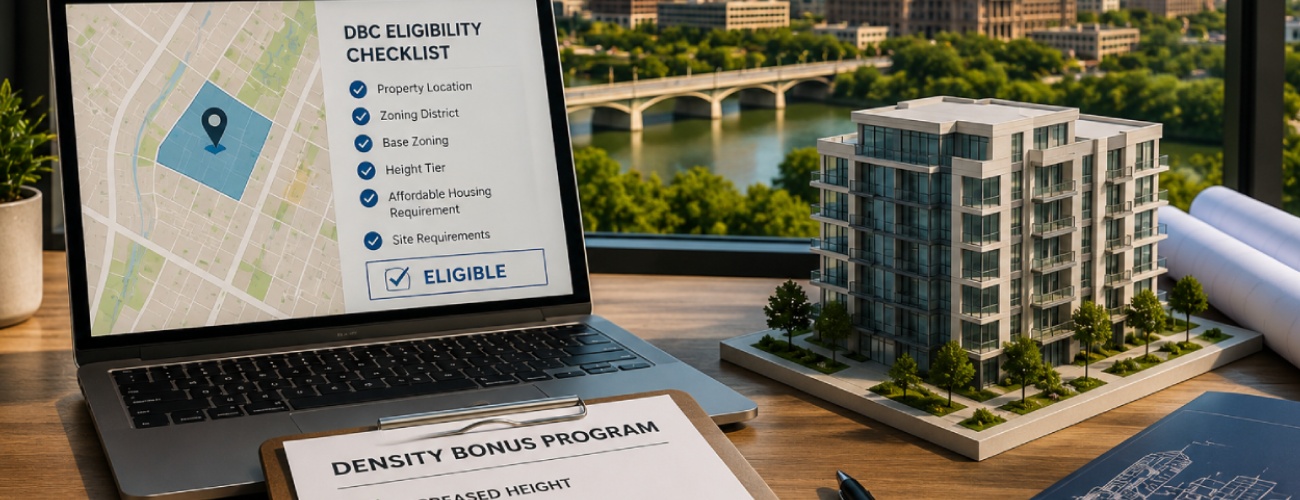 Confirm Your Property’s DBC Eligibility
Base zoning categories, existing overlays, and combining district status all affect whether a property is a genuine DBC candidate, and none of it should be assumed from the program’s name alone.
Request a Preliminary Zoning and Entitlement Assessment to confirm eligibility, identify conflicting regulations, and scope a realistic DBC strategy for your site.
Related reading: Austin Citywide Density Bonus Program: Eligibility, Height Tiers, Affordable Housing Requirements, and Development Strategy | Austin’s DBC Height Tiers Explained: From Base to +60 Feet | DBC vs. DB90 vs. Vertical Mixed Use vs. Downtown Density Bonus