
Table of Contents
Where the region’s next wave of outpatient and specialty healthcare projects will find room to grow, and where the approval process still trips up unwary developers.
A hospital system does not build where the demographics look good on a slide deck. It builds where the entitlement path is provable, the jurisdiction is unambiguous, and the site can clear a design review board that treats a rooftop chiller unit with the same scrutiny most cities reserve for a courthouse annex. The Woodlands, Texas has become one of the more contested healthcare real estate markets in the Houston metro precisely because it looks simple from a distance and behaves like anything but up close.
Montgomery County’s population has climbed to roughly 811,000 residents in 2026, a growth rate near 3.8 percent that continues to outpace most of the state, while The Woodlands itself has pushed past 122,000. That trajectory is the reason every health system, physician group, and medical REIT operating in the Houston corridor has The Woodlands on a target list. It is also the reason the market rewards developers who understand its layered approval structure and quietly punishes those who assume “The Woodlands” means one zoning code, one permitting counter, and one set of design standards.
It does not. The Woodlands is a master-planned community, not an incorporated city with a single governing body. A parcel marketed under The Woodlands name may sit within Montgomery County, an adjoining municipality, or a special governance structure layered with private covenant review through The Woodlands Township. For a medical office building, that distinction is administrative. For an ambulatory surgery center, an imaging center, or a behavioral health facility, it can determine whether a project is feasible at all.
Why The Woodlands Is Different From a Standard Texas Jurisdiction
Most Texas healthcare projects answer to a single city planning department and a single building official. The Woodlands answers to several parties simultaneously, each with independent authority over a different layer of the same project.
| Approval Area | Likely Reviewing Authority |
|---|---|
| Architecture, landscaping, signage, exterior design | The Woodlands Township Development Standards Committee |
| Entitlement, subdivision, site development, access | Montgomery County or the applicable municipality (Conroe, Shenandoah, Oak Ridge North) |
| Building, structural, MEP permits | The applicable municipal or county building authority |
| Fire and life safety | Montgomery County Fire Marshal or municipal fire authority |
| Floodplain, drainage, grading | Montgomery County and/or the applicable municipal authority |
| Accessibility compliance | Texas Department of Licensing and Regulation (TDLR) |
| Healthcare facility licensing | Texas Health and Human Services Commission (HHSC) |
| Radiation-producing equipment | Texas Department of State Health Services |
Approval layers for a typical medical or healthcare project in The Woodlands. Sequencing and scope vary by facility type and exact parcel jurisdiction.
The Township’s commercial standards explicitly govern building design, signage, landscaping, lighting, and parking, and exterior improvements require review before construction begins.
That review is not cosmetic. A national health system arriving with a prototype design built for suburban Dallas or Austin will frequently need to revise massing, rooftop equipment screening, canopy design, emergency entrance treatment, and signage packages to satisfy Township standards. Developers who budget for that revision cycle up front move faster than those who discover it in redlines.
What Kind of Healthcare Use Are You Actually Building?
The single most common entitlement mistake in this market is treating “medical facility” as a defined use. It is not. A general medical office and a freestanding emergency department sit at opposite ends of a regulatory spectrum, and the difference determines everything from parking ratios to state licensing exposure.
Facility types that warrant a distinct entitlement and licensing analysis include:
- General medical office and specialty clinics
- Urgent care and dental facilities
- Imaging and diagnostic centers
- Physical therapy and rehabilitation
- Dialysis and infusion centers
- Ambulatory surgery centers
- Freestanding emergency departments
- Behavioral health and substance-use facilities
- Skilled nursing, assisted living, and senior care
- Hospital construction or expansion
Operational characteristics, not the name on the building, drive the review. Reviewers weigh patient volume, hours of operation, ambulance access, overnight stays, hazardous materials, medical gas systems, and parking demand. A 6,000-square-foot primary care suite and a 6,000-square-foot infusion center can trigger meaningfully different review paths despite identical square footage.
How Does the Entitlement Process Actually Unfold?
A healthcare project in The Woodlands generally moves through nine stages, though sequencing and complexity scale with the facility type and its regulatory classification.
1. Confirm jurisdiction and title restrictions before site selection
Verify the exact governing jurisdiction, the tract’s legal description and recorded plat, existing deed restrictions and development agreements, and whether the site already carries healthcare, office, or institutional entitlements. Confirm whether the intended use is permitted by right, permitted conditionally, or requires an amendment.
2. Build a precise use matrix
Define the facility type with the operational specificity described above, since it will govern parking, fire access, and licensing pathways downstream.
3. Run a feasibility and entitlement audit
Montgomery County requires a development permit for proposed development and separately identifies commercial fire code, structure, septic, subdivision, and floodplain-related permits, warning that incomplete applications will be rejected and permit fees are non-refundable.
4. Secure pre-application feedback
A well-run pre-application meeting brings Township design review staff, county or city planning staff, the civil engineer, architect, and fire marshal representative to the same table before design work advances. Written confirmation of permitted use, parking ratios, fire lane requirements, and review sequence at this stage prevents costly redesign later.
5. Secure land-use approvals
Depending on the parcel, this may include site plan approval, plat or replat approval, conditional use approval, a zoning change, variance, or traffic-impact approval.
6. Complete Township commercial design review
This stage evaluates architectural character, materials, signage, lighting, landscaping, parking layout, and screening of mechanical equipment and generators.
7. Obtain civil and infrastructure permits
Floodplain review should begin early, since Montgomery County directs applicants to a separate floodplain process whenever any portion of a property falls within a mapped floodplain.
8. Submit building and healthcare-specific plans
Nearly all healthcare construction exceeds the $50,000 threshold that triggers registration and review through TDLR and a Registered Accessibility Specialist, making Texas Accessibility Standards compliance a parallel track that must be coordinated from schematic design forward. Facilities requiring HHSC licensing add another layer entirely, since the agency regulates certain categories of healthcare facilities to protect patient health and safety, with requirements that vary by facility classification.
9. Construction, inspection, and certificate of occupancy
For a hospital or a highly regulated facility type, a certificate of occupancy is not the finish line. The operator may still need a state license, accreditation, equipment registration, and payer enrollment before treating a single patient.
This is the stage where most projects lose weeks, not because any single step is unreasonable, but because Township, county, fire, TDLR, and HHSC reviews run on separate timelines with separate comment cycles. JDJ Consulting’s permit expediting work in The Woodlands exists specifically to sequence these reviews so they run in parallel rather than in series, which is often the difference between a twelve-month approval timeline and one that stretches well past eighteen. You can see how that process is structured for this market here.
Where Is Healthcare Development Already Concentrated?
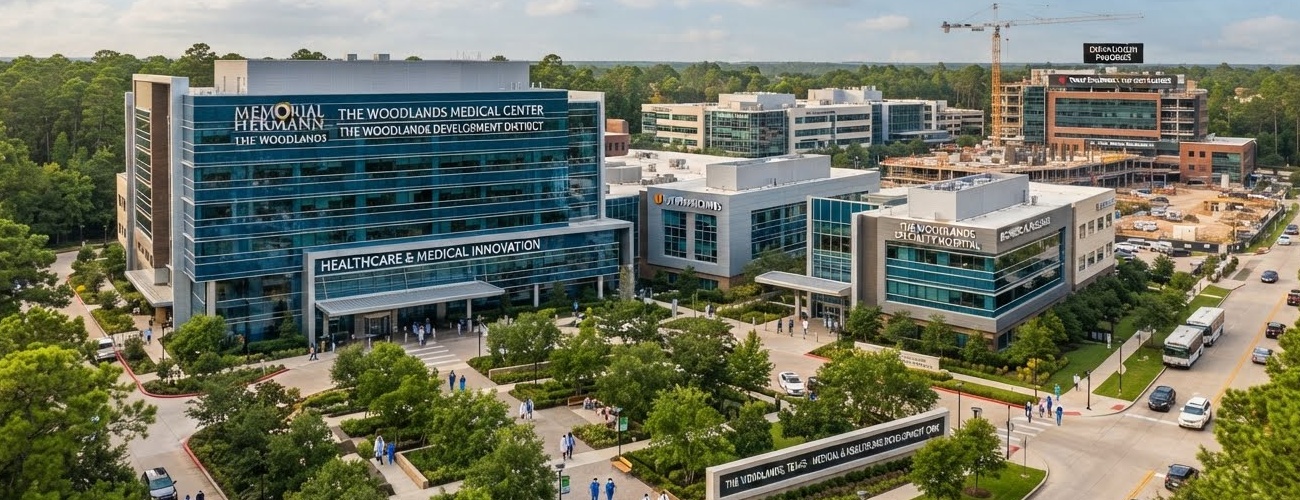
The established anchor is the I-45 medical corridor around Memorial Hermann The Woodlands Medical Center, which the system identifies at 9250 Pinecroft Drive alongside four medical plaza office buildings.
A second major anchor sits at the Houston Methodist The Woodlands Hospital campus near I-45 and State Highway 242, which has built out a substantial hospital and specialty-care presence including a dedicated medical office building.
These corridors are not saturated across every service line. They are more saturated for conventional medical office, primary care, and hospital-affiliated specialty space than for many outpatient specialties.
The broader Houston medical office market recorded positive net absorption of 342,580 square feet in the first half of 2025, a figure that signals continued demand even as the pace of absorption cooled relative to prior periods. That is a market rewarding differentiated, well-positioned product rather than one automatically absorbing anything with an exam room and a parking lot.
Where Are the Real Opportunities for New Development?
The SH 242 corridor
Anchored by an existing hospital campus and expanding residential and employment growth, this corridor supports specialty outpatient centers, imaging, orthopedics, cardiology, and ambulatory surgery. The tradeoff is direct competition with hospital-owned facilities and rising land costs near the strongest intersections.
Village commercial nodes
The Woodlands Parkway and village centers suit smaller-format primary care, pediatrics, dentistry, physical therapy, and behavioral health. Parcel size and parking capacity limit how large these projects can scale.
Research Forest Drive and employment districts
Occupational medicine, sports medicine, and executive health services can work well near office employment, though older office stock often lacks the floor-to-floor height, plumbing capacity, and parking allocation medical conversion requires.
The western and northern expansion edge
Areas toward FM 1488, Kuykendahl, and Gosling offer more developable land and less direct competition, but infrastructure and traffic patterns are less mature, and some tracts still require phased infrastructure investment.
Conroe-facing regional sites
Locations serving both The Woodlands and greater Montgomery County can support regional outpatient centers and behavioral health facilities that do not require a hospital-campus address, though visibility and immediate patient density are typically lower.
Across all five submarkets, the strongest opportunities tend to be service-line-specific rather than another undifferentiated medical office building. Behavioral health, geriatric and memory care, rehabilitation, women’s health, and imaging positioned outside the hospital campuses are hypotheses worth testing against referral patterns and claims data rather than assumed shortages.
What Incentives and Capital Tools Apply?
The Woodlands Area Economic Development Partnership outlines local property tax abatements, infrastructure support, and workforce initiatives as part of its regional incentive toolkit, though a standard physician clinic should not assume automatic eligibility.
Local authorities generally evaluate capital investment, new taxable value, job creation and wage levels, regional draw, infrastructure burden, and whether the project would occur without assistance.
At the state level, the Texas Governor’s incentive portal notes that local incentives and abatements sit outside its state-level summary and should be pursued through the local economic development representative, which makes early coordination with both county and Township offices essential rather than optional.
Larger or hospital-affiliated projects may also draw on the Texas Jobs, Energy, Technology and Innovation Act, Skills Development Fund grants, New Markets Tax Credits for qualifying community-serving facilities, or hospital-system capital programs and sale-leaseback structures, depending on the operator and facility classification.
Common Hurdles by Project Role
Developers and investors
- Jurisdictional ambiguity across Township, county, and municipal lines
- Overreliance on “medical-ready” marketing language that hasn’t been verified
- Underwriting a building before securing a credible healthcare operator
- Parking demand that exceeds standard office ratios for imaging and infusion uses
Architects and engineers
- Prototype designs that conflict with Township architectural standards
- High MEP intensity, including air changes, redundancy, and medical gas systems
- Coordinating Texas accessibility review with clinical workflow late in design
General contractors
- Long-lead equipment controlling the schedule, from generators to imaging systems
- Conflicting comments across fragmented Township, county, fire, and state reviews
Healthcare operators
- Correctly classifying licensing category before design is locked
- Physician recruitment and referral base development running parallel to construction
Nearly every hurdle on this list traces back to the same root cause: parallel review tracks that do not talk to each other unless someone is actively managing the sequence. That coordination role, moving applications through Township, county, fire, and state review simultaneously rather than one after another, is where experienced entitlement consulting earns its fee back many times over on a healthcare timeline.
A Practical Development Sequence
- Map hospital campuses, medical offices, clinics, and residential growth areas at the parcel level
- Separate the market into hospital-adjacent, village-center, employment-center, and expansion-edge submarkets
- Build a use-by-use entitlement matrix for each candidate parcel
- Confirm both public jurisdiction and private Township design review requirements before committing to a site
- Secure a healthcare operator or anchor tenant before building speculatively
- Screen for TDLR accessibility and state licensing requirements during concept design, not construction documents
- Coordinate with Montgomery County, The Woodlands Township, and the regional economic development partnership before finalizing the capital stack
For most sponsors, the fastest way to execute that sequence is to bring in local entitlement expertise before the site is under contract, not after. JDJ Consulting’s permit expediting and entitlement consulting work in The Woodlands is built around exactly this kind of pre-acquisition and pre-design diligence, giving developers a clear read on jurisdiction, review sequence, and licensing exposure before capital is committed.
Frequently Asked Questions
Is a medical office building an allowed use in The Woodlands?
Generally yes, as a commercial or institutional use, but confirmation depends on the specific parcel’s jurisdiction and whether it falls under Montgomery County, an incorporated municipality, or Township-governed private covenants. Licensed facilities such as surgery centers or hospitals face additional state-level review beyond standard entitlement.
Who reviews building design for a healthcare project in The Woodlands?
The Woodlands Township’s Development Standards Committee reviews architecture, signage, landscaping, and site appearance, separate from the public jurisdiction that handles zoning, platting, and building permits.
Does every healthcare project need a state license to operate?
Only regulated facility types, including hospitals, ambulatory surgery centers, and certain behavioral health and diagnostic facilities, require Texas Health and Human Services Commission licensing. A standard medical office typically does not, though it still requires full building and accessibility review.
How long does healthcare entitlement typically take in this market?
Timelines vary widely by facility type and jurisdiction, but projects requiring Township design review, county or municipal entitlement, TDLR accessibility review, and state licensing in sequence rather than in parallel commonly see the longest delays.
What is the biggest misconception developers have about this market?
That “The Woodlands” functions as one uniform jurisdiction. In practice, a parcel’s exact governmental and covenant status must be confirmed before any design or underwriting assumptions are finalized.
The Woodlands rewards developers who treat jurisdiction as a first question rather than a footnote. Healthcare projects that succeed here are the ones where entitlement strategy, Township design review, and state licensing requirements are mapped before the first design meeting, not discovered during it. JDJ Consulting’s team of permit expeditors and entitlement consultants in The Woodlands works directly with developers, architects, and healthcare operators to navigate that layered approval structure from site selection through certificate of occupancy.