Table of Contents
Part of our complete guide to Office-to-Residential Conversion in Downtown LA →
A Unified Adaptive Reuse Project combines at least one existing building being converted with new construction on the same site, and if the project includes affordable housing, it unlocks two of the strongest incentives in Los Angeles’s current adaptive reuse framework: unlimited density in the new-construction portion, and the ability to add up to two new residential floors above the existing building. This structure is worth understanding even for owners initially focused on a straightforward single-building conversion, since a Unified approach can materially change a deal’s unit count and economics if there’s excess land or a compatible adjacent structure on the site.
What Qualifies as a Unified Adaptive Reuse Project
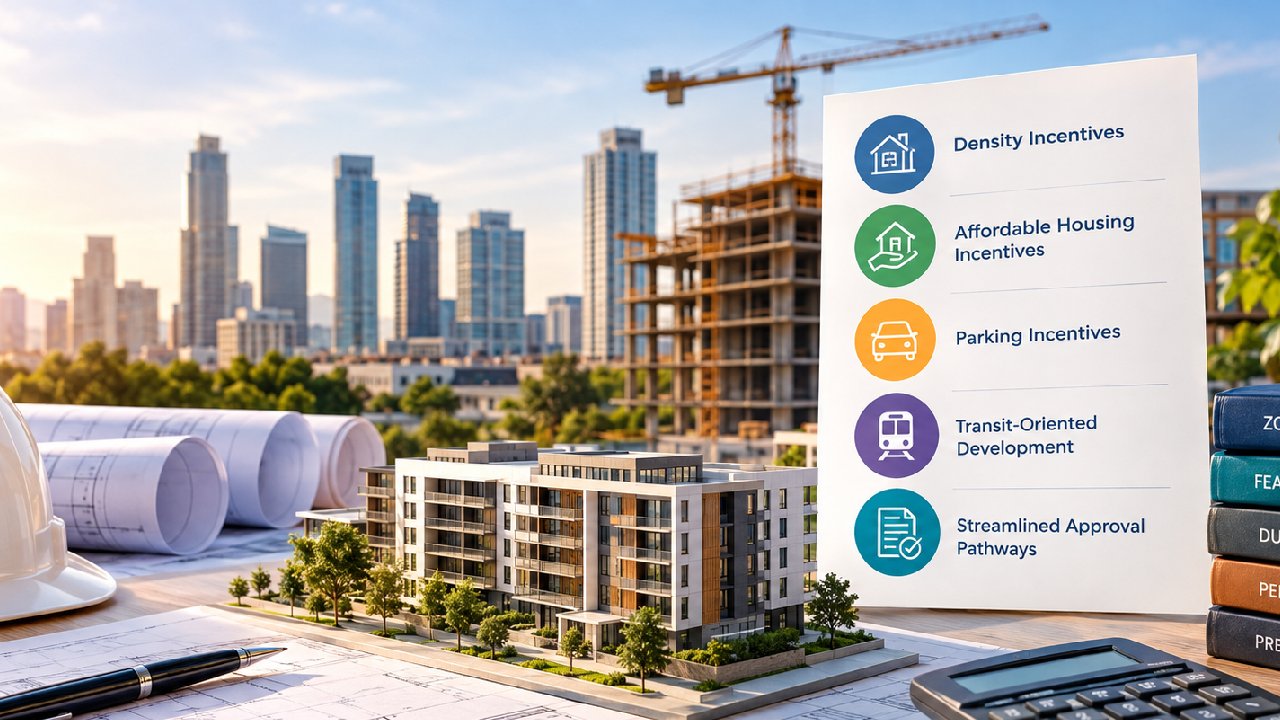
The incentive structure is deliberately weighted toward affordable housing production:
- Unlimited density in the new-construction portion of the project, available to Unified Adaptive Reuse Projects that provide affordable housing, removing the density cap that would otherwise constrain how many new units can be built alongside the converted building.
- Up to two new residential floors above the existing building, also available specifically to qualifying affordable Unified projects, effectively allowing owners to add height beyond what the base zoning would otherwise permit.
Both incentives are tied specifically to the affordable housing component. A Unified project that doesn’t include affordable housing doesn’t get access to these density and height incentives, and follows a different, more restrictive approval path as a result.
Modeling the Trade-Off: Affordable Set-Aside vs. Added Density
Before deciding whether to structure a project as Unified with an affordable component, model both sides of the trade explicitly:
- What affordable set-aside percentage and AMI restriction would the project need to meet to qualify for the incentives (confirm current requirements with LA City Planning, since affordable housing program terms are set independently of the base adaptive reuse ordinance and can change)
- How much additional buildable area the unlimited density and two-floor allowances actually generate for your specific site and building envelope
- The revenue trade-off between market-rate units lost to the affordable set-aside and the incremental units gained through added density and height
- The approval-track time savings of Administrative Review versus a Conditional Use Permit, and what that’s worth in carrying costs and market-timing risk
For many sites, the added density and faster approval path more than offset the affordable set-aside, but this needs a project-specific pro forma, not a rule of thumb, since site size, existing building footprint, and buildable envelope all vary significantly.
FAQ
Do I have to include affordable housing to do a Unified Adaptive Reuse Project? No, but skipping the affordable component means forgoing the unlimited density and two-additional-floor incentives, and moves the project into a Conditional Use Permit process instead of Administrative Review.
Can I add new construction to a converted building without triggering Unified project rules? If your project combines an existing adaptive reuse building with new construction on the same site, it’s treated as a Unified project regardless of whether you include affordable housing, the affordable component only affects which incentives and approval track apply.
Is Unified Adaptive Reuse the same as adding a rooftop story? No. The rooftop story exemption (which doesn’t count toward height or floor-area limits, used for shared amenities) is available more broadly; the two-additional-floor allowance is a distinct, larger incentive specific to affordable Unified projects.