Table of Contents
Austin has rewritten more of its Land Development Code in the last three years than in the previous three decades combined. For a developer or property owner sitting on a single-family lot, that rewrite is not background noise. It is the difference between a one-house parcel and a three-unit site, or between a permit that gets bounced for a lot-size violation and one that clears review in weeks.
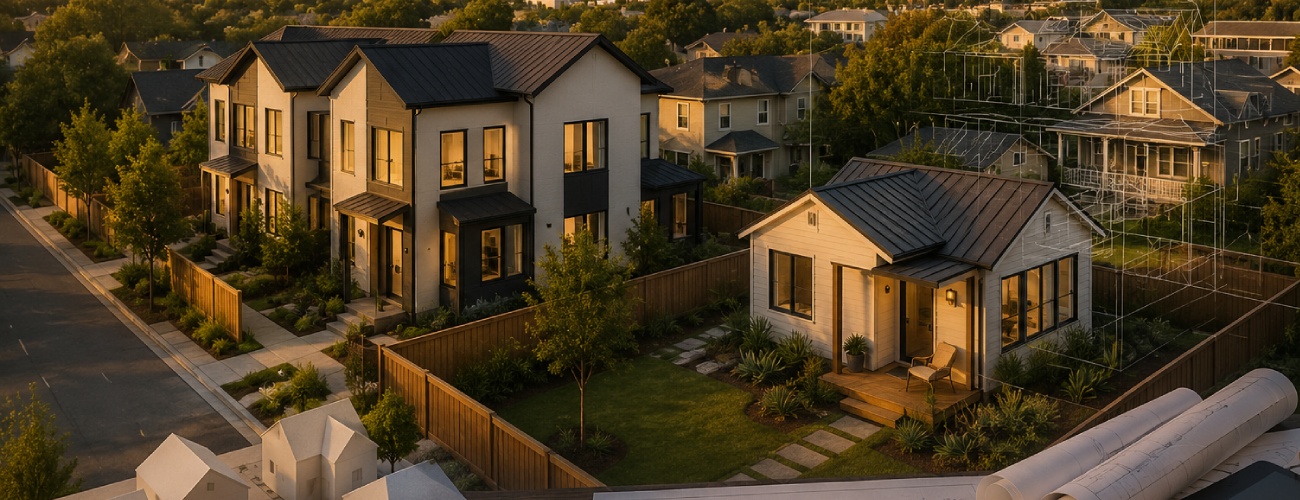
Austin’s HOME Initiative, ADU rules, and small-lot housing program are three interlocking city policies that let owners build more units, on smaller lots, with fewer restrictions, on land that was previously limited to a single detached house. Used together, they can turn a standard single-family parcel into a two- or three-unit infill project without a rezoning case. Used carelessly, they produce a design that trips on a setback, a compatibility buffer, or an impervious cover limit and has to be redrawn after money has already been spent on plans.
This guide lays out what each program actually allows, where they overlap, and where a developer needs a professional feasibility read before committing capital to a site plan.
Why This Matters Now
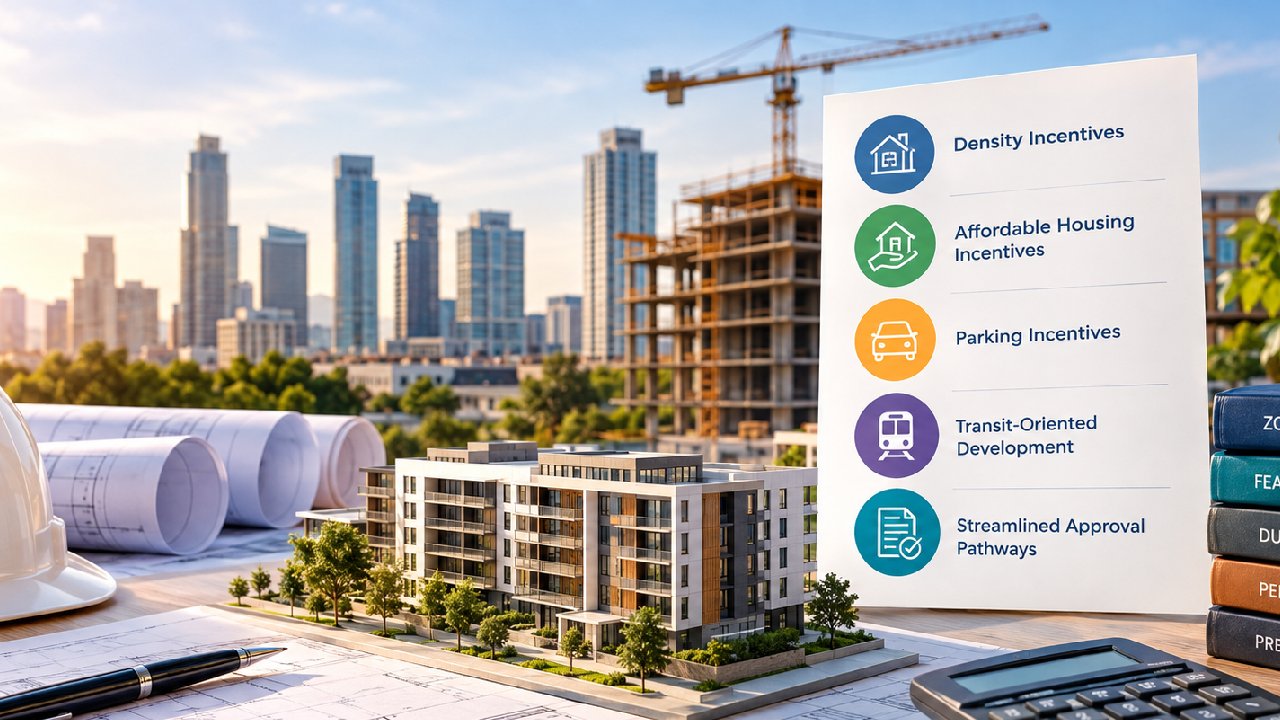
Austin’s population growth has consistently outpaced housing production, and the city has treated single-family zoning reform as its primary lever to close that gap. The city’s own Strategic Housing Blueprint identifies density bonuses, fee waivers, and land-use flexibility as core tools, and the last three years have seen that policy translate into code.
Three changes matter most for anyone evaluating a residential lot in Austin right now:
- HOME Phase 1 (adopted December 2023) allows up to three residential units on most single-family lots, where one was previously the norm.
- HOME Phase 2, covered in the same HOME Initiative guide, cut the minimum lot size for a single-family unit from 5,750 square feet to 1,800 square feet, created a new “small lot single-family residential use” category (detailed in our small-lot housing guide), reduced standard setbacks to 10 feet (5 feet if the space is used as a porch), and shrank the compatibility buffer around existing single-family homes from 540 feet to 75 feet.
- The Citywide Density Bonus Program (approved May 2026) replaced the short-lived DB90 program with a more durable, citywide density bonus structure tied to affordable-unit commitments, giving larger multifamily and mixed-use projects a separate, additional path to added height and density.
Layered on top of all three is Austin’s ADU policy, which has moved from a capped, owner-occupancy-tied accommodation to a right that applies broadly across single-family zoning districts, with size now governed by building coverage and impervious cover limits rather than a flat square-footage cap.
None of these programs replaced the others. They stack, and stacking is where the strategy lives.
How the Three Programs Compare
| Program | What It Governs | Minimum Lot Size | Unit Impact | Review Path |
|---|---|---|---|---|
| HOME Phase 1 | Unit count on a single-family lot | 5,750 sq ft (standard SF-1/SF-2/SF-3) | Up to 3 units on a qualifying lot | By-right, standard building permit |
| HOME Phase 2 / Small Lot | Subdivision and standalone development on undersized lots | 1,800 sq ft | 1 unit per qualifying small lot | By-right under new “small lot single-family residential use” category |
| ADU Policy | Secondary units on an existing single-family lot | 2,500 sq ft (varies by source; verify per parcel) | 1 to 2 ADUs added to the primary unit, subject to coverage limits | By-right permit, no owner-occupancy requirement, no parking requirement |
| Citywide Density Bonus Program | Height and density for larger multifamily/mixed-use projects in exchange for affordable units | Project-dependent | Varies by affordability commitment | Discretionary bonus application, not by-right |
The first three rows are what most single-lot and small-infill developers will actually use. The fourth becomes relevant once a site is large enough, or assembled enough, to support a multifamily project rather than a house-scale one.
Why a Strategy-First Approach Matters
Austin’s code changes have moved fast enough that a rule a developer read about eighteen months ago may already be superseded. HOME Phase 2 is itself a partial supersession of the standalone small-lot concept, folding it into a formal land-use category. The ADU square-footage cap that governed projects through 2023 has since been replaced by coverage-based limits, which behave differently on every lot depending on existing structures, tree cover, and impervious surface already in place.
That pace of change is exactly why treating this as a paperwork exercise is a mistake. The programs are not a checklist to work through in order. They are a set of decisions with real financial consequences: how many units a lot can legally support, what that does to per-unit land cost, how long the entitlement and plan review process will take, and where a design choice that looks compliant on paper runs into a heritage tree, a flood plain boundary, or a private deed restriction the city does not enforce but a court will.
JDJ’s role on an Austin infill or small-lot project starts before a site plan is drawn. That means:
- Screening a candidate lot against HOME Phase 1 and Phase 2 eligibility, including whether it qualifies as a small lot outright or needs subdivision first.
- Modeling unit yield under different configurations (single ADU addition versus small-lot subdivision versus a three-unit HOME Phase 1 build) to identify which produces the best return for that specific parcel.
- Flagging site-specific constraints, such as heritage tree critical root zones, Wildland-Urban Interface designation, or Uprooted Report status, before they surface mid-permit.
- Coordinating with Austin Water, Austin Energy, and Development Services on utility capacity and address assignment for multi-unit configurations.
- Carrying the approved strategy through application, plan review, and closeout.
That is the layer generic permit-runner services skip. It is also the layer that determines whether a project pencils at all.
The JDJ Process, Applied to Austin Missing-Middle Projects
Consultation. Establish the developer’s goals for the site, whether that is maximum unit count, a single ADU for rental income, or a two-lot subdivision play, and confirm current zoning district and lot dimensions.
Feasibility & Zoning. Run the lot against HOME Phase 1 and Phase 2 thresholds, ADU coverage math, tree and floodplain constraints, and, where relevant, Citywide Density Bonus Program eligibility for larger sites. This step produces the unit-yield comparison that drives the rest of the project.
Application & Submittal. Prepare and submit the building permit, site plan, or subdivision plat package aligned to the confirmed strategy, including any variance requests the site actually requires.
Approval & Closeout. Manage plan review comments, coordinate utility sign-off, and carry the project through Certificate of Occupancy.
Frequently Asked Questions
What is the Austin HOME Initiative? The HOME Initiative is a two-phase set of Austin Land Development Code amendments that expanded allowable unit counts on single-family lots and reduced the minimum lot size required to build a home, effectively legalizing gentle density on parcels that were previously restricted to one house.
How many units can I build on a single-family lot in Austin? Under HOME Phase 1, most single-family lots in SF-1, SF-2, and SF-3 zoning can now support up to three residential units, subject to setback, height, and impervious cover limits that still apply.
What is the minimum lot size for a house in Austin now? HOME Phase 2 reduced the minimum lot size for a single unit to 1,800 square feet under the new small lot single-family residential use category, down from the previous 5,750-square-foot standard.
Do I need to live on my property to build an ADU in Austin? No. Austin’s current ADU policy does not require owner-occupancy of the primary residence to build or rent a detached accessory dwelling unit.
Is there a size limit on ADUs in Austin? There is no flat square-footage cap under current HOME-era rules. Size is instead constrained by building coverage and impervious cover limits, which means the practical maximum varies lot by lot and should be modeled against your specific parcel rather than assumed.
Does Austin require parking for ADUs or HOME Phase 1 units? No. Austin eliminated minimum parking requirements for new residential construction, including ADUs and additional units under HOME Phase 1, in November 2023.
How does the Citywide Density Bonus Program relate to HOME? The Citywide Density Bonus Program, approved in 2026, is a separate, discretionary bonus path aimed at larger multifamily and mixed-use projects, distinct from the by-right unit counts HOME Phase 1 and Phase 2 provide on standard single-family lots.
Can heritage trees or floodplain status block a HOME or ADU project? Yes. Construction within a protected tree’s critical root zone requires separate review, and lots in flood-prone areas or designated in the city’s Uprooted Report face additional constraints regardless of what HOME or ADU rules otherwise allow. A site-specific feasibility screen catches these before they stall a permit.
Explore the Full Series
Each of the three programs above gets its own deep-dive treatment, because each has enough mechanical detail, and enough room for a developer to leave value on the table, to warrant a dedicated read before you finalize a design.
Start with Austin’s HOME Initiative Explained if you’re trying to pin down how many units your lot can actually carry. It walks through Phase 1’s three-unit allowance and Phase 2’s lot-size and setback changes in full, including how the two phases interact with the new 2026 Citywide Density Bonus Program on larger sites.
If a single secondary unit, rather than a full multi-unit build, is the right scale for your property, Austin ADU Rules in 2026 breaks down the current size, setback, and coverage-based limits that replaced the old flat square-footage cap, along with the ownership and short-term rental rules that shape an ADU’s return.
And if your lot is large enough to consider splitting into multiple parcels rather than adding units to one, Small-Lot Housing and Subdivision Strategy covers how the small lot single-family